Mowers
Choosing a mower for a small lawn
A small lawn is not a scaled-down large one. It is a shape with things in it, and the constraint is not how much grass there is but how much of it is reachable in a straight line. Every mower here has a deck of 33 cm or less, and each of them publishes a cutting-height range rather than a step count — because on a small lawn the height you cut at is the one decision that shows.
By Jean-Benoit Buisson
The constraint nobody states
Mower listings are written as though lawns were rectangles.
They publish a cutting width and, sometimes, a stated area — 150 m², 300 m²,
600 m² — as if the only question were how much grass there is.
On a small lawn the binding constraint is shape. A garden of eighty square metres
usually contains a bed along one side, a path across it, a tree, a washing line post, a
shed corner and a boundary it is expected to be cut right up to.
The number of passes is set by the width. The time is set by everything that stops a
pass.
Which is why every pick here is 33 cm or less
A 30 cm deck turns inside a 40 cm one, gets between a bed and a fence, and does not
have to be lifted over things.
It also means more passes, and that is the honest trade. On an open lawn of 300 square
metres the wider machine wins outright; the crossover is somewhere around the point where
the lawn stops having corners in it.
Two of these do not have motors
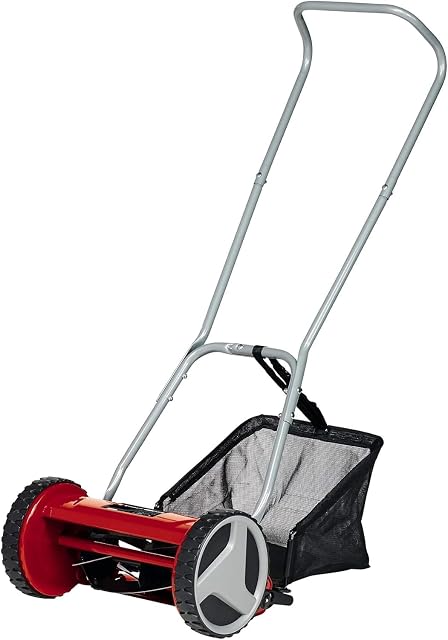
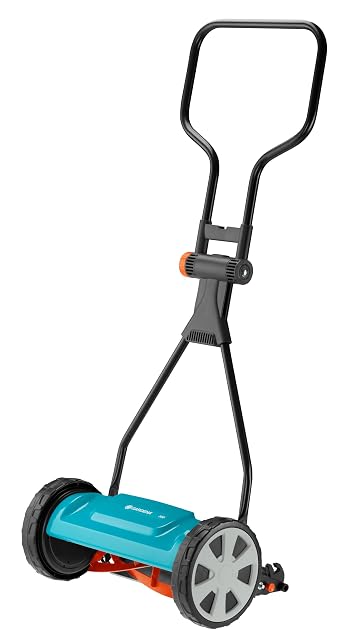
The first two picks are cylinder mowers: five steel blades on a ball-bearing cylinder,
turned by the wheels, cutting by scissor action against a fixed bar.
They are the quietest, cheapest and lightest way to cut a small lawn, and they have one
condition attached which every listing on that shelf states as an area and none states as a
rule:
The grass has to be short already.
A cylinder cuts by trapping a blade of grass between the moving cylinder and the fixed bar.
Grass that has grown past about six centimetres folds over instead of being trapped, and the
mower pushes it flat. That is not a fault; it is the mechanism.
So a cylinder mower suits a lawn cut weekly, and punishes one rescued monthly.
What it gives in return: no cable, no battery, no petrol, no noise, no maintenance beyond
keeping the cylinder clean, and the cleanest cut of anything on this site — a scissor cut
leaves a sharp edge on the leaf where a rotary blade tears it.
The heights, which is the row to read
Every pick here publishes a range in millimetres, and that is deliberate.
A great many mower listings publish a step count instead — “seven heights on one lever”
— which says how many positions exist and nothing about where they are. A mower whose lowest
setting is 40 mm is a different tool from one that starts at 25, and a step count cannot
tell them apart.
The ranges on these six run from 13 mm at the lowest to 75 mm at the highest, and the
useful advice is to sit nearer the top of whichever range you buy.
Longer grass has more leaf. More leaf means more photosynthesis, deeper roots, better
drought tolerance, and a sward dense enough to keep weeds and moss out — which is the
argument the moss products on this site keep making from the other direction.
Guaranteed sound power.
It is the declared figure garden machinery is regulated and compared on, and it is absent
from this whole shelf.
On a small lawn that matters more than on a large one, because a small lawn is surrounded by
neighbours at close range. The two cylinder mowers here solve it by having no motor at all.