What every glove on this shelf is, and is not
Six of the seven products in this family are coated knits: a seamless knitted liner
with a rubber or plastic coating dipped onto the palm and fingers.
One is leather.
That single division decides what the gloves are for, and it is the most important thing on
this shelf.
A coated knit protects against dirt, damp and abrasion. It keeps soil out of your
fingernails, it stops a trowel handle blistering your palm, and it lets you handle wet
compost without your hands going cold.
It does not stop a thorn. A rose thorn, a bramble, a blackthorn spine, a holly leaf or a
berberis spike passes through a knit glove as if it were not there.
That is the actual hazard in a garden, and six of the seven listings here do not address
it.
Which makes this a specialist glove, correctly
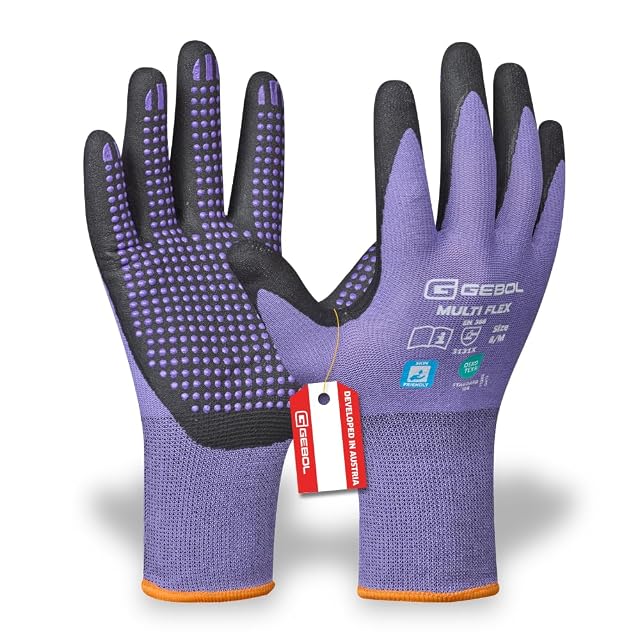
This one is built for the opposite end of the job: dexterity.
“The nitrile coating and the seamless fine-knit fabric allow the highest finger sensitivity
in all work and are especially suitable for delicate tasks.”
That is accurate, and the jobs it names are real ones: sowing, pricking out,
potting on, weeding between seedlings.
Those are tasks where a thick glove is worse than no glove, because you cannot feel what
you are holding and you crush what you are trying to plant.
Seamless, which is what makes that possible
The word matters mechanically.
A sewn glove has seams at the fingers, and the seam is a ridge of doubled material
between your skin and the object. It bunches, it catches, and it is where blisters start
under repeated pressure.
A seamless knit is knitted as a tube on a machine, like a sock, so the inside is
continuous. It follows the hand rather than sitting on it.
Combined with elastane in the yarn, it stretches to the hand instead of being a size
that approximately fits — which is why a glove like this can genuinely be used to pick up a
single seed.
Nitrile, and the thing three listings on this shelf do not say
Nitrile is a synthetic rubber. Latex is natural rubber, from a tree.
Three gloves on this shelf are latex-coated, and none of them mentions that natural rubber
latex is a recognised allergen.
Latex allergy affects a minority of people and it develops with exposure rather than being
present from the start — which is precisely the pattern for somebody who gardens regularly.
It is the reason nitrile replaced latex in medical gloves.
What latex does better: grip on wet objects, and elasticity. It is genuinely the
grippiest coating on this shelf.
What nitrile does better: it resists oils and many chemicals, it does not perish and go
sticky with age, and it is not an allergen.
Two gloves here are nitrile. On a shelf where three are latex and say nothing about it, that
is worth knowing.
The dots
“The nitrile coating with dots guarantees optimal grip in all work and is therefore a good
choice on wet surfaces.”
A dotted or dimpled coating is a real design choice rather than decoration. It works the
same way a tyre tread does: the gaps between the dots give water somewhere to go, so the
coating contacts the object rather than floating on a film.
A fully dipped smooth coating grips better when dry and worse when wet.
Across this shelf: dots here, a crinkle finish on one latex glove, a 3D grip pattern
on another, and a latex profile on a third. All four are attempting the same thing.
Size 7, which is the other reason this glove exists
The smallest size on this shelf, and the only glove here designed for women’s hands
rather than offered in a small size.
The other sizes in this family are 8/M, M, 9, 9, 10 and one unstated.
And “small” is not the same as “shaped for”
A hand is not scaled uniformly. Women’s hands are, on average, narrower across the palm
relative to finger length than men’s.
A men’s glove made small gets shorter fingers and a narrower palm in the same
proportion — so it ends up too tight across the palm, or with loose fingertips.
Loose fingertips are not a comfort problem. They are the failure:
You cannot feel anything, which defeats the whole purpose of a dexterity glove.
You cannot pick up a seed, because there is a few millimetres of empty coated knit
between your fingertip and it.
And the loose material catches, which is where gloves tear first.
Nothing else on this shelf addresses the fit, and two listings do something stranger —
offering a men’s size 9 and describing it in the same breath as a women’s garden glove.
Washing it
Not stated here, and one glove on this shelf says it can be washed by hand or machine.
The general position for a coated knit is that it can be washed and should be air dried
away from heat — a radiator or a tumble dryer hardens a nitrile or latex coating and
cracks it. Which is also why gloves left in the sun on a wall all summer are stiff by
autumn.
What goes unpublished
No standard. One glove on this shelf cites EN 388, the European standard for
protection against mechanical risks — and even that one cites the standard without its four
performance digits.
No performance rating for abrasion, cut, tear or puncture.
No thickness or gauge. On a dexterity glove the knit gauge is what decides how thin and
how sensitive it is, and it is unstated across this whole shelf.
Availability
From 5 € to 7 €, that being the spread across the German and French Amazon stores on the day of the survey.
Listed and unsold: the American, British, Italian and Spanish Amazon catalogues hold the reference with nobody behind it.
Taken from Keepa on the day this page was last revised; stock and prices move without notice.
Prices quoted in this text were read on 26 September 2026. The live price is at the top of the page.