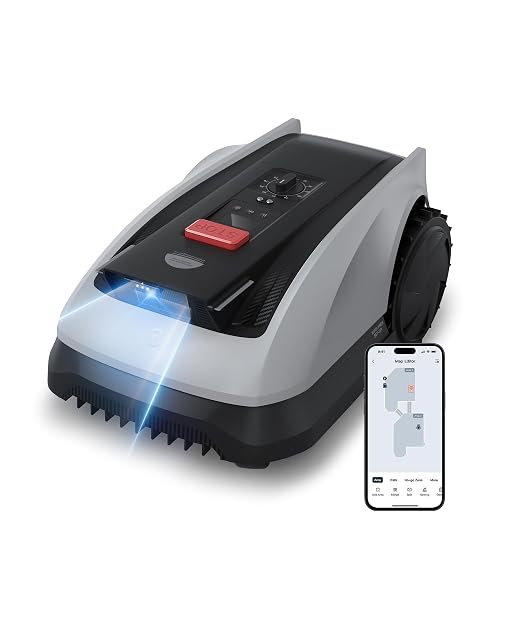
The bottom line The purest wire-free machine here: no cable, no beacons, no antennas and no reference station — install the dock and it works. Navigation is a full-HD camera with on-board AI, obstacle reaction is stated at 0.05 seconds, and two RFID tags handle transitions between separate lawns.
What the maker prints on its own page
A robot mower requiring no boundary cable installation, no beacons and no
antennas — once the charging station is installed, it is ready. Navigation uses
AI and a full-HD vision camera to capture and process the surroundings, so the
machine can see, understand and react to what is around it. The maker states
the system learns continuously from real-world conditions rather than laboratory
training, with knowledge delivered by firmware updates over the air.
Scheduling is done in the app, shared with the rest of the maker’s robot range.
Obstacles on the route are stated to be detected within 0.05 seconds. Multi-zone
management mows several separate lawns, with two supplied RFID tags placed at
the transitions between zones; the maker states additional configuration is
required.
Nothing in the ground
This is the least invasive installation in the family. No wire to peg or bury.
No reference station to site with a view of the sky. No beacons.
For a rented garden, a garden with services buried shallow, or an owner who
simply does not want to spend a Saturday on their knees, that is the whole
argument — and it is a strong one.
Vision alone, and what that means
A camera decides what is lawn and what is not. The strengths are that nothing
can lose signal and nothing needs a clear sky; the weaknesses are light, shadow
and an edge that has grown ambiguous.
The maker’s answer to that is learning: a model improved over the air rather
than fixed at purchase. That is a real difference from a machine whose behaviour
is what it was on the day it shipped, and it is also unfalsifiable from a
listing.
What the listing never tells you
The cutting width. The cutting height range. The slope. The battery. Four of the
five things a buyer would put in a comparison table, absent from a page that
describes the navigation in detail.
That is the shape of this whole shelf: the sensor has become the product, and
the mower underneath is assumed.
Availability
From 678 € to 739 €, that being the spread across the German, French, Italian and Spanish Amazon stores on the day of the survey.
Beyond the euro zone, the British Amazon store prices it in its own currency, which the spread above sets aside.
Nothing came back from the American Amazon store at all; the buy button there runs a search rather than opening an empty page.
Taken from Keepa on the day this page was last revised; stock and prices move without notice.
Prices quoted in this text were read on 26 September 2026. The live price is at the top of the page.
The declared figures, and the point they stop at
Strengths
The simplest installation on the shelf: a dock, and nothing else to place
Two RFID tags supplied for gardens split into separate lawns
Firmware improved over the air, so the navigation is not frozen at purchase
Compromises
No cutting height range, no slope figure, no battery — an unusually thin specification
Vision alone is the approach most affected by light and by an untidy edge
Multi-zone setup is stated to need additional configuration
Specifications
Cutting width
Not published
Stated area
600 m², as stated by the maker
Navigation
Full-HD vision camera with on-board AI, continuously updated over the air
Boundary
None — no wire, no beacons, no antennas, as stated
Slope
Not published
Cutting heights
Not published
Battery
Not published
Charge time
Not published
App
Yes — scheduling and configuration
Guaranteed noise
Not published
Weight
Not published
Amazon reference
B0CTTWN7QG (one reference across 5 Amazon marketplaces)
EAN
6925387144793
What this machine usually gets asked
What do the RFID tags do?
They are placed at the transitions between mowing zones so the machine knows it has crossed from one lawn to another. It is a physical marker rather than a map, and the maker states the setup needs additional configuration.
Is vision-only riskier than RTK?
Different. A camera has nothing to lose signal from and is affected by light, shadow and how clearly the lawn edge reads. A satellite system is unaffected by light and loses accuracy under a canopy. Neither is universally better and the garden decides.
Why is the specification so short?
Because the listing is written about the navigation rather than the mower. No cutting height, no slope, no battery and no width are given, and this page records that rather than filling it in.
Who this one is for
A garden of two or three linked lawns where nothing should be buried or bolted down
A reference exists on these Amazon stores: France, Germany, Italy, Spain, United Kingdom. Listed is not the same as in stock — availability changes daily.
Details checked on September 26, 2026.
Sources
Specifications: manufacturer sheet and Amazon product page. Prices and availability: Keepa. No product on this site has been physically tested.