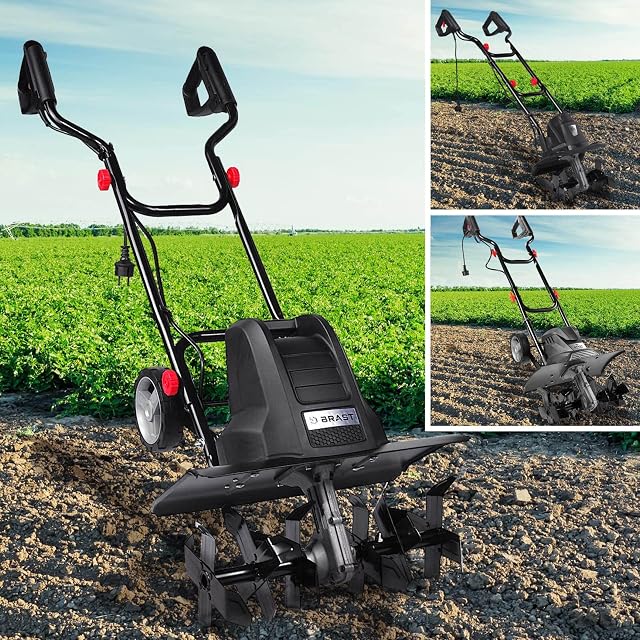
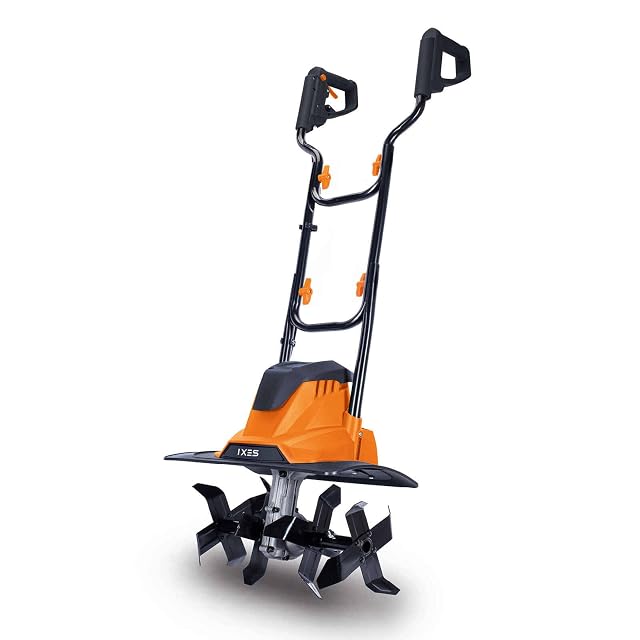
The bottom line The narrowest and lightest-duty machine on the shelf: 30 cm wide, 200 mm deep, four blades, 750 W. That combination is a bed tiller rather than a ground breaker — four blades on a narrow shaft turn easily and will not pull the machine across hard clay.
What the maker prints on its own page
Simple and effective soil working with a powerful 750 watt motor and a light
weight for safe, comfortable work. Robust hoeing blades for fast work and low
wear. An ergonomic folding handle for comfortable work and space-saving
storage. A two-point safety switch for safe operation. A cable strain relief
against damage to the supply lead.
The title adds a 30 cm working width, a 200 mm working depth and four blades.
The smallest machine on a shelf of large ones
30 cm wide and four blades, where the middle of this shelf is 45 cm and
twenty-four.
That is not a lesser version of the same machine — it is a different tool. A
narrow shaft with few blades meets little resistance, turns without dragging the
machine along, and works between rows and inside a bed where a 45 cm machine
cannot go.
What it will not do is break ground. On compacted clay it skitters across the
surface, which is the complaint every underpowered tiller attracts and which is
really a mismatch between machine and job.
Depth, and what it means here
200 mm is a genuine depth and it is within a few centimetres of everything else
on this shelf.
What differs across the shelf is not how deep a machine can reach but whether
it has the power and the weight to get there in your soil. A figure is a
capability of the tine assembly, not a promise about clay in August.
The safety switch, and why it is in the list
A tiller’s tines are its drive. When they bite they pull the machine forward;
when they hit something solid they push it back at the operator. Every control
on this shelf exists because of that behaviour, and a two-point start is the
first of them.
What is not stated
Transport wheels. On a machine that is heavy at the front and has no wheels of
its own, getting it from the shed to the bed is done by carrying it.
And no weight, on a listing that twice calls it light.
Availability
From 69 € to 108 €, that being the spread across the German, French, Italian and Spanish Amazon stores on the day of the survey.
Beyond the euro zone, the American Amazon store prices it in its own currency, which the spread above sets aside.
Listed and unsold: the British Amazon catalogue holds the reference with nobody behind it.
Taken from Keepa on the day this page was last revised; stock and prices move without notice.
Prices quoted in this text were read on 26 September 2026. The live price is at the top of the page.
The declared figures, and the point they stop at
Strengths
The lowest power and the narrowest width here, which on a small bed is the right pairing
A two-point safety switch and a cable strain relief, both stated
A folding handle, on a machine stored eleven months a year
Compromises
Four blades on 30 cm is the sparsest arrangement on this shelf
No transport wheels stated, so the machine is carried rather than rolled
No weight published
Specifications
Working width
30 cm, as stated
Working depth
200 mm, as stated
Power source
Mains, 750 W input as stated
Tines
4 hoeing blades
Transport wheels
Not published
Weight
Not published — described as light
Amazon reference
B00SCTJDR2 (one reference across 6 Amazon marketplaces)
EAN
4006825602005
What this machine usually gets asked
Will 750 W break new ground?
Not well. Four blades on 30 cm at 750 W is a machine for soil that is already worked — turning in compost, preparing a seedbed, weeding between rows. Hard, compacted or previously uncultivated ground wants more of everything.
Why does the blade count matter?
Because blades per centimetre of width decides how finely the soil is worked and how much resistance the machine meets. Four on 30 cm is wide spacing: less resistance, coarser result, and a machine that is easier to control.
What is a two-point safety switch?
A control that needs two separate actions to start, so the machine cannot be set going by knocking one lever. On a tiller — whose tines are the drive and which lurches forward when they bite — that is not a formality.
Who this one is for
Flower beds and vegetable plots already in cultivation, rather than ground being broken
A reference exists on these Amazon stores: France, Germany, Italy, Spain, United Kingdom, United States. Listed is not the same as in stock — availability changes daily.
Details checked on September 26, 2026.
Sources
Specifications: manufacturer sheet and Amazon product page. Prices and availability: Keepa. No product on this site has been physically tested.