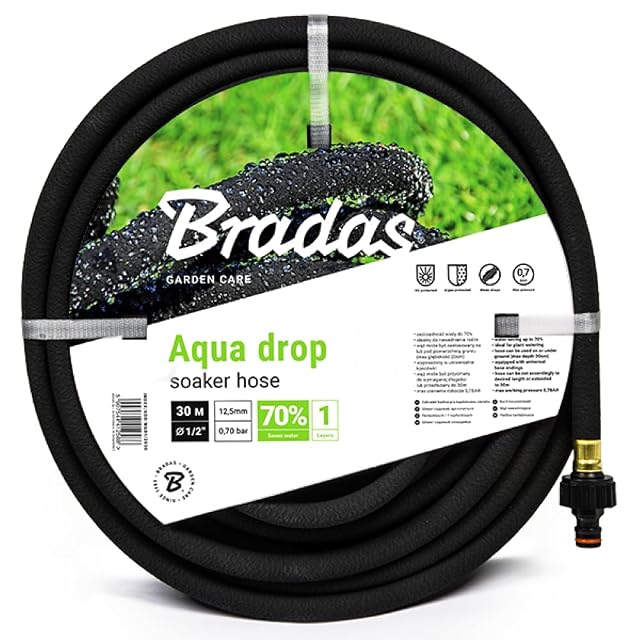
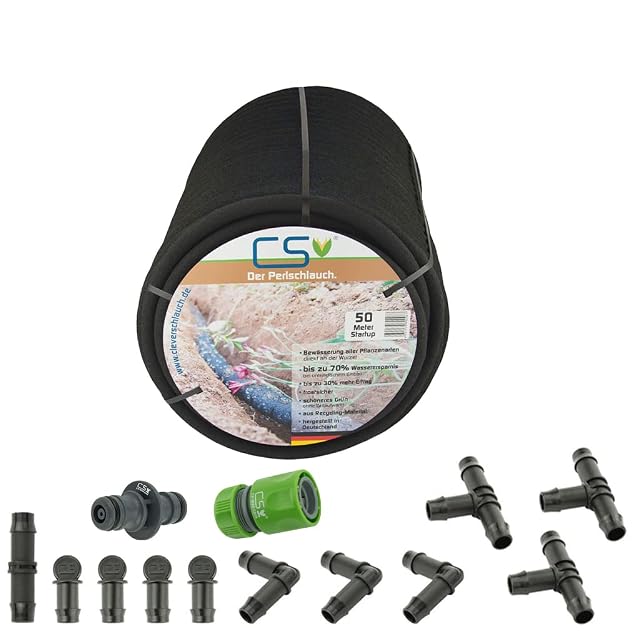
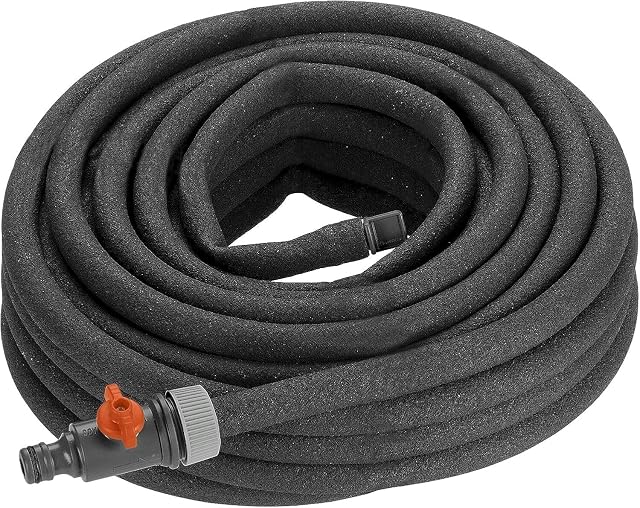
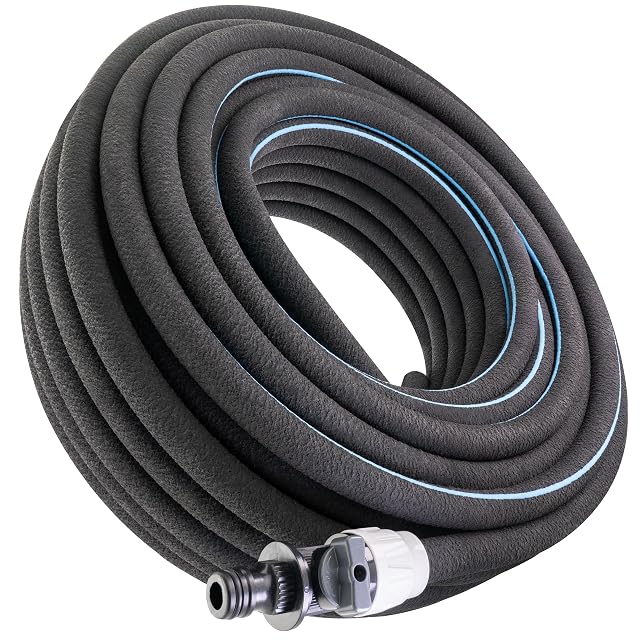
The only per-metre flow on this shelf
0.76 to 1.26 litres per metre per minute, at 0.7 bar.
That is the right way to specify a soaker hose, and no other listing here does
it.
A soaker is a product you cut. It goes down a bed, round a corner, along a
hedge, and the length you use is not the length in the box. A flow figure for
“the hose” only applies to the coil as sold; a figure per metre applies to
whatever you lay.
It also carries its pressure, which is the other half of the specification.
And then the comparison, which does not work
Converted to one unit — litres per metre per hour — this shelf says:
This hose: 46 to 76 L/m/h at 0.7 bar.
Another soaker: 6 to 8 L/m/h at 0.6 bar.
A third: about 20 to 39 L/m/h at 3 to 6 bar.
Two porous recycled-rubber hoses, at 0.6 and 0.7 bar — essentially the same
pressure — differ by roughly a factor of eight.
They cannot both describe the same kind of object in the same way. A different
porosity would do it; so would a different definition of the measurement; so
would a different test. Nothing published on this shelf says which, and this
page will not invent a reconciliation.
What it will do is put all three into the same unit, so that nobody compares
“1.26 litres” against “8 litres” and reaches a conclusion backwards.
At 46 to 76 litres per metre per hour, a 30 metre run uses something between
1,400 and 2,300 litres in an hour.
That is a great deal of water, and it means this is not a hose to leave on. It
is a hose to run for ten or fifteen minutes and turn off — which is how most
people use a soaker anyway, and which the listing does not discuss.
100 % recycled rubber
Stated, and it is the traditional material for this product.
Soaker hoses are made by binding rubber crumb — ground-up tyres — with a
binder and extruding it. The gaps between the particles are the pores. That is
why they are black, why they are heavy, and why they are the one garden product
where “recycled” is the manufacturing method rather than a claim added
afterwards.
Three of the five soakers on this shelf name recycled rubber.
The relevant consequence is stiffness. Rubber crumb hose is not flexible like
PVC; in cold weather it is stiff enough to fight a tight corner, and forcing it
cracks the wall.
Burying it, to 20 cm
The listing’s own figure, with bark mulch given as the alternative.
Buried, a soaker delivers at root depth, loses nothing to evaporation, and is
out of the sunlight that degrades it. It also disappears from view, which the
listing sells as tidiness and which is also the drawback: a blocked buried
soaker shows up as a dying plant, not as a visible fault.
Pre-fitted adapters
Named as suiting all common quick couplings, so the hose connects without a
trip for fittings.
On this site’s connector shelf, “all common” is a phrase worth treating
carefully — three incompatible systems sit on that shelf. Here it means the
usual garden click standard, which is what most people have.
About 0.84 € per metre
30 metres at the German price recorded here.
Across this shelf the range is roughly 0.80 € to 1.81 € per metre, so this
sits at the cheap end — with the highest published output and the shortest
explanation of it.
Availability
From 25 € to 39 €, that being the spread across the German, French and Italian Amazon stores on the day of the survey.
Listed and unsold: the American, British and Spanish Amazon catalogues hold the reference with nobody behind it.
Taken from Keepa on the day this page was last revised; stock and prices move without notice.
Prices quoted in this text were read on 26 September 2026. The live price is at the top of the page.