Under a euro a pair
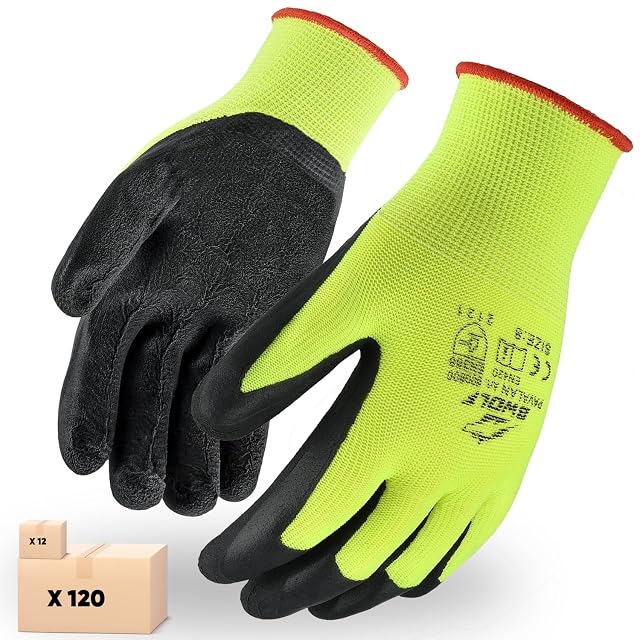
Twelve pairs at about 0.92 € each.
Across this shelf the price per pair runs from that to 9.99 € for a single pair of
leather gloves — a factor of nearly eleven.
And the bulk pack is not simply the cheap option. It matches how gloves are genuinely
used.
Why a box beats a pair
They get soaked. Not by rain — by the job. Watering, wet compost, washing a tool,
emptying a butt. A soaked coated glove takes a day to dry, and a damp glove is worse than no
glove.
One goes missing. A single glove is the most frequently lost object in a garden: put down
on a wall, left in a barrow, dropped under a hedge.
They get dedicated by task. Nobody wants to prick out seedlings in the pair that has just
handled manure, or touch a seed tray with hands that smell of two-stroke.
And they wear out at the fingertips, which on a coated knit is the only place that
matters.
A box of twelve means there is always a dry clean pair. That is the argument, and two other
products on this shelf make it with ten and three pairs.
Polyurethane, which is the third coating on this shelf
Across the family: two nitrile, three latex, one polyurethane, one leather.
PU is worth understanding because it is the specialist of the three coatings.
It is applied very thin. A polyurethane dip is a fine film rather than a rubber layer,
which is why PU-coated gloves are what electronics assembly and precision handling use. The
listing’s claim of “exceptional grip and dexterity” is the right claim for the material.
It grips well dry and less well on wet surfaces than latex, which is softer and
conforms.
And its abrasion resistance is the poorest of the three. A thin film over a knit wears
through at the fingertips faster than nitrile or latex does — which is exactly why the
listing also calls the gloves thin and light, and exactly why selling them twelve at a
time is coherent rather than cynical.
It is not an allergen, which latex is. Three gloves on this shelf are latex-coated and
none of them mentions that natural rubber latex is a recognised sensitiser, typically
acquired through repeated exposure — the profile of a regular gardener.
The glove clip
“The glove clip allows easy attachment to the belt loop, to keep the protective gloves
always to hand.”
The only one on this shelf, and it addresses the failure mode above.
Gloves are lost because they are taken off to do one thing — answer a phone, undo a
knot, pick up something small — and put down. One glove on this shelf solves the same problem
differently, with touchscreen fingertips so they do not come off for a phone at all.
A clip is the cheap version and it works.
The listing, reported as found
Five feature lines, and each is built around a different search term rather than a
different fact.
Line one calls them mechanic’s gloves, and then “perfect for the workshop or as men’s
garden gloves”.
Line two repeats the size and then says “perfect as women’s garden gloves” — of a stated
size 9, which is a large men’s size.
Line three calls them removal gloves and workshop gloves for vehicles.
Line four calls them roofer’s gloves and “thin men’s work gloves”.
Line five is the glove clip, and calls it a belt glove holder.
So the same glove is described as a mechanic’s, a gardener’s, a remover’s, a roofer’s and a
workshop glove, for men and for women, in five lines.
This page reports that because its job is to describe what was published — and because
nothing in those five lines is a specification. There is a coating, a liner fibre, a
size and a count, and everything else is a synonym.
And what is not in them
No standard. One glove on this shelf cites EN 388, the European standard for
protection against mechanical risks — and even that cites the standard without its four
performance digits, which are the part that reports how it scored on abrasion, cut, tear and
puncture.
For a twelve-pack of thin PU gloves, an abrasion figure is precisely what would be worth
knowing.
No washing guidance. One glove on this shelf states it is machine washable, which is the
most economically useful sentence in this family. The general rule for a coated knit is a cool
wash and air drying away from heat — a radiator hardens and cracks a coating.
No gauge. On a dexterity glove the knit gauge is what decides how thin and sensitive it
is, and no product on this shelf publishes one.
And the thing it shares with five others here
It will not stop a thorn.
A polyurethane film over a polyester knit has no puncture resistance. A rose thorn, a
bramble, a blackthorn spine, a holly leaf — each pushes between the knitted loops
and through the film.
Six of the seven products on this shelf are coated knits and every one of them shares this.
One is leather, and it is the only pair here that resists punctures.
The sensible conclusion from this shelf is not a single purchase. It is a box of cheap
coated knits for everything ordinary, and one pair of leather gloves on a hook for the
rose bed and the bramble patch.
This is the cheapest and most sensible answer to the first half.
Availability
From 11 € to 15 €, that being the spread across the German, French, Italian and Spanish Amazon stores on the day of the survey.
Beyond the euro zone, the British Amazon store prices it in its own currency, which the spread above sets aside.
Nothing came back from the American Amazon store at all; the buy button there runs a search rather than opening an empty page.
Taken from Keepa on the day this page was last revised; stock and prices move without notice.
Prices quoted in this text were read on 26 September 2026. The live price is at the top of the page.