The one product on this shelf that does the job the shelf is named after
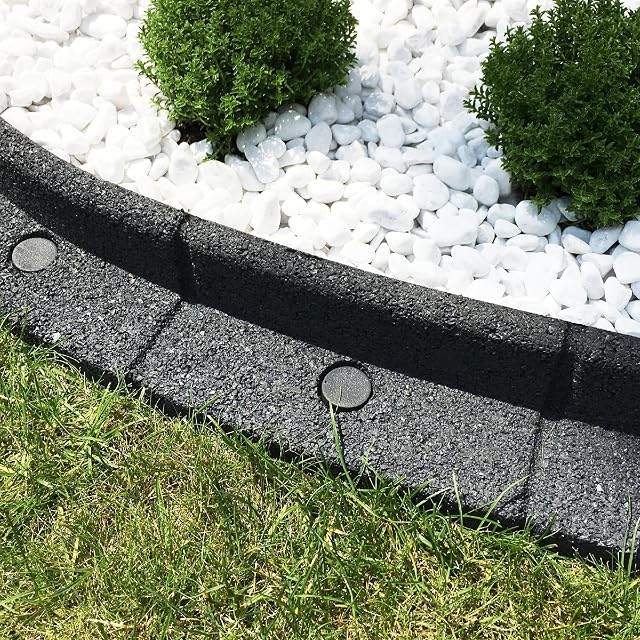
“Designed to be mower-friendly, so the wheels can drive along the FlexiBorder and cut
completely safely up to the mowing edge of the lawn, for a clean finish. FlexiBorder
is robust enough to use a lawn trimmer against it if needed.”
That is a mowing edge. Everything else on this shelf, with one partial exception,
is a bed border.
Why that distinction is the whole shelf
A bed border stands above the lawn. It separates, it retains mulch, it looks
deliberate, and it stops rhizomes if it is buried deep enough.
It also guarantees that the mower cannot reach the grass against it. So along its
entire length, every single cut, for as long as it is installed, there is a strip
that has to be trimmed by hand.
On ten metres of border that is ten metres of strimming, fortnightly, from April to
October. Over a season it is hours.
A mowing edge removes that permanently. The wheel runs on it, the blade passes
over the boundary, and there is nothing left.
Five products on this shelf are bed borders sold as lawn edging. One names robot
mower compatibility, which is the same idea from the other end. This one states the
function directly and is built for it.
And what rubber buys that steel cannot
Contact.
A mower wheel running along a steel edging works if the height is exactly right
and if the operator is careful, and a deck that catches it damages one or the other —
a 0.6 mm steel top edge against a rotating blade is a bad meeting.
Rubber gives. A wheel rides over it, a deck that touches it bounces off, and the
listing adds that a strimmer can be used against it. Nylon line against plastic
edging scores it white and eventually cuts through; against rubber it does not care.
That forgiveness is what this product is for, and it is most of what the price buys.
The TÜV SÜD certificate
“Flexible up to an angle of 70°. Tested and certified for flexibility by the TÜV SÜD
testing body.”
The only third-party result on this shelf.
Every other claim in this family is the seller’s own: robust, durable, flexible,
weather-resistant, five-year warranty. This is a named certification body and a
specific property with a number attached.
Seventy degrees is a tight bend for a rigid material, and it is what lets a border
follow a curved bed or a tree ring without kinking. Steel at 0.6 mm bends willingly
too, and it stays bent; rubber returns.
The certificate does not say the product lasts longer or performs better. It says one
measurable claim was verified by somebody other than the seller, and on a shelf of
adjectives that is worth pointing at.
Recycled rubber
“Completely made from recycled rubber.”
Almost certainly the same feedstock as the soaker hoses on this site’s drip
irrigation shelf, three of which are made of recycled rubber crumb — ground tyres,
bound and extruded.
Which brings the same properties, and they matter here:
It does not rot, rust or go brittle in UV. The two failure modes of this shelf’s
other materials — plastic going chalky and cracking in frost, and steel needing
either zinc or a patina to survive — do not apply.
It is stiff in cold weather. Rubber crumb is noticeably harder to bend at 2 °C
than at 20 °C, which matters on installation day rather than afterwards.
It is heavy. Which is an advantage in a border that has to stay put under a
mower wheel.
The fixings, itemised
“Each 6 metre pack contains 6 × 1 m borders, 5 colour-matched ground pins and 2
connecting dowels.”
An itemised contents list, which on this shelf is rare — one steel product supplies
11 earth clips, and four supply nothing at all.
Five pins for six metres is one roughly every 1.2 m, and pins are what stop a
border creeping under a mower wheel running along it. Colour-matched is cosmetic
and it means they are not visible in a lawn.
Two connecting dowels for six sections is the number to notice. Six 1 m pieces
have five joints, and two dowels do not cover them — so either the sections
interlock directly and the dowels are for joining pack to pack, or some joints are
unpinned. The listing does not resolve it.
The price, stated plainly
About 15.00 € per metre at the German price recorded here.
Across this shelf: plastic at about 1.11 €, galvanised steel at 3.10 €,
Corten at 3.83 €, 4.70 €, 5.00 € and 6.32 € per metre.
So this is thirteen times the cheapest product here and nearly five times the
cheapest metal.
And 6 m is the shortest run on the shelf — every other product is 9, 10 or 12
metres.
Which is a real decision rather than an obvious one
What the money buys is not material. It is the elimination of a recurring job.
A 10 m bed border costs 30 to 65 € and adds ten metres of hand-trimming to every cut
for twenty years. Six metres of mowing edge costs 90 € and removes it.
Whether that trade is worth taking depends entirely on whether you were going to trim
anyway. On a lawn already edged with a spade twice a year it is a large premium for a
tidy finish. On a lawn with a robot mower, where the alternative is a permanent
fringe of long grass around every boundary, it is the only product on this shelf
designed for the problem.
What goes unpublished
No height. No thickness.
On a mowing edge, height is the critical dimension — it has to sit at or just below
the cutting level, and how much of it is above the soil determines whether the wheel
rides smoothly or bumps.
Every other product on this shelf publishes a height, from 11 cm to 20 cm. This one,
whose whole function depends on it, does not.
Availability
From 90 € to 100 €, that being the spread across the German, French, Italian and Spanish Amazon stores on the day of the survey.
Beyond the euro zone, the British Amazon store prices it in its own currency, which the spread above sets aside.
Nothing came back from the American Amazon store at all; the buy button there runs a search rather than opening an empty page.
Taken from Keepa on the day this page was last revised; stock and prices move without notice.
Prices quoted in this text were read on 26 September 2026. The live price is at the top of the page.