The step plate
Three sprayers on this shelf solve the pumping problem, each differently.
One offers a battery compressor as a separate accessory. One is
battery-powered outright. This one gives you somewhere to put your foot.
It is the cheapest of the three answers and it addresses the actual physics.
Which are worth stating
Pumping a sprayer means pulling a plunger up against the pressure already inside
the bottle. On a five-litre sprayer at three bar, the last few strokes take real
force.
The bottle wants to come up with the plunger.
Without a foot plate, you hold the bottle down with one hand while pumping with
the other, bent over, on whatever surface you are standing on. On soft ground or
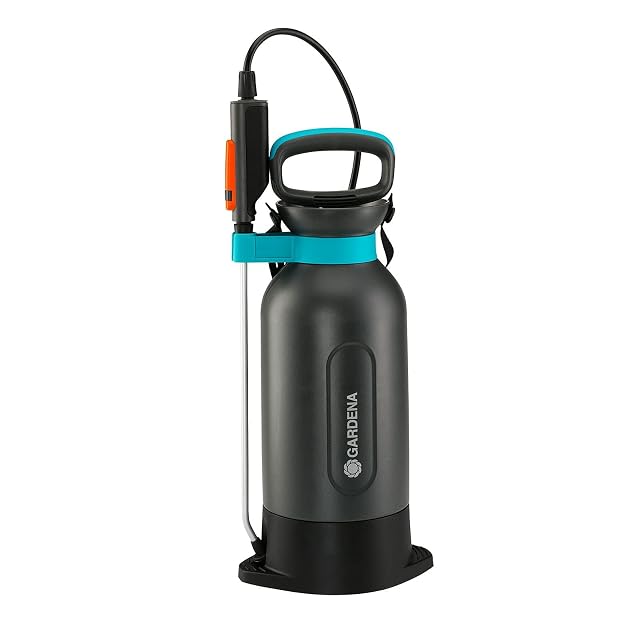
a slope it slides. The listing says exactly this: the step plate and the nozzle
guard allow easy, safe pumping even on uneven surfaces.
With a plate, your foot holds it and both hands pump upright. It is the
difference between twenty strokes being a nuisance and being the reason the
sprayer stays in the shed.
The sight strip
A window in an otherwise opaque bottle, so the level is visible without opening
it.
This is a small feature with a specific payoff, and the payoff is not vanity.
To look inside a pressurised sprayer you have to vent the pressure, unscrew the
lid, look, close it and pump it back up. People do it once, then stop, then run
out mid-hedge.
A strip means you glance at it.
The lance grip lock
Named as a locking function, and five of the seven sprayers on this shelf have
one.
A sprayer trigger is a spring held against a seal, and holding it for the length
of a hedge is a genuine ache that makes people work in bursts. A latch turns it
into a tool you can use continuously.
The nozzle guard
Worth noting because almost nothing else on this shelf has one.
A nozzle is a small, precisely sized orifice on the end of a lance, and a lance
is the part that gets leaned against a wall, laid on gravel, and dropped. Bend
or dent the orifice and the spray goes sideways, and there is no adjusting it
back.
A guard is a moulded shroud around it. It costs nothing and it is the reason
the nozzle is still round in year five.
What goes unpublished
No pressure.
An over-pressure valve is named, which is the safety part — it relieves the
bottle if somebody keeps pumping, and it is what lets you vent before opening.
But the working pressure is absent, and four of the seven sprayers here are the
same. The three that publish it give up to 3 bar, 2.5 to 3 bar, and 6.2 bar.
No weight. No hose length. No nozzle material. One sprayer on this shelf
publishes under a kilogram empty and a 130 cm hose; two specify brass nozzles.
The two jet settings
Named specifically: a piercing jet and a spray.
Those are the two that matter, and the naming is more precise than “adjustable”.
A piercing jet is a narrow stream that carries — it goes into the middle of
a shrub, under leaves, into a crack between paving slabs.
A spray is a cone that covers — it coats the top of foliage, and it drifts.
For weeds between slabs the first is what you want, because the second wastes
most of the liquid on the slabs. For greenfly on a rose it is the other way
round.
And the rule for every sprayer here
One sprayer, one purpose.
Herbicide residue stays in the dip tube, the hose and the nozzle, and rinsing
reduces it without clearing it. A sprayer that has applied weedkiller and then
applies a foliar feed will damage what it was meant to help.
The cheapest sprayer on this shelf costs a small fraction of this one, and
buying a second one and labelling both is the correct answer.
Availability
From 27 € to 39 €, that being the spread across the German, French, Italian and Spanish Amazon stores on the day of the survey.
Beyond the euro zone, the British Amazon store prices it in its own currency, which the spread above sets aside.
Listed and unsold: the American Amazon catalogue holds the reference with nobody behind it.
Taken from Keepa on the day this page was last revised; stock and prices move without notice.
Prices quoted in this text were read on 26 September 2026. The live price is at the top of the page.