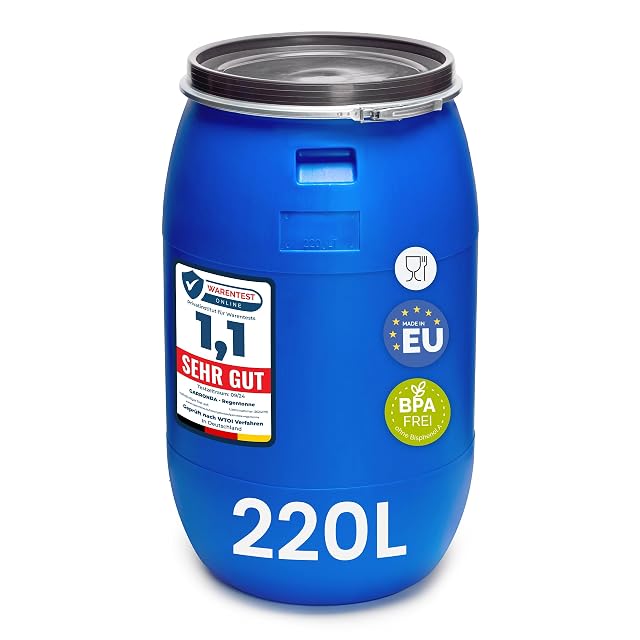
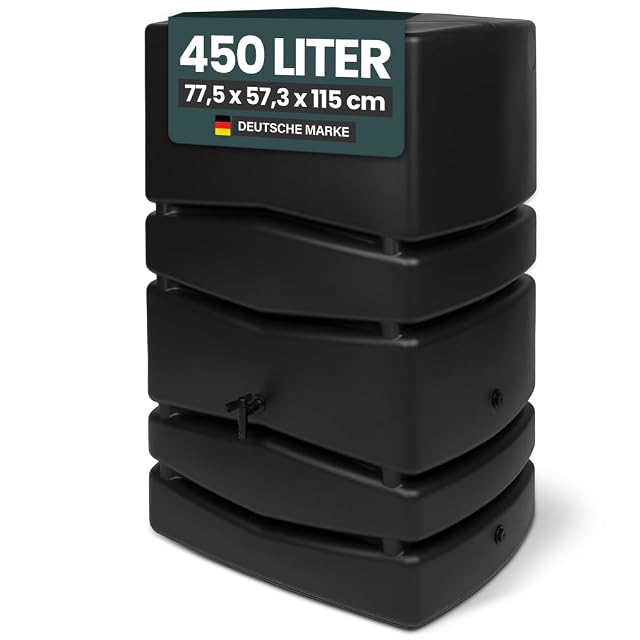
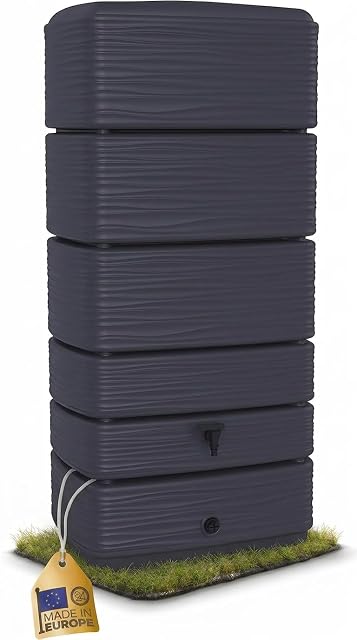
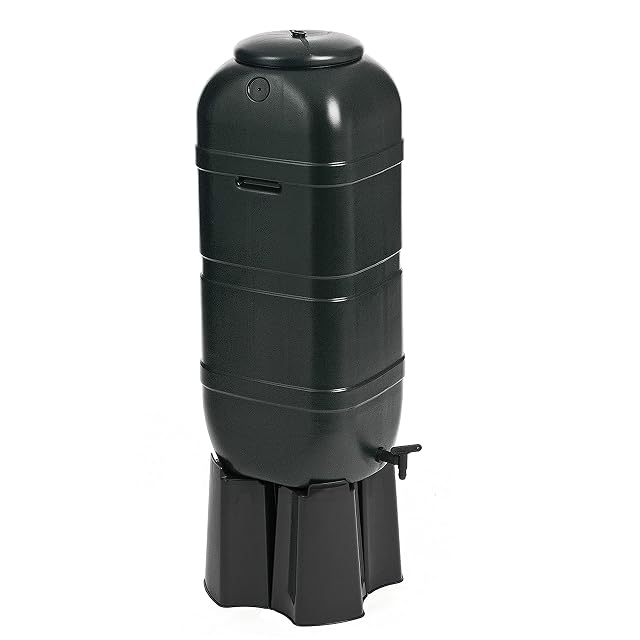
It is a barrel, not a rainwater system
This belongs on this shelf because it holds 220 litres and the listing names
rainwater among its uses.
It is not what the rest of this family is.
No tap. No outlet is described at all.
No downpipe collector.
No overflow.
No dimensions, so the footprint — the figure that matters most against a
house wall — cannot be calculated.
What it is, in the maker’s own words, is a wide-neck barrel in food-grade HDPE
with a lid secured by a metal clamping ring, sold in eleven sizes from 5 to 220
litres, suitable for transport, for rainwater, for animal feed, for pickling
cucumbers and for sauerkraut.
The sentence in capitals
“Please note that the LID HAS NO SEAL, and liquid contents should be stored
upright.”
A manufacturer printing its own limitation in capitals is worth reading twice,
and the meaning is precise rather than alarming.
A clamped lid holds the top on. It is not a gasketed lid, so it is not
liquid-tight if the barrel goes over or gets tipped in a van.
For a barrel standing upright under a downpipe, that changes nothing — rain goes
in, and nothing is trying to get out of the top.
For carrying 220 litres of anything anywhere, it is the whole warning.
What the wide neck is genuinely good for
Cleaning, and this is a real advantage that the purpose-built butts on this
shelf do not have.
Every water butt silts up. Leaf fragments and roof grit wash in, settle, and
build a layer of black sludge in the bottom; algae grows on the walls wherever
light reaches. After three or four years that layer is centimetres deep, it
smells, and it blocks a tap.
Cleaning a butt with a small lid means a hose, a lot of luck and a wet arm.
A barrel whose entire top comes off can be tipped, brushed out with a long brush
and rinsed in ten minutes. That is why brewers, picklers and smallholders use
this shape.
Food-grade HDPE, BPA-free
Stated, along with the claim that it takes up no foreign smells.
That is a genuine material specification and no purpose-built butt on this shelf
offers one — they say “high-quality plastic” or “recycled plastic” and stop.
It also broadens what the barrel is for. Rainwater off a roof is not drinking
water regardless of what the container is made of — it carries whatever was on
the tiles, in the gutter and in the air — but a food-grade barrel can hold
something else afterwards, and a butt cannot.
About 0.33 € per litre
The second cheapest capacity on this shelf, where the range is roughly 0.25 € to
0.56 € per litre.
The honest accounting: add a tap, a hole saw, a sealing washer and a downpipe
collector, and it is no longer the cheap option — it is a project.
Which is exactly right for somebody who wants a barrel and wrong for somebody
who wants a water butt.
Fitting a tap, if that is the plan
Nothing in this listing supports it, so this is general rather than specific: a
tap needs a flat area of wall to seal against, a correctly sized hole, and a
backing nut and washer inside — which means reaching in, which the wide neck at
least makes possible.
And the height question applies here as everywhere on this shelf: a full
watering can is 30 to 35 cm tall, so a tap low on a barrel standing on the
ground cannot fill one. Either the tap goes a third of the way up and strands the
water below it, or the barrel goes on blocks.
Availability
From 73 € to 85 €, that being the spread across the German, French, Italian and Spanish Amazon stores on the day of the survey.
Listed and unsold: the British Amazon catalogue holds the reference with nobody behind it.
Nothing came back from the American Amazon store at all; the buy button there runs a search rather than opening an empty page.
Taken from Keepa on the day this page was last revised; stock and prices move without notice.
Prices quoted in this text were read on 26 September 2026. The live price is at the top of the page.