Batteries in the box
Small, and worth leading with because two meters on this shelf are supplied without
any and one of those needs four AAA cells.
A soil tester is used a handful of times a season. A meter that cannot be used the
day it arrives tends to be used later than intended, or not at all.
The four readings, ranked by how much they can carry
This is the honest way to present any multi-function probe, and it applies to five
products on this shelf.
Temperature — dependable. A thermistor measures temperature by a property that
does not depend on contact area or on how hard the probe was pushed. This reading is
straightforwardly good.
And it is the most useful one here. This site’s lawn seed shelf publishes
germination thresholds — 8 °C on one bag and 10 °C on two others — and seed
sown into colder ground does not germinate, it waits, where birds find it and damp
rots it. The date on a packet does not know what year it is; a soil thermometer
does.
Light — dependable. A photocell measures light properly. Also genuinely useful:
shade is one of the four reasons moss gets into a lawn, and measuring how much light
a corner actually receives is how you choose between a shade seed mix and giving up
on grass there.
Moisture — comparative. This is a conductivity reading, so it responds to
dissolved salts as well as to water. A lawn fed a week ago reads wetter than the
same lawn a month later; a clay soil reads wetter than a sand at the same water
content. Used against itself — the same spot, over time — it answers the watering
question well. As an absolute number it does not.
pH — conditional. Below.
What the other makers on this shelf say about probe pH
This listing publishes no caveat about its pH reading. Three others do, and they are
describing the same method:
One says that if pH reads a constant 7, the probe must be cleaned and the
measurement retaken elsewhere.
The same one says the soil must be compacted before the pH measurement or the
probe cannot register it.
Another says inconsistent insertion depth in the same soil sample gives
inaccurate pH readings.
A third asks for dry or hard soil to be moistened and left ten minutes.
Four variables the user controls: depth, cleanliness, compaction, moisture.
None of the six probe meters on this shelf publishes an accuracy figure for pH —
no tolerance, no calibration, no reference solution.
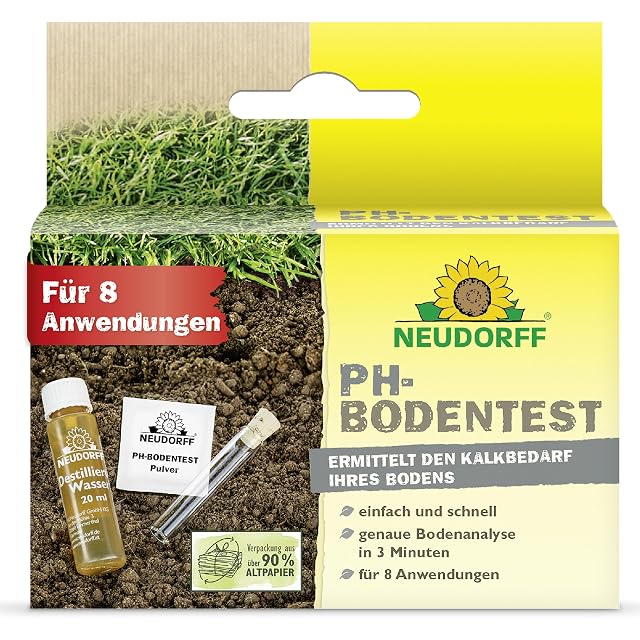
One product on this shelf measures pH by chemistry: powder, distilled water, a
tube, a colour scale, and a table giving the lime requirement. That is the reading a
liming decision should rest on, and it is the only output on this shelf that is a
decision rather than a number.
This page does not call the probe figure wrong. It says the method’s own
manufacturers have described what it depends on.
The aluminium alloy probe
Named as highly sensitive, and the material choice is sensible without changing the
method.
Alloy conducts better than plain steel and resists corrosion better, and
corrosion is the enemy here — a probe is an electrode, and an oxidised surface
does not behave like a clean one. The maker that warns about a stuck reading of 7
is describing exactly that failure.
It is also softer than steel. Which brings up the cover.
The protective cover
The most practical detail in this listing.
The probe is the instrument. Bend the tip and the contact area changes; corrode
it and the electrical behaviour changes; and either way readings taken this year
cannot be compared with readings taken last year.
A soil tester lives in a drawer or a bucket with secateurs, a trowel and a bag of
ties. A cover is what keeps the one part that matters intact.
Wiping it dry after every use is the other half, and no listing on this shelf says
so.
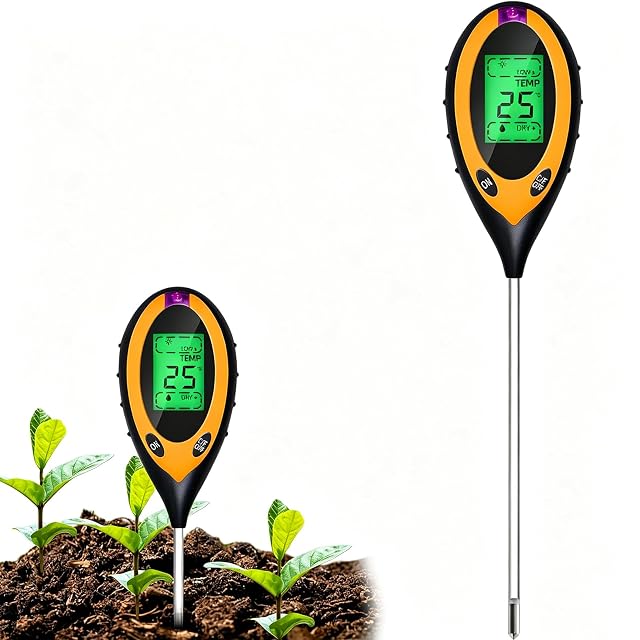
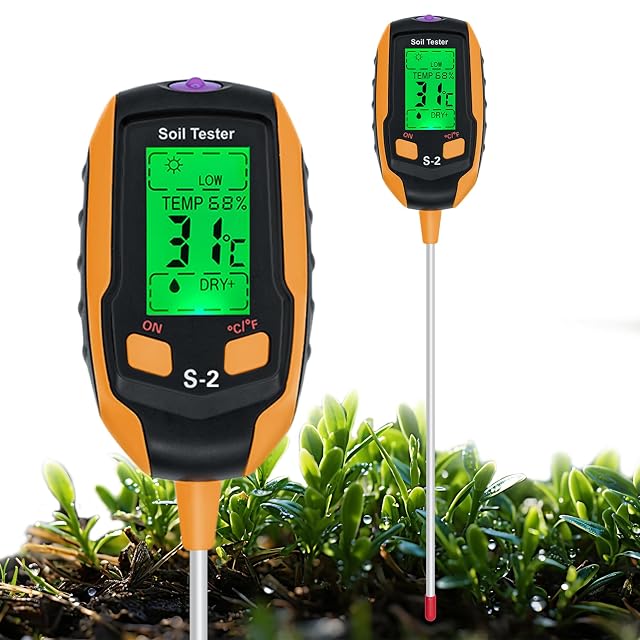
Five to ten seconds, to 10 cm
A 5 to 10 second reading — where one meter here asks for a full minute.
Ten centimetres is the right depth for a lawn: the root zone, below the layer that
dries first and tells you least.
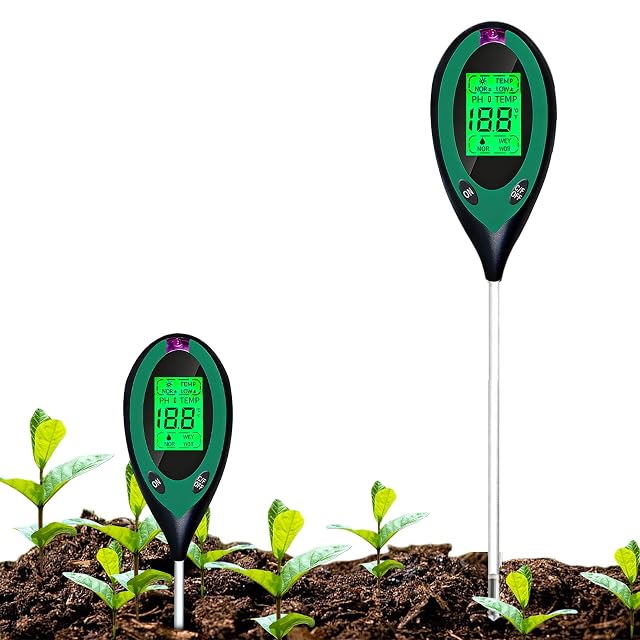
The one-button switch between pH and temperature, and °C or °F, are ordinary
conveniences.
And the observation about the barcode
This meter’s barcode shares a GS1 company prefix with another 4-in-1 meter on this
shelf, and the two carry closely similar specifications under different brands.
That is an observation about what is published rather than a conclusion. What it
means for a buyer is simply that reading both listings does not give two
independent views.
Availability
Around 16 €, read at the German Amazon store on the day of the survey.
Listed and unsold: the French, Italian and Spanish Amazon catalogues hold the reference with nobody behind it.
Nothing came back from the American and British Amazon stores at all; the buy button there runs a search rather than opening an empty page.
Taken from Keepa on the day this page was last revised; stock and prices move without notice.
Prices quoted in this text were read on 26 September 2026. The live price is at the top of the page.