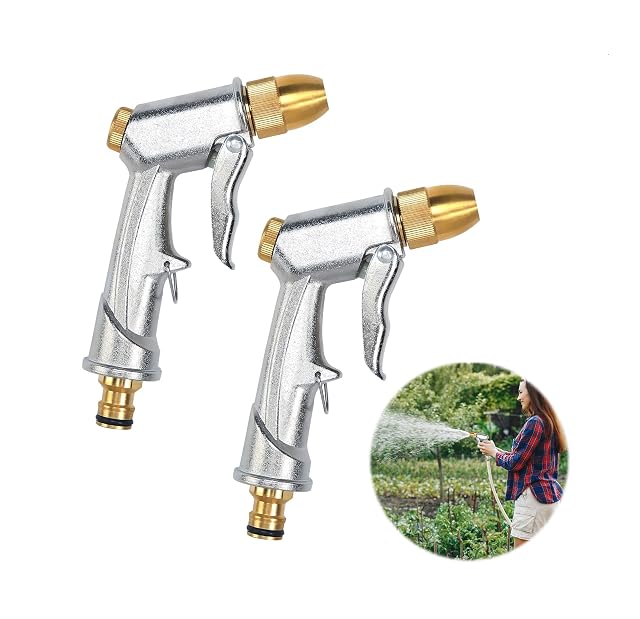
Two of them
The listing is a two-pack, which is the fact that reorders this whole
shelf.
At the German price recorded here that is about €6.50 per gun — less per
unit than the cheapest single gun on this shelf, and those are plastic.
And most gardens do use two
A spray gun is the garden fitting most likely to go missing.
It gets left at the far end of the plot, dropped behind a pot, taken to the car
and never brought back, and cracked by the first frost after somebody left it
outside.
Two taps means two guns. A reel and a tap means two guns. A car and a bed means
two guns, because you do not want the one you wash wheel arches with pointed at
seedlings.
Buying them in a pair is how this is actually solved, and one listing on this
shelf is the only one that offers it.
Three patterns, which is the number that gets used
Fine mist, moderate spray, jet — set by turning the nozzle head left to right.
Guns on this shelf advertise up to ten patterns. Sorted by price, the counts
across this family run 8, 8, 3, 4, 10, 5 and 1, which is no relationship at
all.
Three is the honest number. Almost everybody uses a mist for trays and
seedlings, a spray for watering, and a jet for paving, wheel arches and
rinsing a spade.
A gun with three well-defined settings and firm detents between them is easier
to use one-handed than one with ten positions on a stiff bezel, and this page
treats the smaller number as a design decision rather than a deficiency.
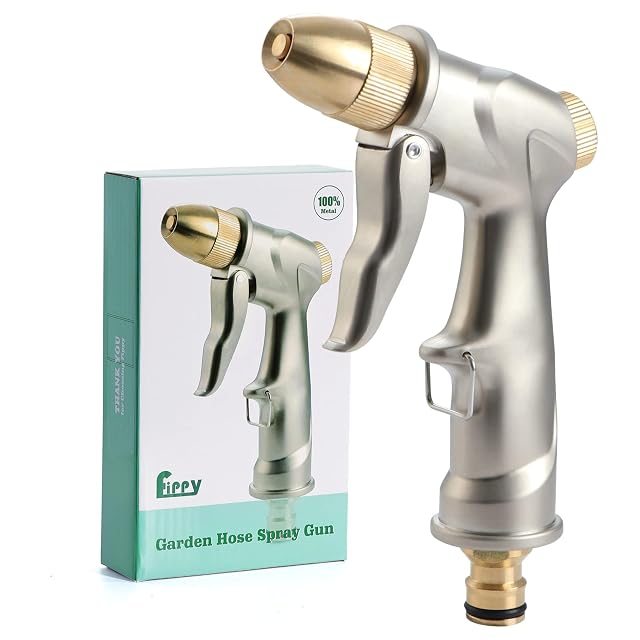
Aluminium alloy
Named as high-hardness aluminium alloy, described as wear-resistant, not easily
deformed, not easily broken, and stronger than plastic spray guns.
The first part of that is fair: metal does not go brittle in frost and does not
go chalky in UV, and those are what kill plastic guns.
The qualification worth adding is where the metal is.
Aluminium alloy is a good body material. It is a softer nozzle material than
brass, and the nozzle is the part water passes through at speed with whatever
grit the hose carried. One gun on this shelf specifies a brass head on a
zinc alloy body for exactly that reason, and it costs more.
For a two-pack at this price, an aluminium body is the right trade, and the
nozzle is where it will show first.
The O-ring
Named at the connection end, to seal and prevent leaks.
Small, and the correct thing to mention, because that joint is where a spray gun
actually fails.
Metal on metal does not seal. A rubber ring in a groove does, and when it
perishes the gun weeps down your wrist for a season until somebody replaces it
— which takes thirty seconds and a 20-cent part, if you know it is there.
What goes unpublished
No flow rate. No thread size. No dimensions. No weight.
That is the whole of this shelf except one product: a metal watering lance that
publishes 44 litres a minute at 4 bar, a 0.7 mm hole diameter and a 35 cm spray
width, and costs about five times as much as this pair.
And the trigger
Held, with no lock mentioned.
That is the cost of the price. A trigger has to be squeezed for as long as water
flows, and over a long watering it aches. Two guns on this shelf avoid it with a
twist control that stays set; one has a proper continuous lock on the trigger.
For washing a car and rinsing a path — which is what a jet is for — a
held trigger is the right control anyway, because letting go stops the water.
Availability
From 13 € to 18 €, that being the spread across the German, French, Italian and Spanish Amazon stores on the day of the survey.
Beyond the euro zone, the British Amazon store prices it in its own currency, which the spread above sets aside.
Listed and unsold: the American Amazon catalogue holds the reference with nobody behind it.
Taken from Keepa on the day this page was last revised; stock and prices move without notice.
Prices quoted in this text were read on 26 September 2026. The live price is at the top of the page.