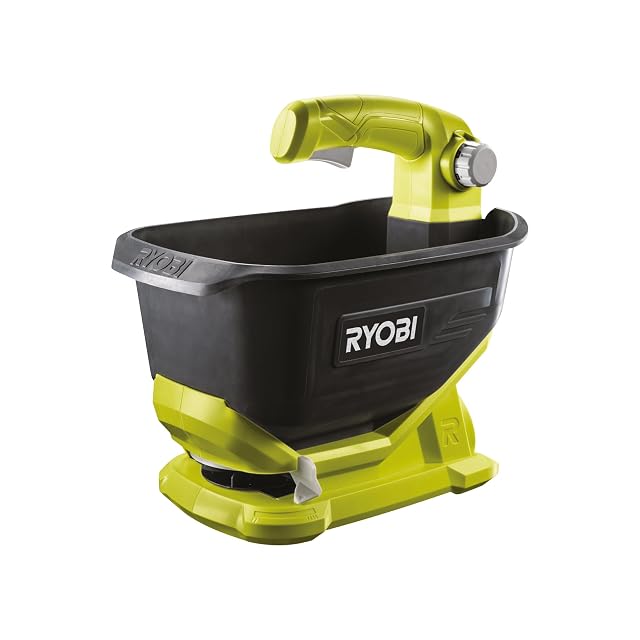
A range, not a maximum
2.5 m to 3.5 m, adjustable.
That is a small thing stated well, and it is worth pointing at.
The other handheld spreader on this shelf publishes “a maximum of five metres”.
A maximum is the widest pattern a machine can produce — at full disc speed, with
whatever material throws furthest, and at the thinnest and least even edge it
makes.
A range describes the working adjustment: where the pattern is usable at
both ends.
Nobody sets a broadcast spreader to its maximum on purpose, because the wider the
cone the harder the overlap is to judge.
The overlap, which is the whole skill with this type
A broadcast spreader throws a cone that is denser in the middle and thinner at
the edges.
At three metres wide, walking, on grass that all looks identical, with no wheel
tracks to line up on because the machine is in your hands — judging the overlap
is genuinely difficult.
Get it wrong narrow: a pale strip where neither pass reached full rate.
Get it wrong wide: a dark strip where two cones stacked, and with nitrogen a
double dose scorches.
Neither shows on the day. Both show about ten days later.
The practical rule is to treat the edge of the cone as half rate, and to set the
narrow end of the range — 2.5 m rather than 3.5 — for anything where evenness
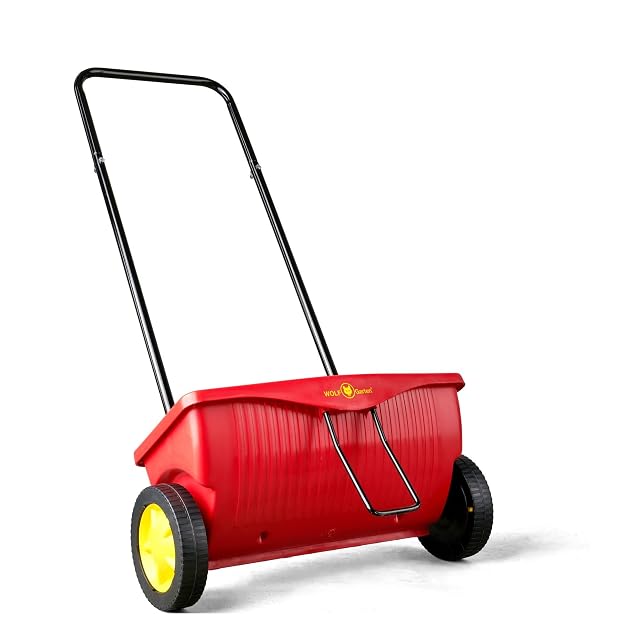
matters. Two spreaders on this shelf avoid the problem with a hard-edged drop
pattern at 40 cm.
Four litres
The largest of the three handheld spreaders here, against 3.3 and 3.3.
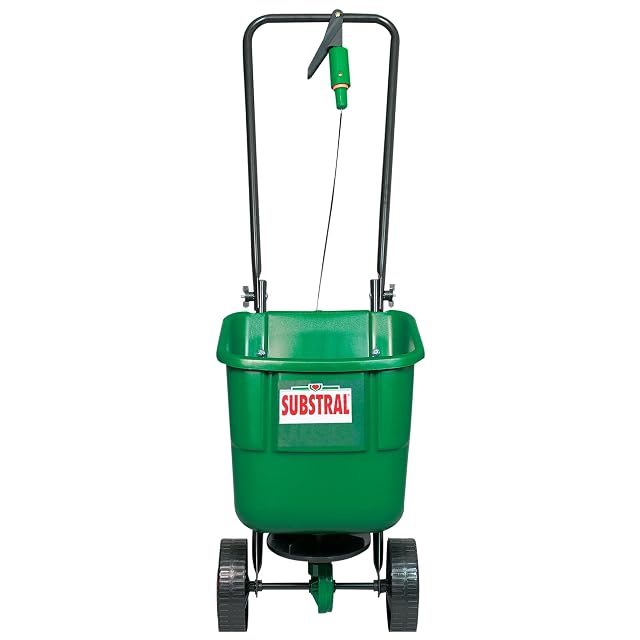
It is still a small hopper. The wheeled machines on this shelf hold 12, 15 and
45 litres, and at three metres a pass, 4 litres of granular feed does not last
long.
What a handheld spreader buys instead is reach: under shrubs, along a fence
line, around a pond, into the corner behind the shed, on a bank too steep to push
a wheeled machine up. Those are places a walk-behind cannot go, and they are
usually the places that need seed.
An 18 V system stated to cover more than 200 tools.
That is the real proposition here and it should be read plainly in both
directions.
If you already own the batteries, this is a cheap way to own a powered
spreader, because the expensive parts are already in the shed.
If you do not, the price on the shelf is not the price. A battery and a
charger for a platform like this cost more than the spreader, and at that point
one battery spreader on this shelf — which includes both — and the two wheeled
machines are all cheaper.
The delivery line is explicit: spreader, no battery, no charger.
What goes unpublished
Nothing about metering.
No rate settings. No scale. No indication of what suits grass seed against lawn
feed against de-icing grit — which are three materials that flow entirely
differently, since fine seed pours through a gap that coarse grit bridges across.
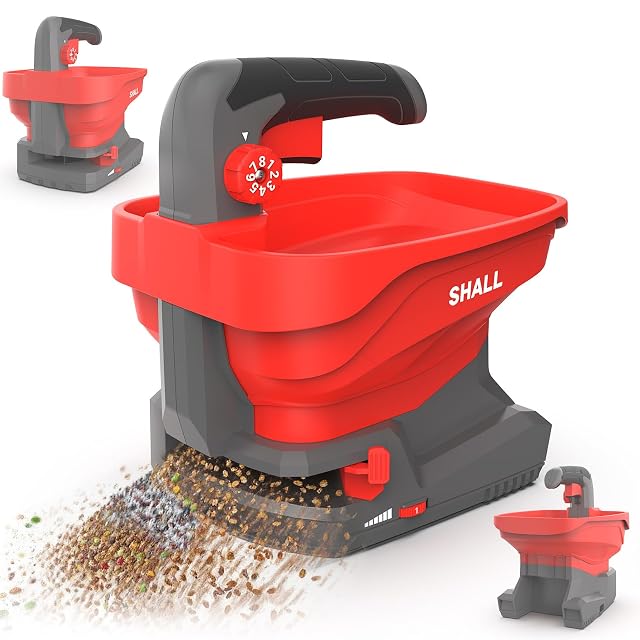
One spreader on this shelf maps its eight numbered settings to material type and
publishes two different coverage figures for fertiliser and for seed. It is the
only one.
Here there is a hopper size and a width range, and the calibration is left to
the user with a bag and a path.
No weight, which on a tool held at arm’s length with 4 litres of fertiliser
in it is the figure that decides how much of a lawn gets done before it goes
down.
And the rule for every spreader on this shelf
Empty it, wipe it out, store it dry.
Fertiliser is a salt: it pulls moisture from the air, cakes into a solid mass,
and corrodes what it sits in. On a battery machine it also reaches a gearbox and
a motor housing, and unlike the drop spreaders here this one cannot simply be
hosed out.
Availability
From 60 € to 72 €, that being the spread across the German, French, Italian and Spanish Amazon stores on the day of the survey.
Beyond the euro zone, the American and British Amazon stores price it in their own currencies, which the spread above sets aside.
Taken from Keepa on the day this page was last revised; stock and prices move without notice.
Prices quoted in this text were read on 26 September 2026. The live price is at the top of the page.