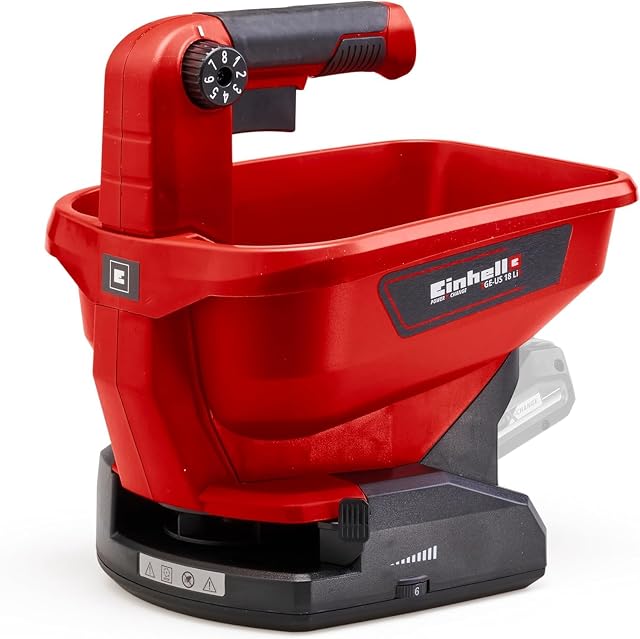
The contradiction in the listing
Two consecutive feature lines.
The third says: “Recommended for a maximum area of 800 square metres.”
The fourth says: “A spread width of a maximum of five metres is individually
adjustable, which means an area coverage of around 15 square metres.”
Eight hundred and fifteen, about the same machine, next to each other.
What can and cannot be said about it
The two figures are probably measuring different things. A 15 m² figure is
about the size of an instantaneous footprint — a five-metre arc, three metres
deep, is roughly that — while 800 m² reads as the size of lawn the machine
suits.
That is a guess, and the listing does not say it. It presents both as area
figures without distinguishing them.
This page reports both and does not reconcile them, because inventing the
distinction would be putting words in a manufacturer’s mouth on the one number a
buyer would use to choose.
Six speeds and eight rates, which is genuinely the best adjustment here
Six-step electronic speed control. Eight-step rate adjustment.
Those control two different things, and separating them is the right design.
Disc speed decides how far material is thrown — the width of the swath.
Faster disc, wider pattern, granules landing further out.
The gate decides how much falls onto the disc — the rate per square
metre.
On most spreaders those are tangled together: open the gate and more material
goes out, over roughly the same width, so the only way to change width is to walk
faster.
Independently adjustable, they let you set a narrow throw at a high rate — for a
strip beside a bed — or a wide throw at a low rate, for an even overseed.
Forty-eight combinations is more than anybody will use, and having the two axes
separate is what matters, not the count.
Five metres, and the overlap problem it creates
The widest pattern on this shelf, against 40 cm at the other end.
A broadcast spreader throws a cone that is denser near the middle and thins
towards the edges. At five metres that gradient is spread over a long distance,
and the passes have to overlap by the right amount or the lawn records it.
Too little overlap: a pale strip where neither pass reached full rate.
Too much: a dark strip where two cones stacked — and a double dose of nitrogen
scorches.
Neither is visible on the day. Both appear about ten days later as stripes.
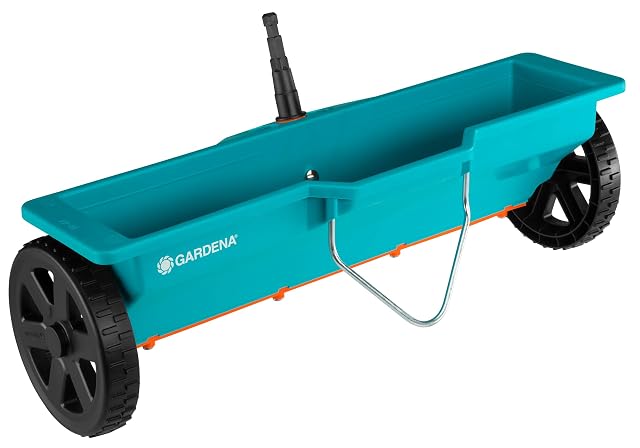
With a handheld spreader the difficulty is worse than with a wheeled one, because
there are no wheel tracks to line up on. You are judging a five-metre swath by
eye, walking, on grass that all looks the same.
The usual practical answer is to set a narrower width and accept more passes.
3.3 litres
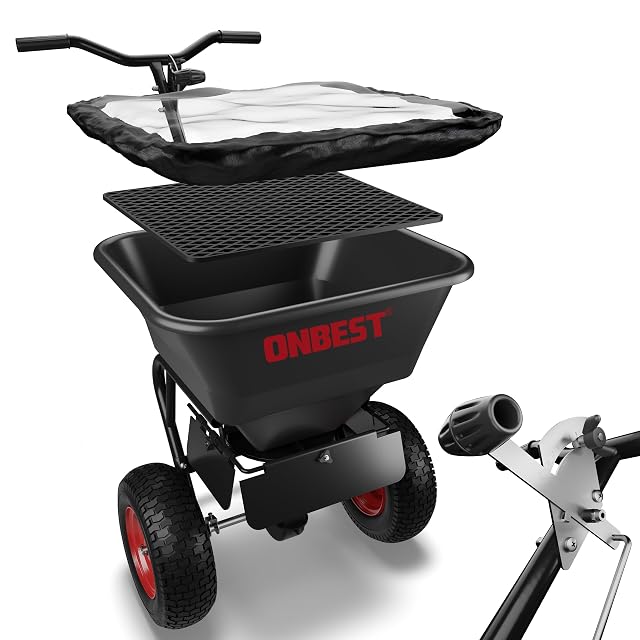
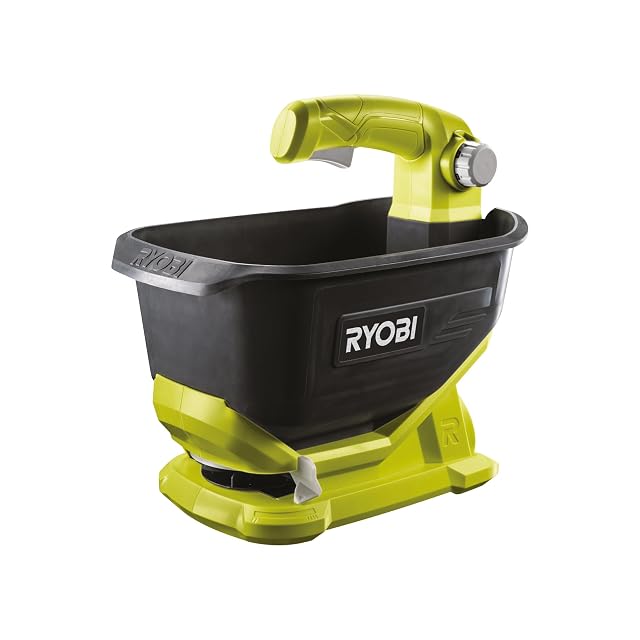
The joint-smallest hopper here, alongside another handheld battery spreader. The
wheeled machines on this shelf hold 12, 15 and 45 litres.
At a five-metre width, 3.3 litres of granular fertiliser goes out very fast. That
is the trade the whole handheld category makes: it weighs little, it reaches
under shrubs and along fences and into the corner behind the shed, and it is
refilled constantly.
No battery, no charger
Stated clearly, twice, including a note that the lithium packs may only be
charged with the matching charger.
That is the platform proposition and it is honest: if you already own batteries
for this 18 V range, this is a cheap tool. If you do not, the real price includes
a battery and a charger, and it moves this from the middle of the shelf to the
top.
One battery spreader on this shelf includes its battery and charger.
And the rule for every spreader here
Empty it and rinse it, every time.
Fertiliser is a salt. It draws water out of the air, cakes solid in a hopper, and
corrodes what it is sitting in — and on a battery machine it also gets into a
gearbox and a motor housing.
A spreader put away loaded does not work next spring.
Availability
From 37 € to 50 €, that being the spread across the German, French, Italian and Spanish Amazon stores on the day of the survey.
Beyond the euro zone, the American and British Amazon stores price it in their own currencies, which the spread above sets aside.
Taken from Keepa on the day this page was last revised; stock and prices move without notice.
Prices quoted in this text were read on 26 September 2026. The live price is at the top of the page.