The arithmetic that identifies the units
The listing publishes two figures: a reach adjustable up to 15 metres, and
coverage of up to 700 m².
A circle of 15 metres radius has an area of about 707 m².
A circle of 15 metres diameter has an area of about 177 m².
Only the first matches. So on this listing, 15 metres is a radius, and the
sprinkler covers a circle roughly 30 metres across.
That reading is not obvious from the words. It is obvious from the numbers, and
this page states it because another impulse sprinkler on the same shelf
publishes a pair of figures that reconcile the opposite way — where the
distance quoted turns out to be a diameter.
Two products, one shelf, the same category, opposite conventions, and neither
listing warns anybody.
Which makes this the largest coverage here
700 m², if the pressure is there.
And the pressure is the thing this listing does not state. Two sprinklers on
this shelf publish a pressure with their coverage; one publishes two pressures
and two results, showing a near doubling of throw between 2.8 and 4.1 bar.
So 700 m² is a maximum on a good supply. It is not a figure to plan a garden
around without knowing what comes out of your own tap.
How an impulse head works, and why it reaches further
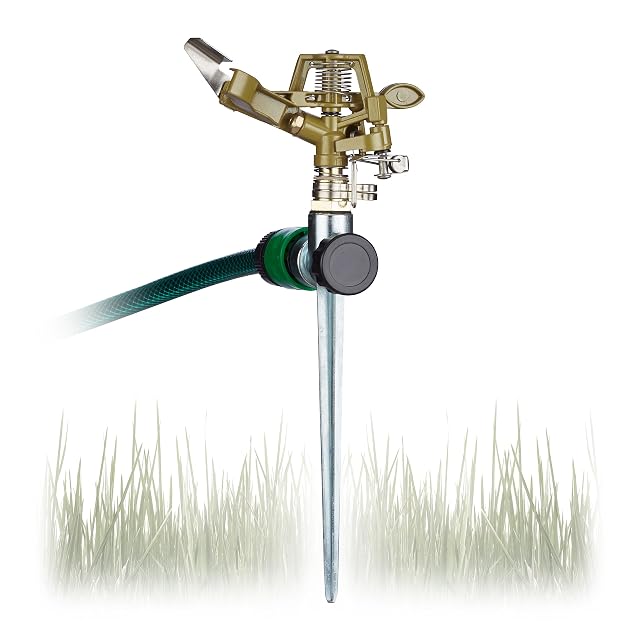
A single jet, and a sprung arm that swings into the stream and back out.
Each swing does two things: it breaks the jet up into droplets, and it kicks
the head round by a fraction of a degree. The head marches across its sector,
hits the stop, and marches back.
Because all the water goes into one stream rather than being split across
twelve nozzles, an impulse head throws further at the same pressure than a
rotating one. That is why the three impulse sprinklers on this shelf quote the
largest areas.
The cost is distribution. A single jet puts most of its water at the far end of
its travel and much less close in, which is why impulse heads are usually set
up to overlap.
20 to 360 degrees
The sector adjustment, and the strongest practical argument for this type.
A fixed circle waters the path, the fence, the patio furniture and the
neighbour. A sector waters the lawn.
20° is narrow enough for a strip — a border along a wall, a hedge line.
180° waters everything in front of a fence and nothing behind it. 360°
is the full circle when the sprinkler can stand in the middle of open grass.
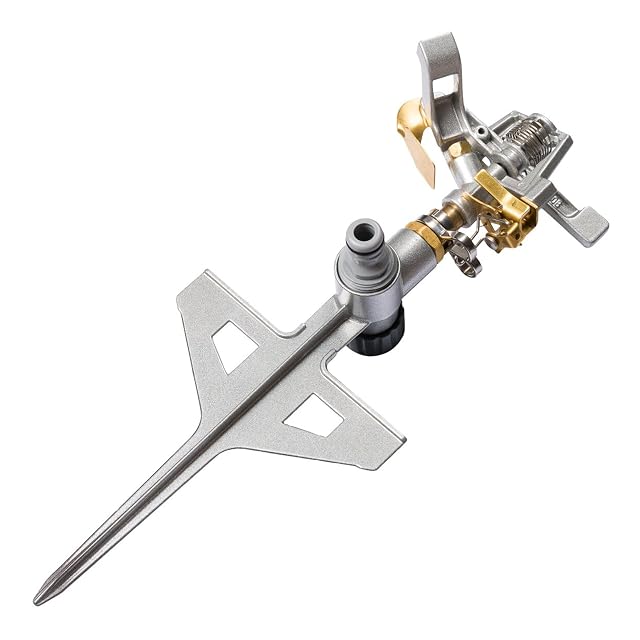
The body is metal, which is unusual here and is the traditional construction
for an impulse head.
The reason is the mechanism: a spring and a pivoted arm hammering back and
forth thousands of times an hour. Plastic bearings in that duty develop play,
and a worn impulse head stops stepping evenly and starts favouring one end of
its sector.
The spike, and the honest caveat
29 × 11 × 5 cm, on a ground spike, and the spike is the weak point.
An impulse arm kicks. Every swing puts a small sideways impulse into the head,
and the head puts it into the spike. In soft ground, after twenty minutes of
watering — which is ground that is getting wetter — a single spike works
loose and the sprinkler leans, and a leaning impulse head waters a smaller
circle in the wrong place.
One sprinkler on this shelf answers this with three folding legs and three
spikes. This one has one, and on soft ground it needs checking.
Availability
From 16 € to 23 €, that being the spread across the German, French, Italian and Spanish Amazon stores on the day of the survey.
Beyond the euro zone, the American and British Amazon stores price it in their own currencies, which the spread above sets aside.
Taken from Keepa on the day this page was last revised; stock and prices move without notice.
Prices quoted in this text were read on 26 September 2026. The live price is at the top of the page.