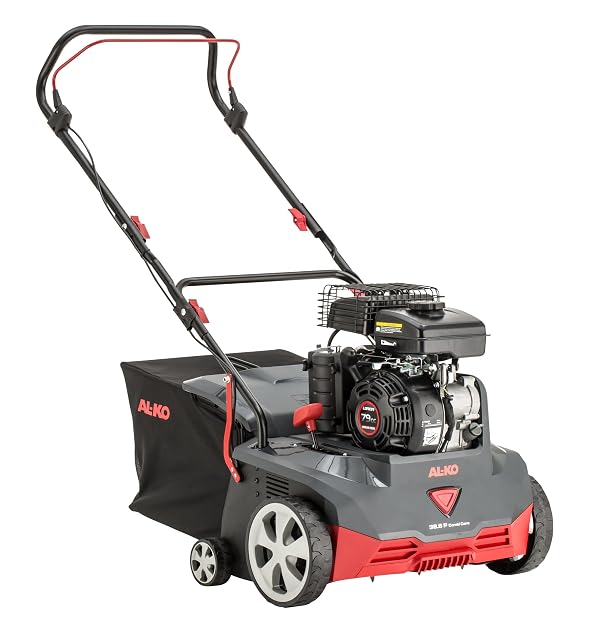
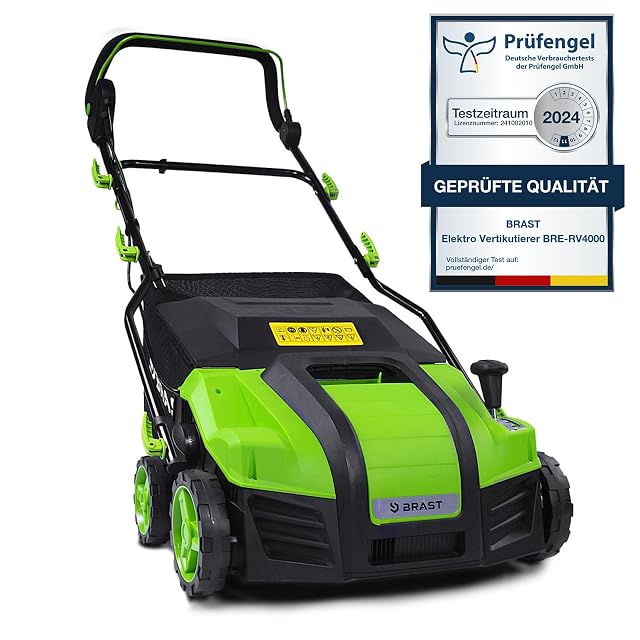
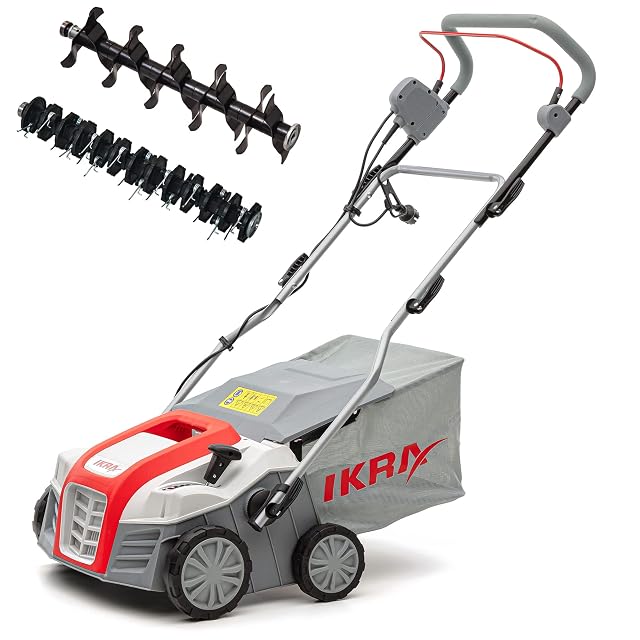
The bottom line The only machine here with free-swinging blades — thirty-two of them — which give way when they meet a stone instead of stopping the machine. The depth range runs from −15 mm to zero and no higher, which says plainly that this is a scarifier rather than a rake. 40 cm, 182 cm³, 40-litre catcher.
What the maker prints on its own page
A petrol scarifier for larger gardens with a 182 cm³ four-stroke engine, 32
free-swinging blades and a 40 cm working width, for efficient scarifying and
aerating of the soil. The working depth is adjustable from −15 to 0 mm. The
40-litre catcher holds the debris. The engine is described as easy-start and the
machine as suited to large lawns and rough terrain.
The blades that give way
Thirty-two blades hinged rather than bolted. When one meets a stone it swings
back; when the obstruction has passed, centrifugal force returns it.
Every other scarifier on this shelf has fixed blades on a roller, which cut
consistently and stop hard on something buried. On a lawn that has had builders
on it, or one on stony ground, that difference is the machine’s working life.
It is also why the count is higher here: a swinging blade cuts a narrower slot
than a fixed one, so more of them are needed for the same coverage.
A depth scale that tells the truth
−15 to 0 mm. Nothing above ground level.
Other machines here offer +5 or +6 mm, which on a bladed roller means the blades
are skimming the surface and doing very little. Those machines have a sprung
cartridge for that job; this one does not, and the scale reflects it honestly
rather than padding the range.
Thirty-two on 40 cm
One blade every 1.25 cm, the closest spacing in the family — against one every
2 cm on the electric machines and one every 2.7 cm on the other petrol one.
Closer means more lines cut per pass and more resistance, which is what the
engine is for.
What is absent
Any aerating roller. The weight. And the catcher, at 40 litres on a 40 cm
machine, is small for the rate at which this one will fill it.
Availability
From 509 € to 717 €, that being the spread across the German, French, Italian and Spanish Amazon stores on the day of the survey.
Beyond the euro zone, the British Amazon store prices it in its own currency, which the spread above sets aside.
Nothing came back from the American Amazon store at all; the buy button there runs a search rather than opening an empty page.
Taken from Keepa on the day this page was last revised; stock and prices move without notice.
Prices quoted in this text were read on 26 September 2026. The live price is at the top of the page.
The declared figures, and the point they stop at
Strengths
Free-swinging blades, which survive a stone rather than stopping on it
Thirty-two blades on 40 cm — the closest spacing on the shelf
The depth scale is honest: it does not pretend to comb above ground level
Compromises
No aerating cartridge stated — the blades do both jobs by depth alone
The catcher is 40 litres where the wide electric machines carry 55
The most expensive machine on the shelf except one, with no weight published
Specifications
Working width
40 cm, as stated
Power source
Petrol, four-stroke, 182 cm³ as stated, easy-start
Blades
32 free-swinging blades
Working depths
−15 to 0 mm
Catcher volume
40 L
Functions
Scarify and aerate
Weight
Not published
Amazon reference
B08JH848TB (one reference across 5 Amazon marketplaces)
EAN
8008984838482
What this machine usually gets asked
What is a free-swinging blade?
A blade hinged on the shaft rather than fixed to it, so that when it meets a stone or a root it folds back instead of transmitting the shock. It is the same principle as a flail, and on rough ground it is the difference between a deflection and a repair.
Why does the depth stop at zero?
Because above ground level a bladed roller is not doing anything useful — combing is a job for sprung tines, and this machine has none. Stopping the scale at zero is an accurate description of what the machine is for.
Thirty-two blades: is closer better?
Closer spacing cuts more lines per pass, which is more thorough and takes more power. On a 182 cm³ engine that is a reasonable pairing; the same spacing on a small electric machine would bog.
Who this one is for
A large, stony or rough lawn where a fixed blade would find something hard
A reference exists on these Amazon stores: France, Germany, Italy, Spain, United Kingdom. Listed is not the same as in stock — availability changes daily.
Details checked on September 26, 2026.
Sources
Specifications: manufacturer sheet and Amazon product page. Prices and availability: Keepa. No product on this site has been physically tested.