What this shelf actually is
Every one of the seven listings in this family names the same places: balcony,
terrace, patio, roof terrace, campsite, pool surround, trade fair.
Not one of them describes installing an artificial lawn.
That distinction matters on a lawn care site and it will appear on every page here.
A proper artificial lawn is a construction: excavate, lay a compacted stone
sub-base, a levelling layer of sharp sand, a weed membrane, then the turf joined with
jointing tape and adhesive, pinned at the edges, and brushed with a sand infill to
hold the fibres upright. It costs more than the turf and it takes a weekend.
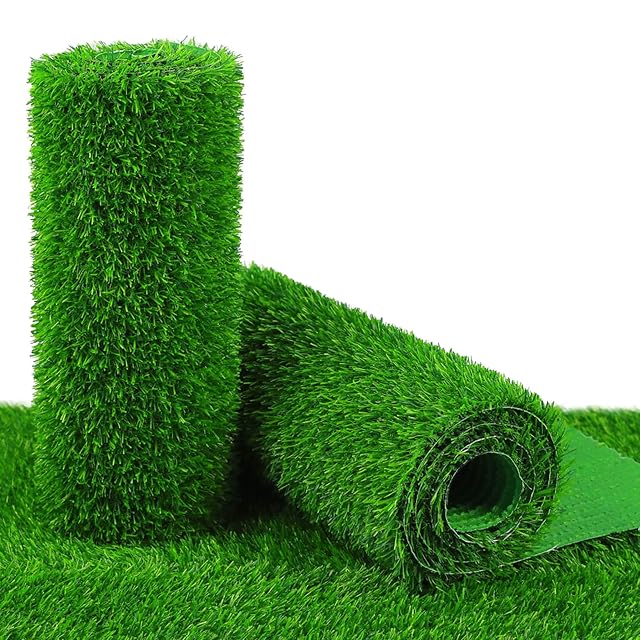
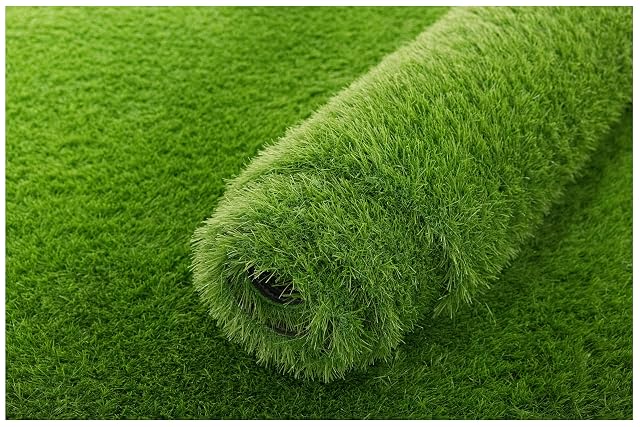
This shelf sells outdoor carpet. It is rolled out, cut with a knife, and laid on
a balcony, a terrace, decking or a patio.
Both are legitimate. They are not the same purchase, and nothing on this shelf tells
you which you are looking at.
Polyethylene, which is the right fibre for a mat
Named, and it is the more useful of the two common choices.
Polyethylene (PE) is soft and flexible. Fibres bend rather than resist, which is
why PE is what gets used where people sit, lie and walk barefoot. It looks more
natural because real grass blades are not stiff.
Polypropylene (PP) is harder and springier. It costs less, it resists crushing
better underfoot, and it feels plasticky. One mat on this shelf is 100 % PP at 33 mm
— tall, and stiff with it.
For a balcony where the point is to sit on it, PE at a short pile is a coherent
choice, and this listing’s claim that it is pleasant for bare feet follows from the
material rather than being asserted about it.
14 mm, and what pile height decides
Across this shelf the pile runs 5 mm, 14 mm, 25 mm, 33 mm, 35 mm, with two
products publishing nothing. A factor of seven.
Short pile (up to about 15 mm) reads as a closely mown lawn — a bowling green
rather than a garden. It does not flatten permanently under a chair leg, it does not
need an infill to stand up, and it shows footprints less. It also never looks like a
real garden lawn, because a real lawn is not 14 mm.
Tall pile (25 to 35 mm) looks more like grass from a distance and flattens under
anything left on it. Without a sand infill to support the fibres, a 35 mm pile under a
table develops permanent flat patches.
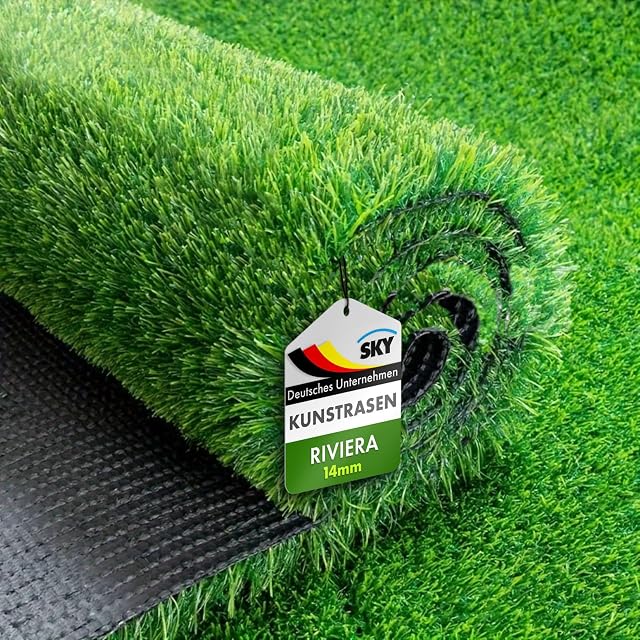
For a small area with furniture on it, 14 mm is the practical choice. The listing’s
description of a “dense, high pile” is doing some work — 14 mm is not high on this
shelf.
The silence about drainage
This is the one real gap, and it is conspicuous.
Six of the seven listings on this shelf name a drainage arrangement: perforated
latex backing, rubber backing with microchannels, a dimpled back, a double backing,
small openings underneath, integrated drainage tied to mould resistance.
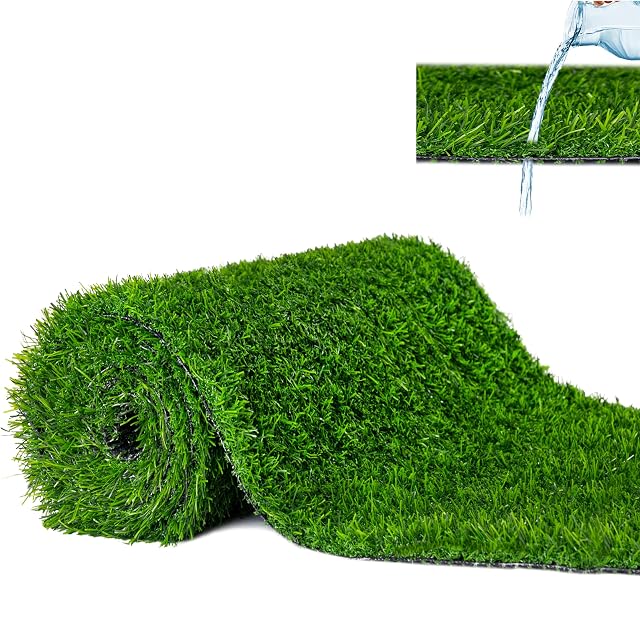
This listing mentions none — no backing material, no perforation, no drainage claim.
It is also the one sold as “Premium Class”.
And what an unperforated mat does on a balcony
Rain lands on it and goes down through the pile to the backing. If the backing does
not pass water, it spreads sideways and sits.
Three consequences, in order of how soon they appear:
It stays wet. A mat that cannot drain takes days to dry rather than hours, and
one listing on this shelf makes exactly this point about its own perforations.
It grows things. In shade, a permanently damp surface grows algae and moss —
which is worth saying plainly on this site, because the three hard-surface biocides
on this site’s moss killer shelf exist for precisely this problem. Artificial grass
is not exempt from moss; it is a shaded damp surface with a textured top.
It marks what is underneath. Standing water between a mat and a timber deck or a
paving slab is how decking rots and how pale stone discolours.
None of that is stated as a fault of this product, because its backing is simply not
described. It is the thing to check before laying it anywhere that gets rained on.
Lead- and cadmium-free
Stated, and only one other listing on this shelf makes any chemical declaration —
that one cites the EU REACH regulation by name and explains what it is.
Both are worth having. Lead and cadmium have been used historically as pigments and
stabilisers in plastics, and an outdoor surface children sit and crawl on is a
reasonable place to want them ruled out.
It is a manufacturer’s statement rather than a certification, and it is more than five
of the seven products here offer.
1.5 square metres
100 × 150 cm — the smallest piece on this shelf, at about 7.35 € per square
metre.
Across the shelf, prices run about 7.00 € to 15.78 € per square metre, so this is
near the cheap end.
The consequence of the small piece is seams. Artificial grass gives itself away at
joins: two edges never quite match in pile direction, and the line catches light
differently. Covering 6 m² with 1.5 m² pieces means four pieces and several metres of
seam.
The widest product on this shelf is 400 cm, which covers most balconies in one piece.
What goes unpublished
No weight per square metre. One product on this shelf publishes 850 g/m², and
weight is the real quality measure for artificial grass — it is the amount of fibre
and backing per unit area, and it is what separates a mat that recovers from one that
lies down permanently.
No fire classification. The same one product publishes Efl. On a balcony,
next to a barbecue, that is not an idle figure.
No backing material, as above.
Availability
From 11 € to 17 €, that being the spread across the German, French and Italian Amazon stores on the day of the survey.
Beyond the euro zone, the British Amazon store prices it in its own currency, which the spread above sets aside.
More than 1.6× the cheapest country at the Spanish Amazon store; a gap of that size normally means forwarded stock rather than a seller on the ground, so the spread above leaves it out.
Listed and unsold: the American Amazon catalogue holds the reference with nobody behind it.
Taken from Keepa on the day this page was last revised; stock and prices move without notice.
Prices quoted in this text were read on 26 September 2026. The live price is at the top of the page.