The one specification that makes it worth listing
400 cm wide.
Every other product on this shelf is 1 m, 1.5 m or 2 m wide. This is four.
Why width is the specification nobody thinks about
Artificial grass does not give itself away by its colour or its pile. It gives itself
away at seams.
Two cut edges never match exactly. The pile leans slightly differently on each side, so
the join catches light differently, and the eye finds a straight line running across
something that is pretending to be grass.
It also fails mechanically. A butted seam opens slightly over a season as the pieces
move, and the gap fills with dirt. An overlapped seam is a ridge and a trip hazard.
So the arithmetic:
A typical balcony — say 2 × 4 m — from 1 m rolls is four lengths and three seams,
each 4 m long. From 2 m rolls it is two lengths and one seam. From this, it is one
piece and none.
A 3 × 4 m terrace from 1.5 m rolls is two lengths and one seam. From this, one
piece and none.
That is the whole argument for this product, and it is a better argument than any
material claim on this shelf.
And the practical cost of one big piece
Twenty square metres in one piece is awkward.
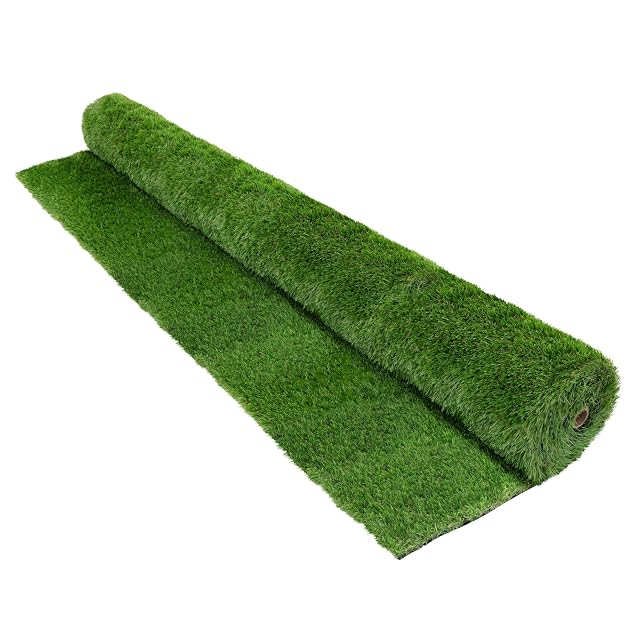
It arrives as a roll roughly 4 m long and thick enough to need two people to lift and
carry. It has to come through a door, up stairs or round a corner, and then be unrolled
in a space that is probably smaller than it is.
The listing says it cuts with a knife and scissors, which is true of all of these and
is the answer: cut it roughly to size before carrying it to the balcony, and trim
to the edges afterwards.
No weight is published. For reference, the only product on this shelf that does publish
one gives 850 g/m² — which over 20 m² would be about 17 kg — and a tufted grass on
a rubber backing is substantially heavier than a needle-felt carpet.
The drainage, described unusually
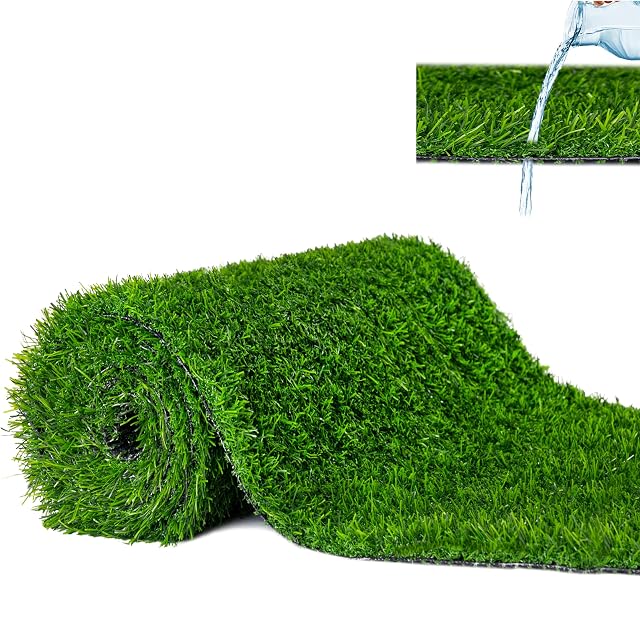
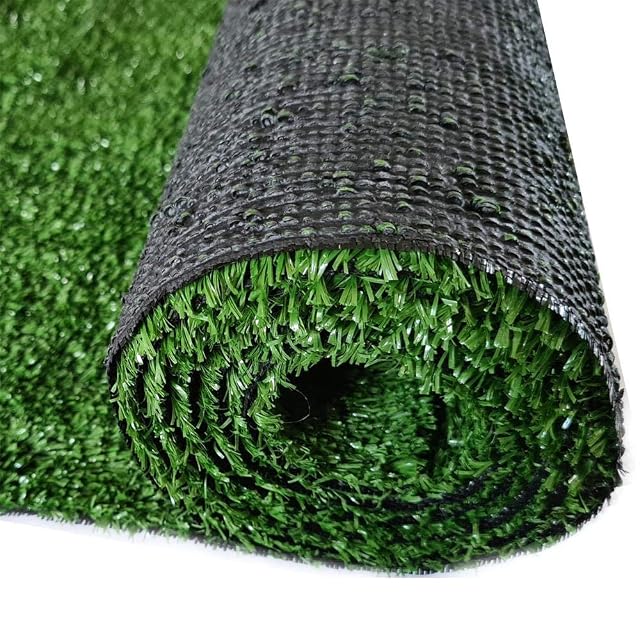
“Small openings on the underside provide high dirt absorption and water permeability —
liquids do not stay on the surface but seep through the artificial grass.”
The perforation claim is standard on this shelf — six of seven listings make one, and
the seventh is the one sold as Premium Class.
“Dirt absorption” is the odd phrase, and read literally it is the wrong way round:
perforations let dirt fall through rather than absorbing it, which is genuinely useful.
A mat that passes fine debris to the floor beneath can be lifted and swept under; one
that traps it accumulates soil in the pile.
Which is the maintenance nobody advertises
Artificial grass collects organic matter and then grows things in it.
Leaf litter, seeds, pollen and airborne dust settle into the pile. In shade, held
moisture turns that into algae and moss around the fibre bases and on the backing.
Given two or three autumns’ worth, there is enough accumulated soil for weeds to
root in the mat itself.
That is worth stating plainly here: artificial grass is a hard surface with a
textured top, and the three concentrates on this site’s moss killer shelf — the ones
for stone, wood, roofs and terraces, which must never touch a real lawn — are the
products for treating it.
The unadvertised maintenance is sweeping or blowing it out, repeatedly in autumn,
before the leaves break down.
The listing’s own suggestion — a vacuum cleaner — is reasonable on a balcony and
will lift dry debris off a short pile. It is not an answer for wet leaves in a tall
one.
What goes unpublished
Almost everything.
No pile height. The main specification of artificial grass. The range on this shelf
runs from 5 mm to 35 mm — a factor of seven — and it decides whether the mat reads
as a bowling green, as grass, or as carpet, and whether furniture flattens it
permanently.
No fibre material. Polyethylene, polypropylene and polyester are all present on
this shelf and they feel completely different: PE soft, PP stiff and springy, polyester
used flat in needle-felt.
No weight per square metre. One product here publishes 850 g/m², and weight — mass
of fibre and backing per unit area — is the real quality measure. Pile height says how
tall the fibres are; weight says how much there is.
No fire classification. The same one product publishes Efl.
Which leaves this page with three facts
20 m², in a 400 cm width, at about 13.40 € per square metre — mid-shelf, on
a range from about 7.00 € to 15.78 €.
And perforated.
That is enough to recommend it for one specific purpose — covering a whole balcony or
terrace with no seam — and not enough to say anything about how it will look or how
long it will last.
A site that filled those gaps from expectation would be a site whose specifications
could not be trusted anywhere else.
Availability
From 268 € to 275 €, that being the spread across the German and French Amazon stores on the day of the survey.
Listed and unsold: the American, British, Italian and Spanish Amazon catalogues hold the reference with nobody behind it.
Taken from Keepa on the day this page was last revised; stock and prices move without notice.
Prices quoted in this text were read on 26 September 2026. The live price is at the top of the page.