Where this belongs, first
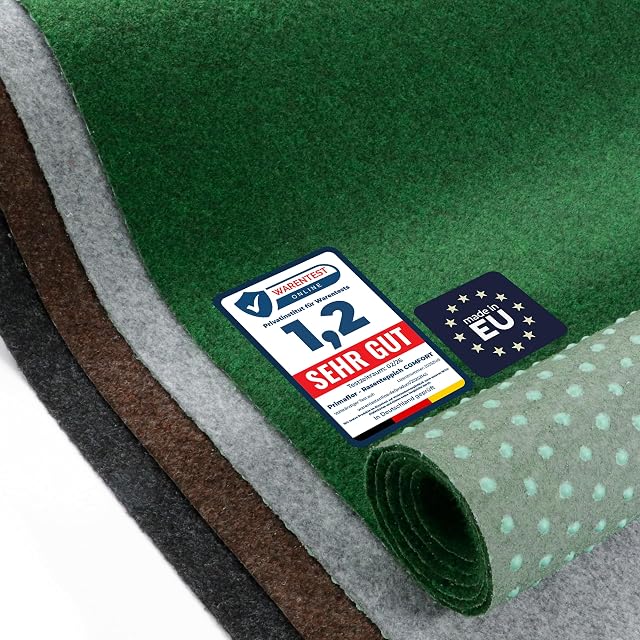
Every listing on this shelf names balcony, terrace, pool, patio, playground,
restaurant, trade fair.
None describes a lawn installation. A proper artificial lawn needs a compacted
sub-base, a sand levelling layer, a weed membrane, jointing tape and a brushed-in
sand infill. This shelf sells outdoor carpet: roll it out, cut it, lay it.
That distinction runs through this page, and it bears directly on the 33 mm pile.
33 mm, and the reason a real installation uses sand
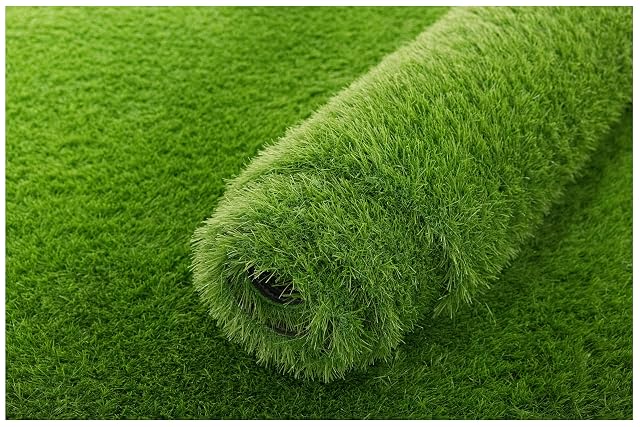
The second tallest pile on this shelf, where the range runs 5, 14, 25, 33, 35 mm.
Tall pile looks more like grass. It also has a problem that nobody selling a mat
mentions.
A 33 mm fibre has to hold itself up.
In a properly installed artificial lawn, it does not have to. Kiln-dried sand is
brushed into the pile after laying, filling the base of the fibres and supporting
them upright — which is why a commercial artificial lawn still stands up after five
years of being walked on.
A mat laid loose on a balcony has no infill. The fibres stand by their own stiffness
alone, and under a table leg, a plant pot or a sun lounger they take a permanent
set. A flat rectangle appears where the furniture was and it does not come back.
Short pile does not have this problem in the same way — which is the real argument
for the 14 mm mat on this shelf, and it is not the argument its own listing makes.
And 100 per cent polypropylene makes the fibre stiffer
Published, and it is the honest half of the trade.
Polypropylene (PP) is the harder, springier, cheaper fibre. It resists crushing
better than polyethylene, it keeps its shape, and it feels like plastic.
Polyethylene (PE) is soft and flexible, bends like a real blade, and is what gets
used where people sit and walk barefoot.
At 33 mm of PP, the fibres are long and stiff. That is a good combination for
looking like grass from standing height and a poor one for lying on — and the
listing does name pool and jacuzzi surrounds, where bare feet and wet skin meet it.
The one mat on this shelf that specifies polyethylene is 14 mm, which is the
opposite trade: soft and short.
Two products here combine both fibres, PE and PP, which is what commercial artificial
turf normally does — PE for the visible blades, PP for the curled backing fibre that
supports them.
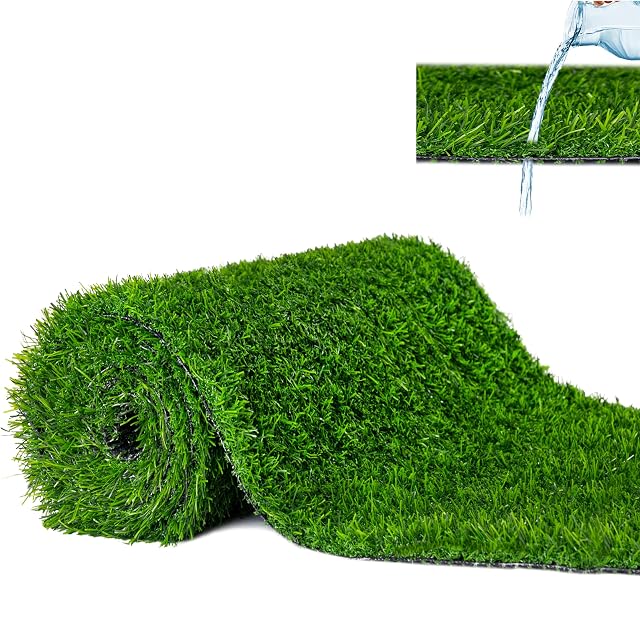
The perforated latex backing
“The latex backing with drainage holes provides effective water drainage. Perfect as
UV-permeable artificial grass, weatherproof balcony grass carpet or outdoor carpet
for damp areas such as a pool, jacuzzi or patio.”
That is the right specification for a mat that will be laid where water arrives, and
it is worth explaining what it prevents.
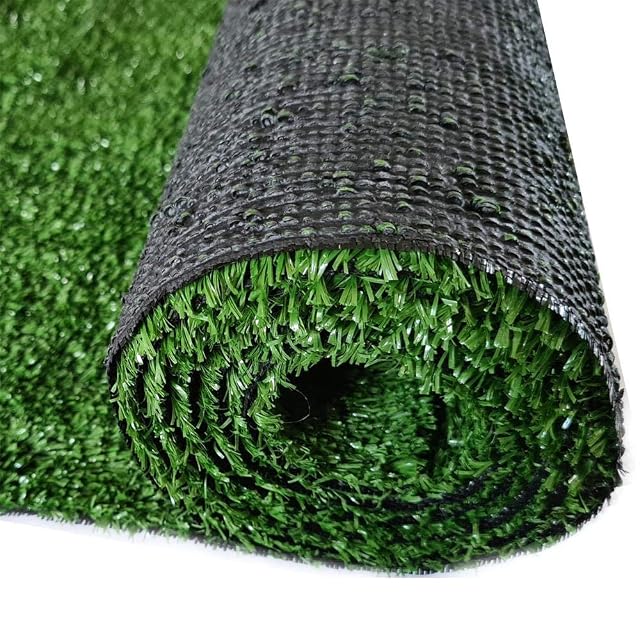
Latex is the standard secondary backing for tufted artificial grass: the tufts are
stitched through a primary woven layer and latex is coated onto the back to lock them
in. Without it, fibres pull out.
The holes are what stop water sitting on top of that latex layer. A latex coating
is waterproof by nature, so a backing without perforations is a tray.
Six of the seven listings on this shelf name a drainage arrangement. One does not
— and it is the one sold as Premium Class.
What drains and what still grows
A perforated mat lets water through and dries in hours rather than days.
It does not stop the other thing, and no listing on this shelf mentions it:
Artificial grass grows moss and algae. In shade, on a north-facing balcony, under
a tree, the pile collects leaf litter and dust, holds moisture in it, and green film
develops on the backing and around the fibre bases.
That is precisely the surface the three hard-surface biocides on this site’s moss
killer shelf are for — the ones for terraces, paving, wood and roofs, and never for
a lawn. Artificial grass is a hard surface with a textured top, and it gets treated
like one.
The maintenance nobody advertises is: sweep or blow the leaves off, several times
in autumn, before they break down into the pile.
150 × 150 cm
2.25 m², at about 13.29 € per square metre.
The shelf runs from about 7.00 € to 15.78 € per square metre, so this sits in the
upper half.
The square shape is unusual and it means seams. Artificial grass gives itself away
at joins: two cut edges never match exactly in pile direction, and the line catches
the light. Covering a 3 × 4 m terrace with 1.5 m squares is eight pieces and a great
deal of seam.
The widest product on this shelf is 400 cm, which takes most balconies in one
piece.
What goes unpublished
No weight per square metre. This is the real quality figure for artificial grass —
total mass of fibre and backing per unit area — and it is what separates a mat that
recovers from one that lies down. One product on this shelf publishes 850 g/m²
and six do not, including this one, whose 33 mm pile makes it the most relevant.
No fire classification. The same single product publishes Efl. On a terrace
with a barbecue on it, that is not academic — and PP melts.
No pile weight or stitch density, which is the other half of how tall pile is
judged.
Availability
From 30 € to 37 €, that being the spread across the German and French Amazon stores on the day of the survey.
Listed and unsold: the American, British, Italian and Spanish Amazon catalogues hold the reference with nobody behind it.
Taken from Keepa on the day this page was last revised; stock and prices move without notice.
Prices quoted in this text were read on 26 September 2026. The live price is at the top of the page.