Three feature lines, and one of them is worth everything else on this shelf
The whole published description:
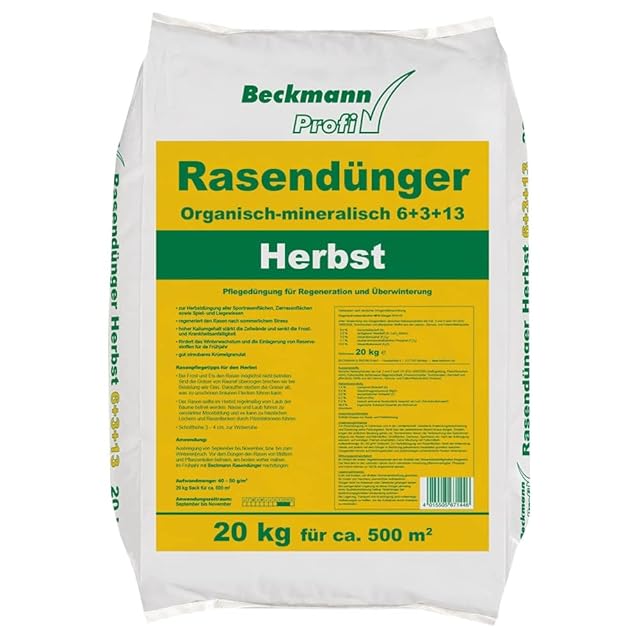
For a winter-hardy, hard-wearing lawn. The high potassium content strengthens
cell walls and lowers susceptibility to frost and disease. A free-flowing crumb
granule.
And, in the title, an analysis: 6+3+13.
Which is the number that changes the shelf
Five of the seven autumn feeds in this family publish no analysis. They sell
“potassium booster”, “KaliumPlus”, “potassium power”, “high potassium content” —
with no figure.
Two publish one. Put them side by side and the result is not what the labels
suggest.
This sack: 20 kg at 13 % potash is 2.60 kg of K₂O. About 11.86 € per
kilogram of potash.
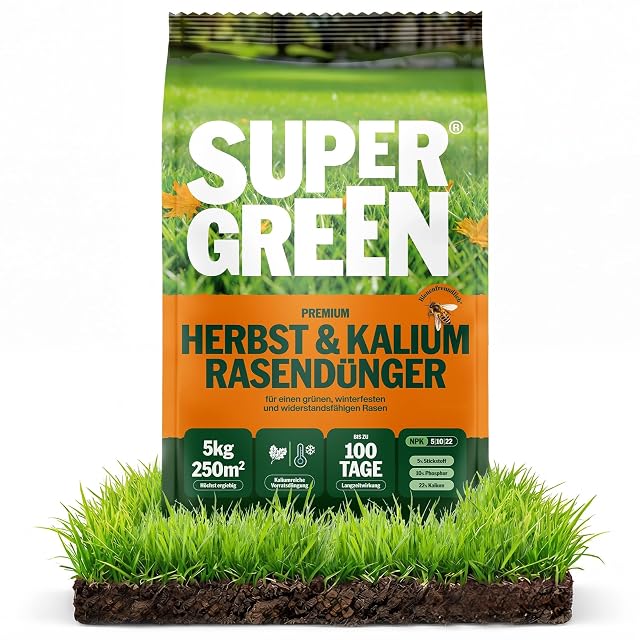
The other analysed feed: 5 kg at 22 % potash is 1.10 kg of K₂O. About
23.18 € per kilogram of potash.
The bag with the lower percentage delivers potassium at roughly half the
price.
Why the percentage misleads
A percentage is a concentration, not a quantity.
Twenty-two per cent is genuinely a stronger fertiliser — less product for the
same nutrient, less to carry, less to spread. That has real value and it is not
what most people think they are comparing.
What a lawn needs is a quantity of potassium per square metre, and that
quantity can come from a little of a strong feed or more of a weaker one. The
bag that supplies it cheapest is the one to buy, and the only way to see which is
to multiply weight by percentage.
Five products on this shelf make that impossible.
No application rate. No coverage area.
So the cost per square metre — the figure that actually matters — cannot be
calculated.
That is the frustrating shape of this listing. It publishes the one number the
shelf mostly hides, and omits the two the shelf mostly gives.
The rest of this family uses 20 g/m² or 40 to 45 g/m². At 6+3+13, a professional
autumn feed would normally go on at the higher end of that range rather than the
lower, because the analysis is less concentrated than a 22 % product — but
“normally” is not a specification, and this page will not supply a dose for a
product that publishes none.
Anybody buying it should work from the label on the sack.
“Profi”, and what a 20 kg sack implies
Twenty kilograms is the professional pack size, and it is worth being clear about
what that means for a domestic garden.
At a plausible rate it covers several hundred square metres — which is more than
one autumn application on most lawns, so the sack gets opened and stored.
Fertiliser does not store well. It is a salt: it draws moisture out of the
air, and a crumb granule in particular cakes into a solid mass. A part-used sack
folded over in a damp shed is a brick by the following September.
The answer is a sealed container, and it is the same reason this site’s spreader
shelf keeps returning to emptying and rinsing a hopper: everything on this shelf
sets hard and corrodes.
Free-flowing crumb granule
The third feature line, and it is about spreading.
A crumb granule is irregular rather than a smooth round prill. It flows well when
dry, which is what “easily spreadable” means, and it is more fragile — it abrades
into dust in a hopper and it absorbs moisture faster than a hard prill.
No size is published. One product on this shelf publishes 2 to 5 mm, and the
granule size is what a spreader is set for: this site’s spreader shelf carries a
machine whose settings map to fine seed, medium fertiliser and coarse grit, and
getting that wrong at 20 g/m² is a striped lawn.
What an autumn feed is doing
All seven products here are autumn feeds, and 6+3+13 is a textbook autumn
analysis: nitrogen low, potassium high.
Nitrogen makes leaf, and soft leaf going into winter is what frost burns and what
fungal disease colonises. Potassium thickens cell walls, which is the mechanism
behind every frost-hardiness claim on this shelf — and this is the only listing
here that states the mechanism in one sentence without embroidering it.
Availability
Around 31 €, read at the German Amazon store on the day of the survey.
Nothing came back from the American, British, French, Italian and Spanish Amazon stores at all; the buy button there runs a search rather than opening an empty page.
Taken from Keepa on the day this page was last revised; stock and prices move without notice.
Prices quoted in this text were read on 26 September 2026. The live price is at the top of the page.