What it is, and what it is not
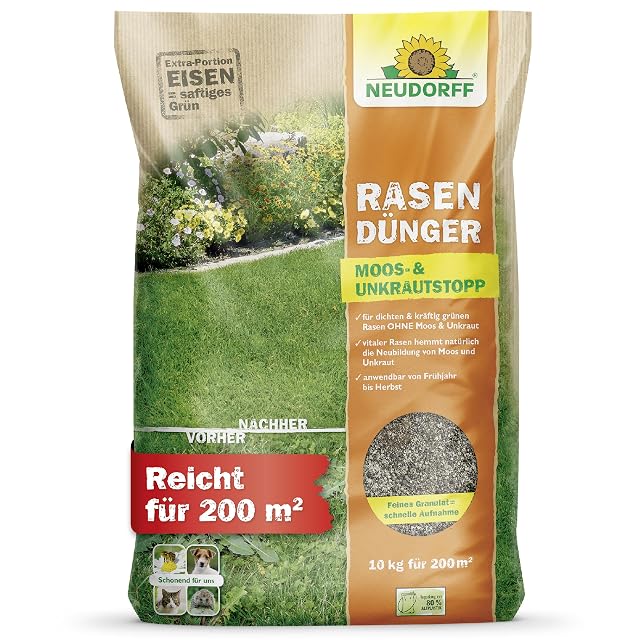
An organic-mineral lawn fertiliser with added iron: NPK 8-4.5-13.
It is not a pesticide. One product on this shelf is a plant protection product
containing a herbicide, restricted to one application a year with the lawn out of
use for two to three days afterwards. Three others are biocides for stone that
would kill grass outright.
This is a feed. The “moss and weed stop” in the name describes an outcome achieved
by growing better grass, not by a weedkiller — which is precisely the claim this
page has to examine.
The claim: “makes scarifying unnecessary”
“The nutrients strengthen the lawn so much that it sustainably displaces mosses
and weeds, without scarifying.”
The agronomy behind that is real, and it is worth stating properly because it is
the most sensible idea on this shelf.
Moss does not invade healthy grass. It colonises the gaps — and it gets those
gaps from four things: shade, compaction, poor drainage, and cutting
too short.
A dense, vigorous, well-fed sward with no gaps in it is a sward moss cannot get
into. Feeding properly over a season genuinely does reduce moss, and it is a
better long-term answer than an annual iron treatment that resets the symptom.
And the caveat the claim needs
It does not remove the moss that is already there.
Iron blackens moss within days. The dead moss is still physically present:
occupying the ground, holding water at the surface, and breaking down into
thatch.
Left in place it makes the thatch layer thicker than it was before the treatment —
and thatch is itself one of the things that keeps grass thin.
So the honest version: this product can remove the need for the machine. It
does not remove the need for the rake. This site’s aerator shelf carries
dethatching rakes for exactly that job, and one of them is the only tool on that
shelf that publishes a working width.
The preparation, which is the best instruction on this shelf
“Mow the lawn to 4–5 cm and apply 50 to 80 g/m² by hand or spreader to a moist
lawn.”
Two instructions, and both matter more than the product.
Mow to 4 to 5 cm. That gets the granules down to the base of the sward and
onto the moss instead of leaving them balanced on leaf blades. And 4 to 5 cm is
itself a higher cut than a lot of people use — cutting short is one of the four
reasons moss gets in, because short grass has less leaf to photosynthesise with
and lets light to the soil.
Apply to a moist lawn. This is the single biggest determinant of whether an
iron treatment works at all. Granules on dry grass stay granules. On moist grass
the iron goes into solution and onto the moss, which has no cuticle and no
vascular system and absorbs dissolved minerals straight across its entire surface.
Dew in the morning, or a lawn watered the evening before, is the condition. Rain
immediately afterwards washes it through before it acts.
The rate, which is the highest here
50 to 80 g/m², and 10 kg for 200 m² — which is 50 g/m², the bottom of the
range.
For comparison, the other iron feed on this shelf goes on at 35 g/m², and the
autumn feeds on this site’s fertiliser shelf run 20 to 45 g/m².
So the 10 kg bag is 200 m² at the low rate, and rather less at the high one — and
the listing does not say which situation calls for which. At about 0.19 € per
square metre it is in the middle of this shelf.
Organic-mineral, which is a genuine middle position
Part of the nutrient content is mineral — soluble, immediately available, which is
where “immediate effect” comes from. Part is organic — bound in plant or animal
material, released as soil organisms break it down, which is where the long
duration comes from.
The practical consequence is that it is harder to scorch a lawn with than a
purely mineral feed at the same nitrogen figure, because not all the nitrogen
arrives at once.
At 8 % nitrogen it sits between the 14 % of the other iron feed here and the
5 to 6 % of the autumn feeds on this site’s fertiliser shelf. That is a
spring-to-autumn analysis, which matches the stated window.
13 % potassium is high, and the listing gives the correct reason: potassium
makes grasses stand firm and raises resistance to drought, cold and disease, by
thickening cell walls.
The iron, which is not quantified
“An extra portion of iron.”
No percentage — and the other iron feed on this shelf publishes 6 %.
That matters for one reason above all others: iron stains hard surfaces
permanently.
Iron sulphate rusts. On concrete, sandstone, block paving, decking or a gravel
path it leaves an orange-brown mark that is iron oxide bound into the surface.
Brushing does not lift it and a pressure washer spreads it.
Without a percentage, the risk cannot be graded — only avoided:
Keep granules off every hard surface, and sweep strays back onto grass before
watering in.
Do not treat a strip that drains onto a path.
Work the edge by hand. This site’s spreader shelf explains why: the two drop
spreaders there put nothing outside their own 40 cm, while a rotary spreader
throws a cone two to five metres wide.
Robot mowers
Named as suitable, and it is a coherent pairing.
A robot cuts little and often and returns the clippings, which returns their
nutrients — modestly, and genuinely. A lawn cut that way is also cut more
frequently, which favours dense fine growth, which is exactly the condition this
product’s central claim depends on.
The catch nobody mentions: a robot cutting at a low height is doing one of the four
things that lets moss in. The 4 to 5 cm in this listing’s own instructions is the
figure to set the robot to.
Availability
From 37 € to 52 €, that being the spread across the German, French, Italian and Spanish Amazon stores on the day of the survey.
Beyond the euro zone, the British Amazon store prices it in its own currency, which the spread above sets aside.
Nothing came back from the American Amazon store at all; the buy button there runs a search rather than opening an empty page.
Taken from Keepa on the day this page was last revised; stock and prices move without notice.
Prices quoted in this text were read on 26 September 2026. The live price is at the top of the page.