The only fully specified sprayer on this shelf
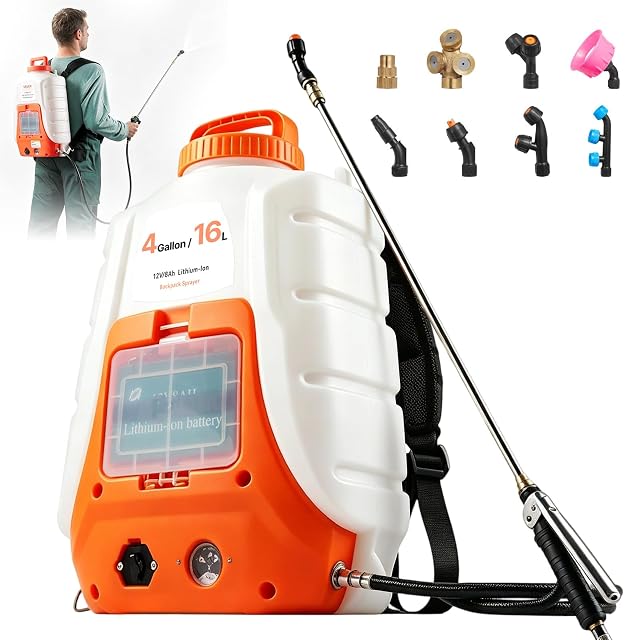
90 PSI maximum, which the listing also gives as 6.2 bar.
4.1 litres per minute.
8 Ah lithium battery, 4 to 6 hours of spraying per charge.
Four of the seven sprayers here publish no pressure at all. Only this one
publishes a flow rate.
That combination is what actually describes a sprayer: how hard it pushes, and
how much comes out.
Constant pressure, and why it is the real difference
The listing sells this as the end of manual pumping. That is the smaller half of
the argument.
A hand-pumped sprayer is pressurised to about 3 bar and then falls as you
spray. Two minutes later it is at 1.5 bar, and at 1.5 bar the same nozzle
produces a coarser spray at a lower flow rate. You pump again, and it steps back
up.
For watering, irrelevant. For a measured chemical, it is the whole
difference: the dose applied per square metre depends on the flow, and the
droplet size depends on the pressure. A bed sprayed while the pressure decays
gets a heavier, finer application at the start and a lighter, coarser one at the
end.
A pump holding 6.2 bar applies the same rate and the same pattern from the first
square metre to the last. That is the argument for a powered sprayer, and it is
better than convenience.
Two wands, and one of them is the honest one
A metal wand, adjustable from 54.5 to 100 cm.
A plastic wand, stated as suitable for bleach and other corrosive liquids.
That second one is the most candid provision on this shelf.
People put aggressive things in garden sprayers — bleach on a patio, acetic acid
on weeds, algae remover on decking — and a metal lance in contact with bleach
corrodes from the inside where nobody looks.
Supplying a dedicated plastic wand is a manufacturer accepting how its product
is actually used. One other sprayer here specifies an acid-resistant bottle; none
of the rest addresses it at all.
Eight nozzles
The largest set here, and this is the one category where a high count is
justified.
On a hand sprayer, nozzle patterns are an adjustment ring. On a powered sprayer
at constant pressure, they are interchangeable orifices — and because the
pressure is constant, each one produces a predictable and repeatable pattern.
That is the difference between a marketing count and a set of tools.
The enlarged filler with a filter screen
Named, and both halves matter.
Enlarged because pouring 15 litres of mixed liquid through a small neck,
from a bucket, is how sprayers get spilled.
Filter screen because a powered pump is less tolerant of grit than a hand
pump. Undissolved powder and dirt from a bucket block nozzles and wear a pump’s
internals, and a mesh at the inlet is where that gets stopped.
The disagreement in the listing
The title says 16 litres. The feature text says 15 litres. The
manufacturer’s own reference string says four gallons, which is about 15.1
litres.
Nothing published resolves it. This page reports all three rather than choosing,
and notes that the practical difference is one refill in ten.
What a battery adds to the list of things that can break
Worth saying plainly on the dearest product here.
A hand sprayer has a plunger, a few seals and a trigger. Its failure is a seal,
and one product on this shelf sells those seals as spares.
This has a battery, a charger, a motor, a pump, a pressure switch and wiring, in
a device carried on a back and filled with corrosive liquid.
None of that is a reason not to buy it — the case for constant pressure stands.
It is a reason to note that the cheapest sprayer on this shelf costs a small
fraction of this one and has almost nothing in it to go wrong.
And the same rule, with more at stake
One sprayer, one purpose.
A 15-litre tank, a pump, two wands and eight nozzles hold a great deal of
residue in places rinsing does not reach. A powered sprayer used for herbicide
should be labelled and used for nothing else.
The eight-nozzle set makes that easier to get wrong, not harder.
Availability
From 79 € to 82 €, that being the spread across the German, French, Italian and Spanish Amazon stores on the day of the survey.
Listed and unsold: the British Amazon catalogue holds the reference with nobody behind it.
Nothing came back from the American Amazon store at all; the buy button there runs a search rather than opening an empty page.
Taken from Keepa on the day this page was last revised; stock and prices move without notice.
Prices quoted in this text were read on 26 September 2026. The live price is at the top of the page.