Four metres a pass
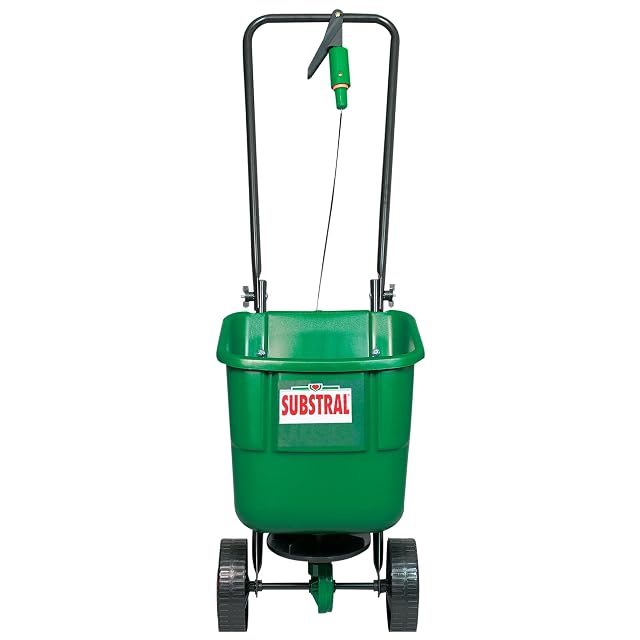
Up to 2 m per side, so a swath of about four metres.
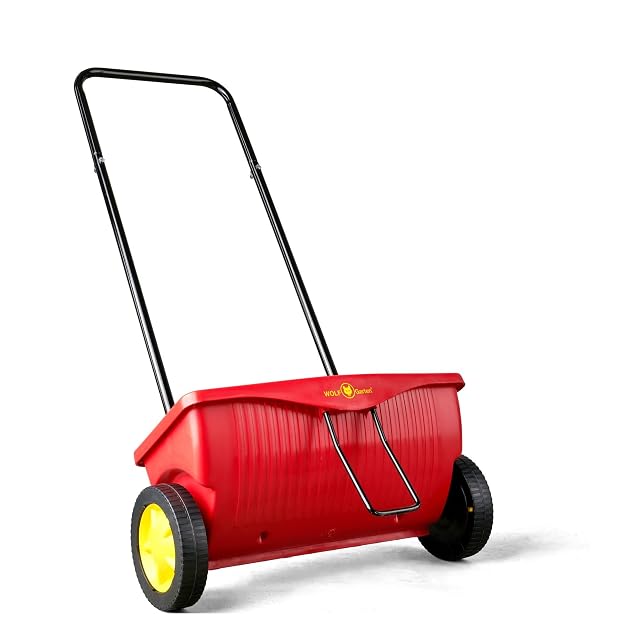
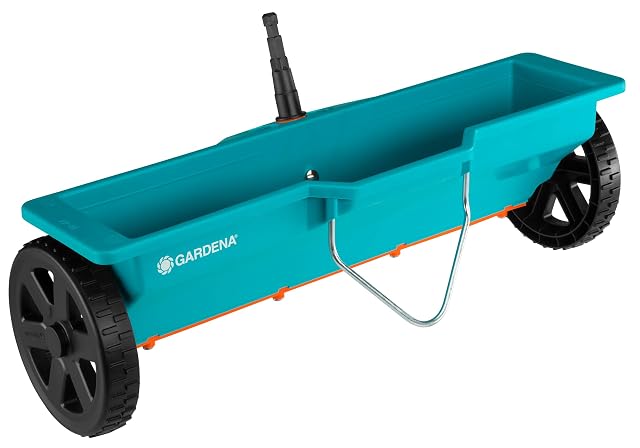
The drop spreaders on this shelf are 40 and 41 cm. This covers roughly ten times
the ground per pass, and that is the entire argument for a rotary machine.
On a 300 m² lawn that is the difference between 750 metres of walking and 75.
And the price of it, which the listing does not mention
A broadcast spreader throws a cone, and the cone is denser near the middle
than at the edges.
That means the passes have to overlap, by roughly the right amount, and the lawn
keeps the score.
Too little overlap leaves a pale strip where neither pass reached full rate.
Too much leaves a dark strip where two cones stacked — and with a nitrogen
feed, a double dose scorches to brown.
Neither is visible while you are doing it. Both appear about ten days later, and
then they stay for a month.
The working rule is to treat the outer edge of the pattern as half rate, and walk
so that each pass throws to the centre of the previous wheel track. Nothing
on this listing says it, and it is the single most useful thing to know about
owning one.
Two spreaders on this shelf sidestep the problem entirely with a drop pattern
that has a hard edge. They are 40 cm wide.
The stop bar
Named as a spreading stop bar on the U-shaped handle, with spreading startable
and stoppable at the grip.
This is a more important feature than it looks.
A rotary spreader that cannot be shut off keeps delivering while the wheels turn
— and, worse, keeps delivering to the same patch whenever you stop moving.
You stop at the end of every run. You stop to step over a hose, to open a gate,
to move a chair. Each of those is a stationary dose on one square metre of lawn,
and with a nitrogen feed that is a dead patch.
A bar at the handle means spreading stops when you do. It also means you can
start it after the machine is moving, which avoids a heavy spot at the start
of every pass.
The closable outlet
“A closable spreading opening prevents trickling while filling.”
Small, specific, and the sort of thing only somebody who has done it thinks
about.
A rotary spreader’s outlet is a hole in the bottom of the hopper, directly above
the disc. Tipping a bag in with it even slightly open puts a heap of fertiliser
on the ground under the machine — which, for most people, is a path or a drive.
Iron-containing lawn feeds stain concrete and paving permanently, and
sweeping up after it has rained does not help. That is why this matters.
Twelve litres, and a stable stance
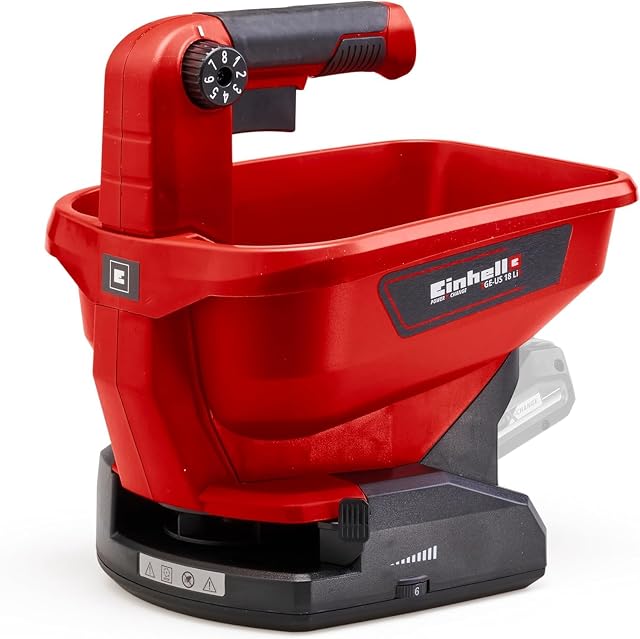
12 litres is a genuine domestic hopper — between the 3.3 and 4 litres of the
handheld spreaders here and the 45 of the large walk-behind.
The listing also mentions a stable stance while filling, which pairs with the
closable outlet: a rotary spreader on two wheels wants to tip forward when you
pour 10 kilos into it, and a machine that stands square while you do is a machine
you do not have to hold.
What goes unpublished
No rates.
The dosing device is adjustable and the listing says nothing about what any
setting delivers, or what setting suits lawn feed against grass seed against
salt.
Those three materials flow completely differently — fine seed runs through a gap
that coarse grit bridges — and one spreader on this shelf maps its numbered
settings to each. This does not.
Calibration means running a measured quantity over a measured area on a path and
weighing what comes out, which almost nobody does.
And the maintenance rule
Empty and rinse after every use, without exception.
Fertiliser and de-icing salt are both salts. Both draw moisture out of the air,
both cake into a solid mass in a hopper, and both corrode steel and seize a disc
bearing.
A rotary spreader put away loaded in November has a jammed disc in March.
Availability
From 50 € to 62 €, that being the spread across the German, French and Italian Amazon stores on the day of the survey.
Beyond the euro zone, the American and British Amazon stores price it in their own currencies, which the spread above sets aside.
More than 1.6× the cheapest country at the Spanish Amazon store; a gap of that size normally means forwarded stock rather than a seller on the ground, so the spread above leaves it out.
Taken from Keepa on the day this page was last revised; stock and prices move without notice.
Prices quoted in this text were read on 26 September 2026. The live price is at the top of the page.