Forty centimetres of wheel
The largest published diameter on this shelf, and on a wheelbarrow that is the single
specification that most changes the job.
Because a barrow is a wheel with a box on it
Across this family the wheels are 38 cm, this 40 cm, a solid 400 mm
polyurethane, and one pair of two unstated pneumatics.
A narrow range, and two centimetres of radius does more than it sounds.
It rolls over things. A lawn edge, a tree root, the lip of a paving slab, a doorway
threshold. A larger wheel climbs those; a smaller one stops at them, and the barrow has to
be lifted — which is the moment loaded barrows go over.
It sinks less. A bigger wheel has a longer contact patch under the same load, so it
spreads the weight and it does not cut a line into a wet lawn. That matters more than
anywhere when the barrow is being used on grass, which on this site’s shelves is most of
the time.
It rolls more easily. Rolling resistance falls as diameter rises, for the same tyre and
the same load.
And it is pneumatic, which is the other half
Five of the seven barrows here are pneumatic and one is solid polyurethane.
Air does two jobs. It rolls better than a solid tyre of the same size, and it
cushions the load — the shock of dropping off a step goes into the air in the tyre
rather than into the tub, the frame, and your wrists.
That second one is why builders’ barrows are pneumatic. A hundred kilos of gravel landing
on a solid wheel transmits everything.
And it punctures. Thorns, blackthorn, a screw in a load of rubble, a sharp stone under
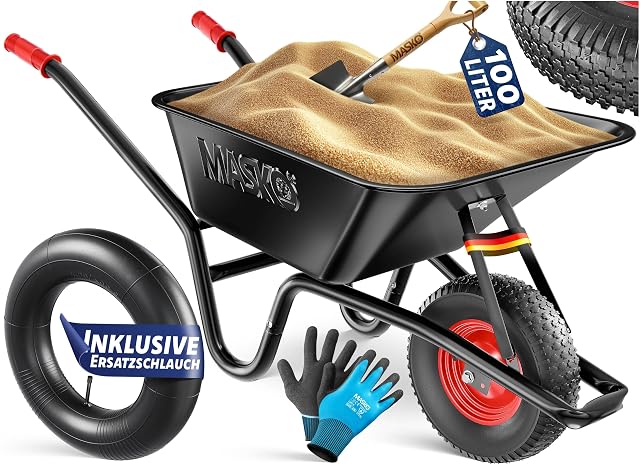
a gravel heap. One barrow on this shelf supplies a spare inner tube in the box, which
is the most honest inclusion in this family; this one does not.
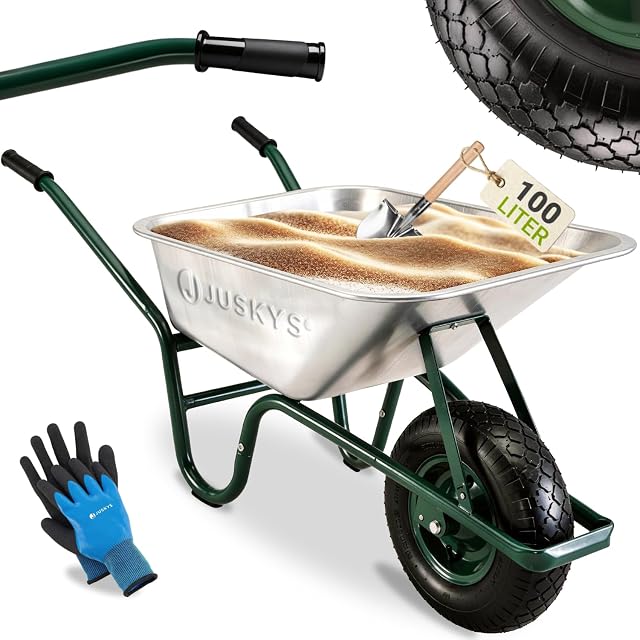
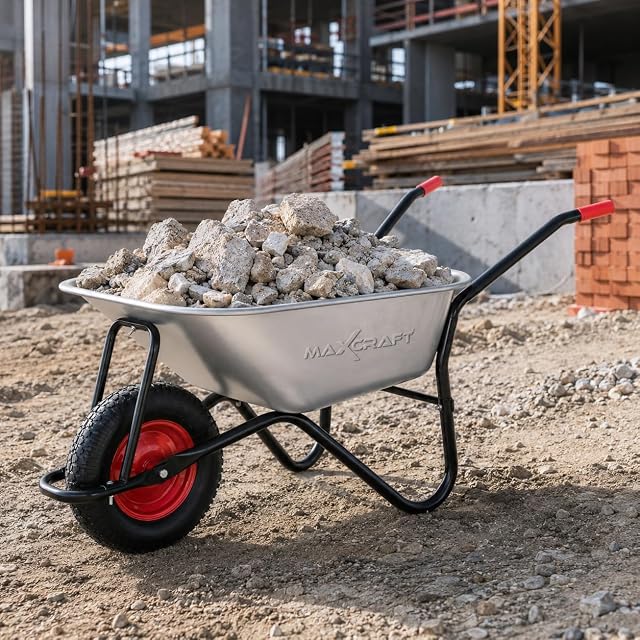
Galvanised, which is the right tub
“Through the galvanising the tub is very robust and durable. It is well protected against
corrosion and external influences.”
The reason this matters is specific to wheelbarrows and it is worth stating properly.
A barrow tub is scraped by a shovel on every single use. Loading soil, gravel or rubble
means a steel blade dragged along the bottom and up the front lip, dozens of times per
load.
No coating survives that. The question is what is underneath.
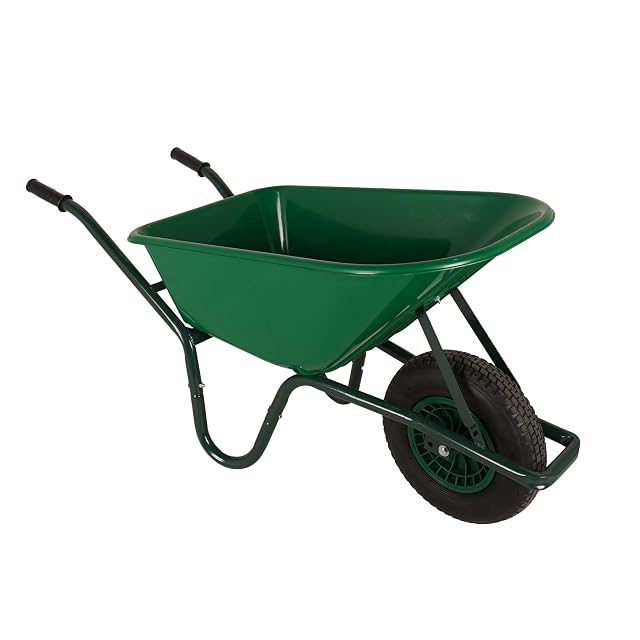
Paint comes off and leaves bare steel holding wet soil — one barrow on this shelf has a
painted tub.
Galvanising comes off too, and leaves zinc, which corrodes in preference to the
steel around it and keeps protecting the scrape electrically. That is what a sacrificial
coating is for, and it is the same reasoning as the galvanised lawn edging on this site’s
edging shelf.
Three barrows here have plastic tubs, which cannot rust and which go brittle in frost
and chalky in UV.
The long handles
“For good leverage and easy lifting, the two long shafts. Grips in plastic for a pleasant
feel.”
That is mechanically correct, and worth spelling out because it is the reason barrow
handles are as long as they are.
A wheelbarrow is a lever. The wheel is the fulcrum, the load sits between the
wheel and your hands, and the handles are where force is applied.
Longer handles mean less force at your hands to lift the same load — which is exactly
the claim. It is also why the weight you feel depends on where the load sits in the tub:
shovel it towards the front, over the wheel, and the handles carry very little.
What length costs is room. A long barrow needs a wider turning circle and more space
to park, and its length becomes its height when it is stood on its nose against a shed
wall.
No overall length is published here, and one barrow on this shelf publishes 142 cm.
The gloves
A pair included, as on one other barrow here.
Worth a note because this site has a shelf of them, and one finding from it applies
directly: of seven glove products there, only one offers thorn and puncture
protection, and it is leather. A coated knit glove — which is what comes free with a
barrow — protects against dirt and abrasion and will not stop a bramble.
The 250 kg, unqualified
Like four other barrows on this shelf.
One product here publishes its rating as two figures: 150 kg dynamic and 250 kg
static (not in motion).
That distinction applies to every barrow ever made. Static is what the frame holds
standing still; dynamic is what it holds while being pushed, tipped, run over a step
and set down — the only condition a barrow is actually used in. On the one listing that
splits it, the gap is 40 per cent.
For scale, and it is the number worth carrying: 100 litres of wet soil weighs roughly 130
to 150 kg. A tub filled to the brim with wet soil is close to the moving limit of any
barrow on this shelf, and filling one with gravel is asking more again.
What goes unpublished
No dimensions. Not length, width or height — and width decides whether the barrow goes
through a gate or a side passage. Two barrows on this shelf publish all three.
No empty weight. One publishes 11.2 kg.
No tyre pressure. One publishes 2 bar, and it is the most useful maintenance figure
in this family: an under-inflated pneumatic tyre is the commonest reason a barrow feels
heavy after a winter in a shed. On the largest pneumatic wheel here, its absence is a
particular shame.
No frame tube size. Two barrows on this shelf publish theirs, at 3 cm and 33 mm
— and the frame, not the tub, is what carries the load in bending every time the handles
are lifted.
Availability
From 60 € to 70 €, that being the spread across the German, French, Italian and Spanish Amazon stores on the day of the survey.
Nothing came back from the American and British Amazon stores at all; the buy button there runs a search rather than opening an empty page.
Taken from Keepa on the day this page was last revised; stock and prices move without notice.
Prices quoted in this text were read on 26 September 2026. The live price is at the top of the page.