Where this shelf belongs, before anything else
All seven listings in this family name balcony, terrace, garden, conservatory,
campsite, roof terrace, pool and lounge areas.
None of them describes laying an artificial lawn. That is a construction — compacted
sub-base, sand levelling layer, weed membrane, jointing tape, pinned edges, brushed-in
sand infill — and it costs more than the turf.
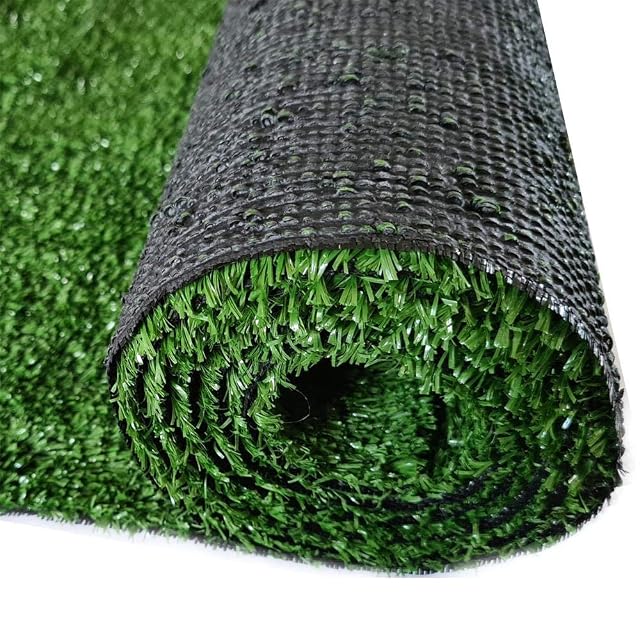
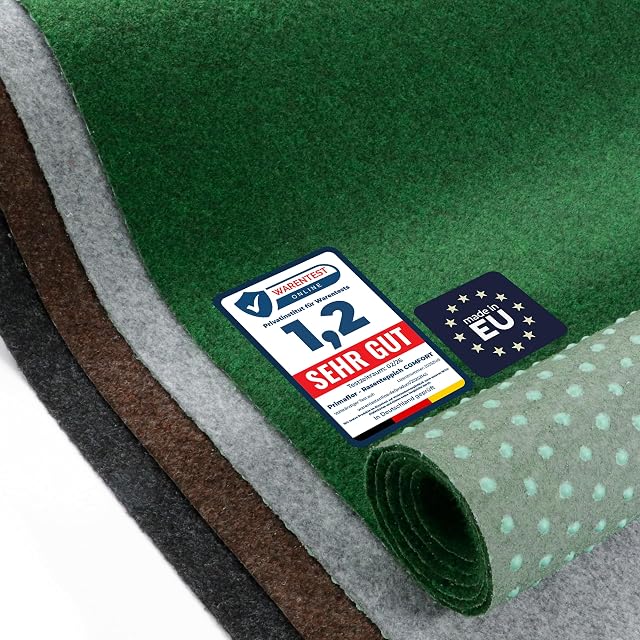
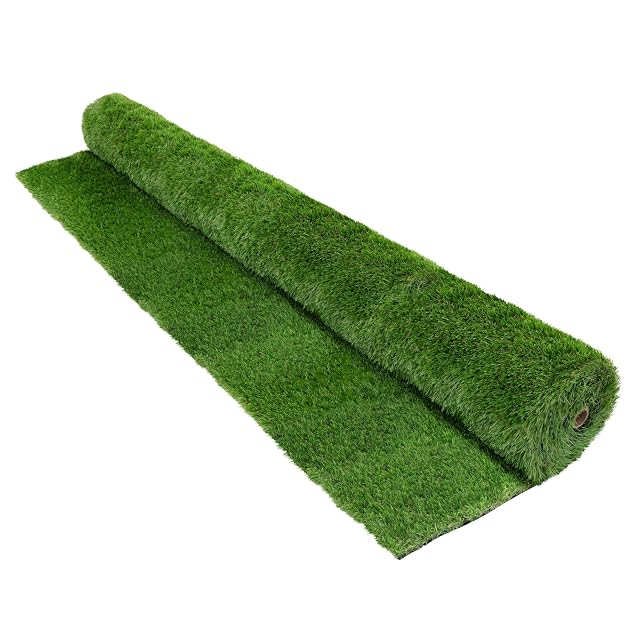
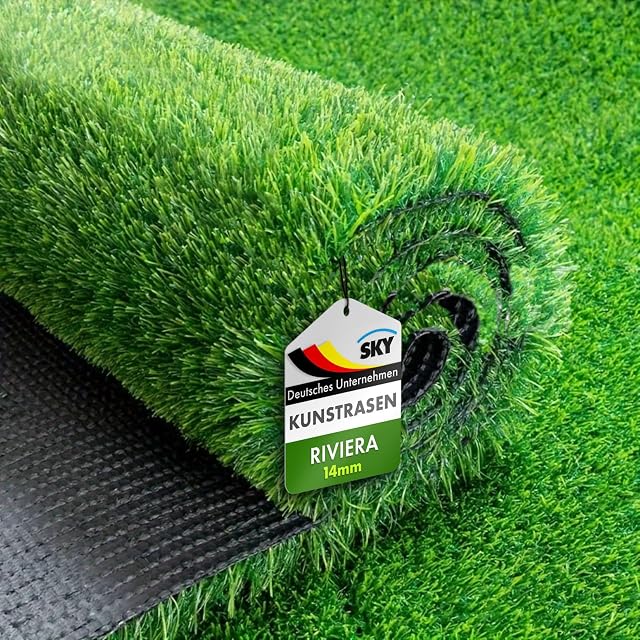
This shelf sells outdoor carpet. Rolled out, cut with a knife, laid down.
The cheapest square metre here
100 × 500 cm is 5 m², at about 7.00 € per square metre.
Across this shelf the range is about 7.00 € to 15.78 € per square metre — a factor
of 2.25.
And this is also the listing that publishes the least about what the material is,
which is worth stating as a pair rather than separately.
What is published, and it is unusual
“REACH-compliant for more safety — REACH is the EU chemicals regulation for
controlling problematic substances. Our product meets these requirements and has been
tested for relevant harmful substances.”
That is the only reference to an external standard anywhere on this shelf.
Every other claim in this family is the seller’s own: premium, realistic, durable,
environmentally friendly, non-toxic. One other listing states that its product is free
of lead and cadmium, which is a manufacturer’s declaration about two specific
substances.
REACH is a regulation, and citing it — and then explaining what it is rather than
assuming the acronym means something to the reader — is the better form of the claim.
It matters more on this product category than on most. Artificial grass is a plastic
surface that children sit on, that gets hot in the sun, and that is in contact with
bare skin. Plasticisers, pigments and flame retardants are the relevant question, and
this is the only listing here that engages with it.
The drainage, tied to mould
Three of the five feature lines are about water, and they connect properly:
“Dries quickly — the drainage lets rainwater flow away without problems and it then
dries again.”
“Mould-resistant — thanks to the integrated drainage water is quickly carried away.
No standing water forms, so the artificial grass stays permanently dry, hygienic and
free of mould.”
That is a mechanism rather than a feature list, and it is the right mechanism.
A tufted artificial grass has a latex or rubber secondary backing, which is
waterproof by nature. Without perforations it is a tray: water runs down through the
pile, meets the backing, spreads sideways and sits.
Six of the seven listings on this shelf name a drainage arrangement. One does not,
and it is the one sold as Premium Class.
And the part this listing still does not say
Drainage stops water sitting. It does not stop the other thing.
Artificial grass grows moss and algae. On a north-facing balcony, under a tree, in
a shaded corner, the pile collects leaf litter and airborne dust, holds moisture in
it, and green film develops around the fibre bases and on the backing.
That is exactly the surface the three hard-surface biocides on this site’s moss killer
shelf are made for — the products for stone, wood, roofs and terraces, which must
never go on a real lawn. Artificial grass is a hard surface with a textured top.
The maintenance nobody advertises: sweep or blow the leaves off, repeatedly in
autumn, before they break down into the pile. A mat that has been left under a lime
tree for two autumns has soil in it, and then it grows weeds.
“Several widths can be laid side by side”
Stated in the first feature line, and it is the practical note for a 1 m roll.
Artificial grass gives itself away at seams. Two cut edges never match exactly in
pile direction, and the join catches light differently from either side of it.
A 1 metre width means a seam every metre. Covering a 3 × 4 m terrace is four lengths
and three seams, running the full 4 m.
Two mitigations, neither of which this listing mentions:
Lay all pieces with the pile leaning the same way. Artificial grass has a
direction, like carpet, and it looks completely different viewed with and against it.
Alternating pieces makes the seams obvious.
Butt the edges, do not overlap. An overlap is a visible ridge that catches feet.
The widest product on this shelf is 400 cm, which covers most balconies with no
seam at all.
What goes unpublished
No pile height. The main specification of artificial grass, and the range on this
shelf runs 5 mm to 35 mm — a factor of seven. It decides whether the mat reads as
a bowling green or as a garden lawn, and whether furniture flattens it permanently.
No fibre material. PE, PP and polyester are all present on this shelf and they
feel entirely different: PE soft, PP stiff and springy, polyester used in needle-felt
grass carpets.
No weight per square metre. One product here publishes 850 g/m², and weight is
the real quality measure — fibre and backing mass per unit area is what separates a
mat that recovers from one that lies down.
No fire classification. The same one product publishes Efl.
So: the best chemical declaration on the shelf, and the least description of the
material it applies to.
Availability
From 35 € to 43 €, that being the spread across the German and French Amazon stores on the day of the survey.
Nothing came back from the American, British, Italian and Spanish Amazon stores at all; the buy button there runs a search rather than opening an empty page.
Taken from Keepa on the day this page was last revised; stock and prices move without notice.
Prices quoted in this text were read on 26 September 2026. The live price is at the top of the page.