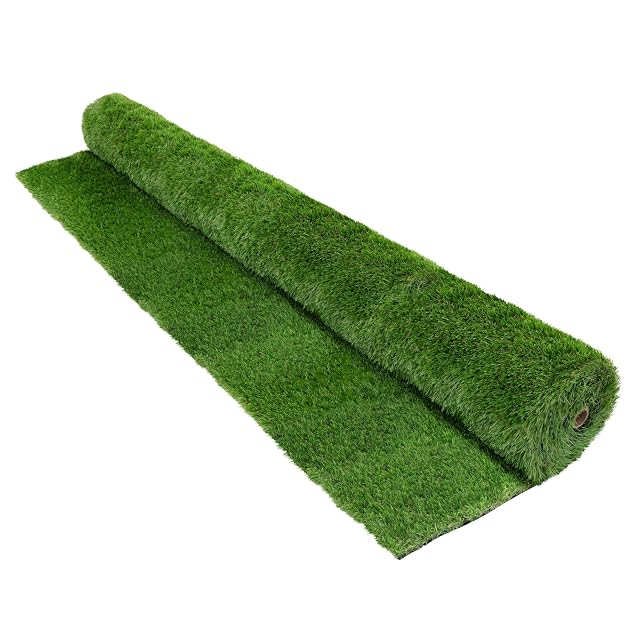
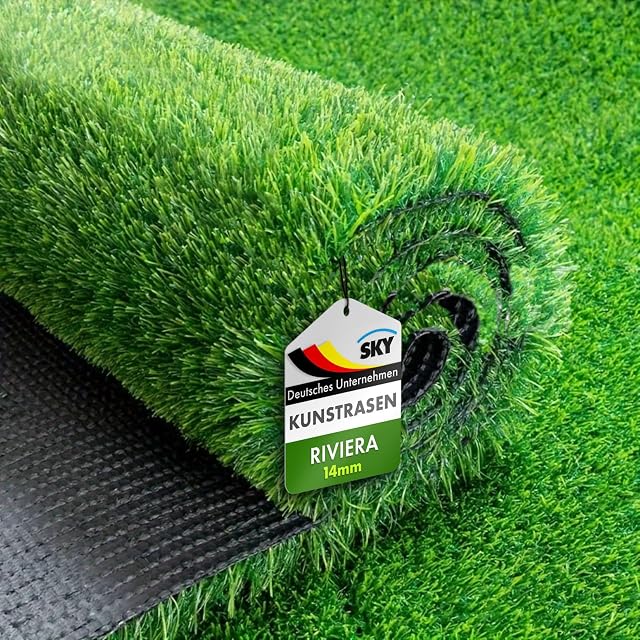
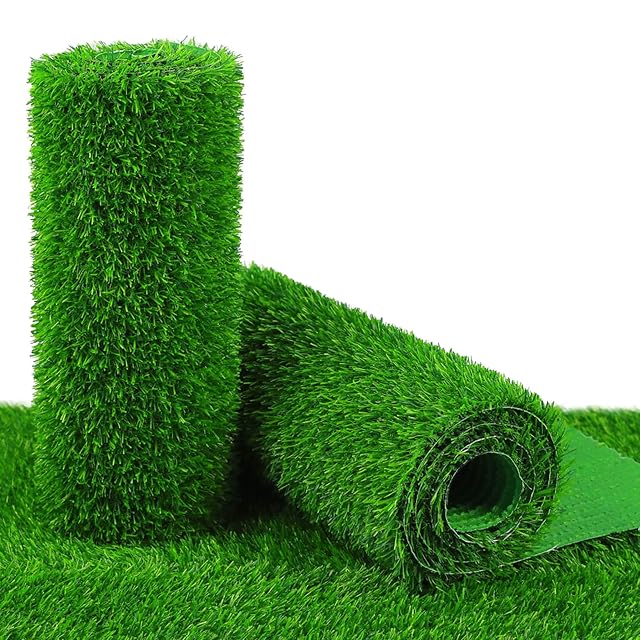
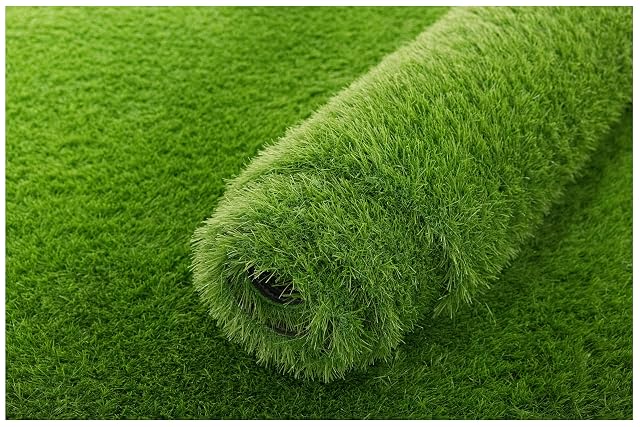
Where this shelf belongs
All seven listings here name balcony, terrace, garden, playground, decorative areas,
camping.
None describes an artificial lawn installation — the sub-base, sand levelling layer,
weed membrane, jointing tape, pinned edges and brushed-in sand infill that a permanent
artificial lawn needs.
This shelf sells outdoor carpet, and that fact bears directly on the 35 mm pile
below.
The four-colour pile, which is the realism feature
“This high-quality artificial grass convinces through its realistic four-colour
appearance and looks like real grass.”
That is the most substantive realism claim on this shelf, and it is the one that
actually works.
Real grass is never one green. A lawn contains lighter new blades, darker mature
ones, blue-green tints depending on species, and a layer of pale brown dead material
at the base — the thatch this site’s aerator shelf exists to rake out.
Single-colour artificial grass reads as carpet for exactly that reason. The eye
registers uniformity instantly, at any pile height, and no amount of length fixes it.
A four-colour pile normally means two or three greens plus a brown or beige thatch
fibre, short and curled, sitting at the base. The thatch fibre does two jobs at
once: it breaks the colour up, and it physically supports the long blades from below.
That is how commercial artificial turf is built, and no other listing on this shelf
mentions it.
35 mm, and the problem nobody selling a mat will tell you
The tallest pile here, where the range runs 5, 14, 25, 33, 35 mm.
Tall pile looks most like grass. It also cannot hold itself up indefinitely.
In a properly installed artificial lawn, kiln-dried sand is brushed into the base
of the pile after laying. It fills between the fibres and supports them upright, which
is why a commercial installation still stands up after years of use.
A mat laid loose has no infill. The fibres stand by their own stiffness, and under
a table leg, a plant pot, a barbecue or a sun lounger they take a permanent set.
A flat rectangle appears and it does not recover fully — brushing the pile up with a
stiff broom helps and does not restore it.
So the 35 mm is worth having where nothing stands on it: a garden corner, a strip
along a wall, a dog run, an area that is walked across rather than furnished.
For a terrace with a table on it, the 14 mm and 25 mm products on this shelf are the
more sensible choice, and the 5 mm needle-felt carpet cannot be flattened at all.
Both fibres, and a double backing
“Made from high-quality plastic (polyethylene (PE) and polypropylene (PP)) material
and offers a dense, hard-wearing structure. The double backing provides extra
stability and a long service life.”
Two useful statements.
PE and PP together is the proper construction. Polyethylene is the soft flexible
fibre used for the visible blades; polypropylene is the stiffer springy one used for
the curled support fibre at the base. One mat on this shelf is 100 % PP at 33 mm —
tall and stiff throughout — and one is PE at 14 mm.
At 35 mm, having a PP support fibre is not optional. It is what gives the PE blades
anything to lean on in the absence of sand.
A double backing is a primary woven layer the tufts are stitched through, plus a
secondary coating — normally latex — that locks them in. Naming it as double is a
claim about dimensional stability: a large piece that stretches, shrinks or curls
at the edges is the failure mode of a thin single-backed product, and a 4.5 m² piece
is large enough for it to matter.
Water-draining
Stated, without the mechanism named.
Six of the seven listings on this shelf mention drainage; one does not. Two name the
method precisely — perforated latex, and rubber with microchannels — and this one
states the property.
The reason it matters is that a latex backing is waterproof by nature. Without
perforations it is a tray: water runs down through the pile, meets the backing, spreads
sideways and sits.
And the thing drainage does not prevent
Moss and algae in the pile.
A 35 mm pile is the best leaf trap on this shelf. It collects leaf litter, seeds and
airborne dust deep between the fibres, holds moisture in it, and in shade grows green
film around the fibre bases — and in time enough organic matter accumulates for actual
weeds to root in it.
This is worth stating plainly on a lawn care site: artificial grass is a hard surface
with a textured top. The three concentrates on this site’s moss killer shelf — for
stone, wood, roofs and terraces, and never for a real lawn — are the products for it.
The unadvertised maintenance on a tall pile is blowing or sweeping it out, several
times in autumn. A mat left under a tree for two autumns has soil in it.
4.5 square metres on a 1.5 m width
150 × 300 cm, at about 15.78 € per square metre — the dearest on a shelf
running from about 7.00 €.
The 1.5 m width is better than the two 1 m rolls here. Seams are what give
artificial grass away: two cut edges never match exactly in pile direction, and the
join catches light differently from each side.
Two rules no listing on this shelf gives: lay every piece with the pile leaning the
same way, and butt the edges rather than overlapping them — an overlap is a ridge
and a trip hazard.
The widest product here is 400 cm, which covers most balconies seamlessly.
What goes unpublished
No weight per square metre. One product on this shelf publishes 850 g/m², and
weight is the real quality measure — the mass of fibre and backing per unit area is
what separates a mat that recovers from one that lies down after a season.
On the tallest pile on the shelf, at the highest price per square metre, that
is the figure that would justify both. It is absent.
No fire classification. The same single product publishes Efl. On a terrace,
next to a barbecue, a 35 mm plastic pile is the most flammable-looking thing on this
shelf and the listing says nothing about it.
No pile weight or stitch density, which is the other half of how a tall pile is
judged.
Availability
From 71 € to 87 €, that being the spread across the German, French, Italian and Spanish Amazon stores on the day of the survey.
Listed and unsold: the American and British Amazon catalogues hold the reference with nobody behind it.
Taken from Keepa on the day this page was last revised; stock and prices move without notice.
Prices quoted in this text were read on 26 September 2026. The live price is at the top of the page.