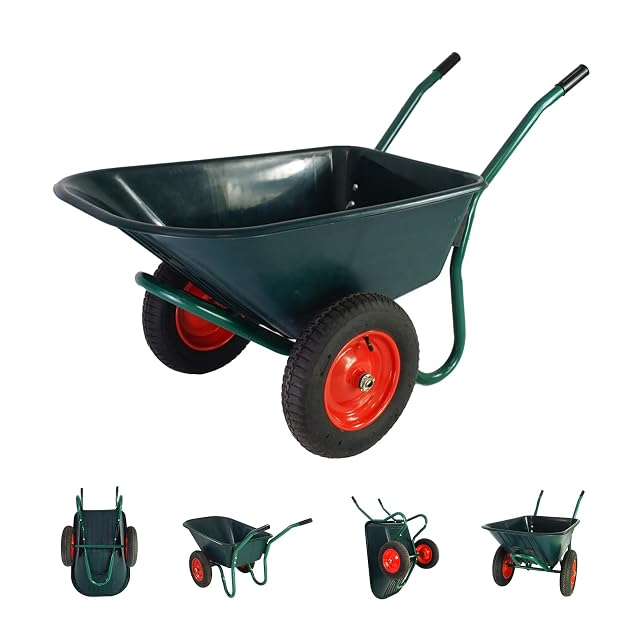
The best-specified barrow on this shelf
11.2 kg empty. About 3 mm tub wall. 73 cm grip height. 33 mm steel tube
frame, welded and bolted. 100 L, 160 kg, two 4PR pneumatic wheels on steel rims
with ball bearings and car valves.
Nine published figures. Across the rest of this family, four barrows publish no dimensions
at all — one of them replacing them with a note that its figures are guide values.
The empty weight. 11.2 kg, and it is the only such number on this shelf.
It matters twice over: it is subtracted from what the barrow can carry, and it is what you
lift — over a step, into a car, off a trailer, and onto its nose against a shed wall.
The tub thickness. About 3 mm, and again the only one.
Three barrows here have plastic or PVC tubs, and “plastic” covers everything from a
flexible bin to a structural moulding. Three millimetres is substantial, and it is the
figure that separates a tub a shovel corner splits from one it does not.
The grip height. 73 cm, and nothing else on this shelf publishes a height of any kind.
That is the number that decides your posture. Barrow handles too low mean pushing with bent
arms and a stooped back for the length of the job; 73 cm is roughly wrist height for an
adult standing straight, which is what “raised grip height for comfortable, upright
pushing” is describing.
Two wheels, which is the real decision
The only two-wheeler in this family, and it is a genuine fork rather than an improvement.
What two wheels give:
It cannot tip sideways. That is how loaded barrows are actually lost — a wheel drops
into a soft patch, the load shifts, and 130 kg of wet soil goes onto the lawn. A single-
wheel barrow is balanced by the person pushing it, continuously, and on a slope or across a
camber that balancing is most of the effort.
It stands up. Put it down anywhere, at any point, and it stays where it is with the load
in it. A one-wheeler has to be set on its legs deliberately and squarely.
It shares the load. Two wheels halve the ground pressure, which on a wet lawn — where
garden barrows live — is the difference between rolling across and cutting two lines into
it.
What one wheel gives that two cannot:
It pivots. A single-wheel barrow turns almost on the spot, which is what makes it usable
in a garden full of beds and paths.
It goes where a wheel fits. Along a plank, down a gap the width of its tub, over a
narrow bridge, along the edge of a trench. A two-wheeler needs the width of both wheels on
firm ground.
It tips to empty more easily, straight forward over its own wheel.
So: two wheels for open ground, slopes and heavy loads; one wheel for a garden with
things in it. Six of the seven barrows on this shelf are the second.
160 kg, which may be the honest number
The lowest rating among the 100 L barrows here — four claim 250 kg and one claims
250 kg static with 150 kg dynamic.
That last one is the key to reading this figure.
A static rating is what a frame holds standing still. A dynamic rating is what it
holds while being pushed, tipped, run over a step and set down — the only condition a barrow
is used in. On the one product that publishes both, the gap is 40 per cent.
This barrow’s single figure of 160 kg sits almost exactly on that dynamic value.
This page does not claim to know which convention each manufacturer used. What it can say is
that 160 kg unqualified and 150 kg dynamic describe a very similar capability, and that an
unqualified 250 kg does not obviously describe a better one.
For scale: 100 litres of wet soil weighs roughly 130 to 150 kg, so a full tub of it is
at the limit of this barrow and of the dynamic figure of the one that splits its rating.
The wheels, described properly
Two 4PR pneumatic wheels on steel rims, ball-bearing, with car valves and a tread
pattern.
Four claims and all four are substantive.
4PR is a ply rating — a tyre specification describing casing strength, carried over
from the number of fabric plies in the construction. It is a real designation rather than a
marketing word, and it means a replacement can be specified.
Car valves — the ordinary Schrader type. That means any foot pump, any compressor, any
garage airline fits it with no adapter, which is more useful than it sounds: the
commonest reason a barrow feels heavy is a soft tyre, and one barrow on this shelf publishes
2 bar as the pressure to keep it at.
Ball bearings rather than a plain bushing. This is where cheap barrows die: the whole
load turns through one bearing surface, and a plastic bushing wears oval, the wheel
develops play, then it leans and rubs the frame. Ball bearings do not.
A tread pattern, for mud and uneven ground — which the listing names explicitly.
The frame, welded and bolted
33 mm powder-coated steel tube, welded and bolted.
Both words matter, and this is the only listing on this shelf to use them together.
Welded joints are stiff and permanent. Bolted joints can be tightened and taken
apart. A frame that is welded where stiffness is needed and bolted where assembly is needed
is the right arrangement — and it is also why this barrow can be shipped flat and still end
up square.
The 33 mm figure matters because a plastic tub is not a structural part. A steel tub
contributes stiffness to the whole barrow; a plastic one is a container bolted on. So on a
plastic-tub barrow the frame has to be stiff on its own, and 33 mm of tube is what does it.
One other barrow on this shelf publishes 3 cm; the rest publish nothing.
Plastic, and the trade it brings
What it gains: it cannot rust — and a barrow tub is scraped by a shovel on every
use, a steel blade dragged along the bottom and up the front lip dozens of times per
load. No coating survives that. Paint leaves bare steel holding wet soil; galvanising
leaves protective zinc; plastic has nothing to corrode.
What it loses: it goes brittle below freezing and chalky under UV. Five summers
outdoors and then a load of rubble on a frosty February morning is what cracks a plastic tub
at a bolt hole.
About 3 mm, “impact-resistant”, is the answer to that, and it is the only wall thickness
published in this family.
The 11.2 kg, read one more way
Light, for a 100 L barrow on two steel-rimmed wheels with a 33 mm steel frame.
And it is worth one caution. A light barrow with two wheels and 160 kg in it is
a stable, easy thing to push and a difficult thing to tip and empty — because emptying a
two-wheeler means lifting the handles high and pushing the whole load forward over the axle
line, with nothing to pivot on.
Which is the shape of this entire page: everything two wheels gain in stability, they give
back in manoeuvring.
Availability
Around 90 €, read at the German Amazon store on the day of the survey.
Nothing came back from the American, British, French, Italian and Spanish Amazon stores at all; the buy button there runs a search rather than opening an empty page.
Taken from Keepa on the day this page was last revised; stock and prices move without notice.
Prices quoted in this text were read on 26 September 2026. The live price is at the top of the page.