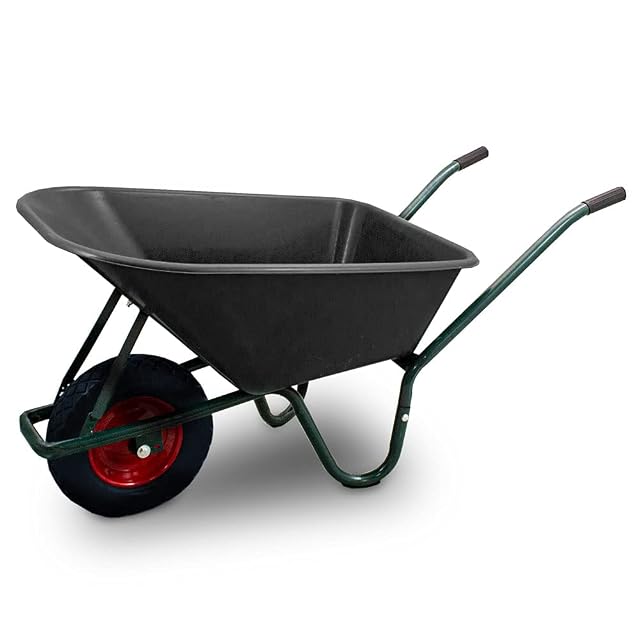
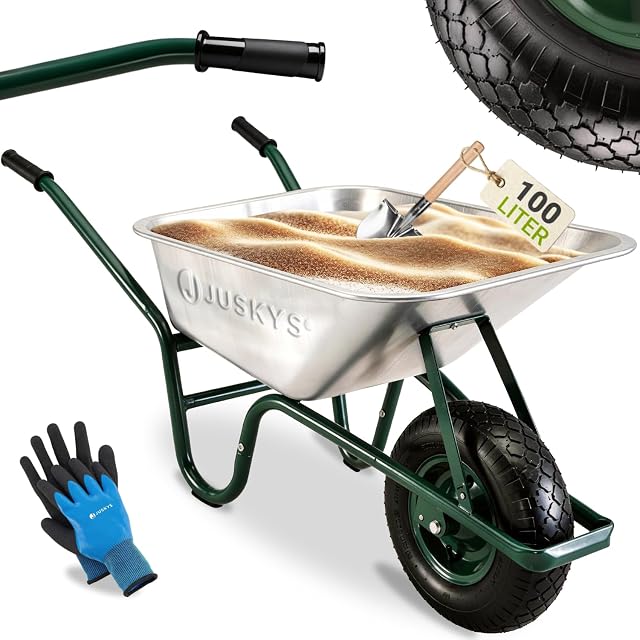
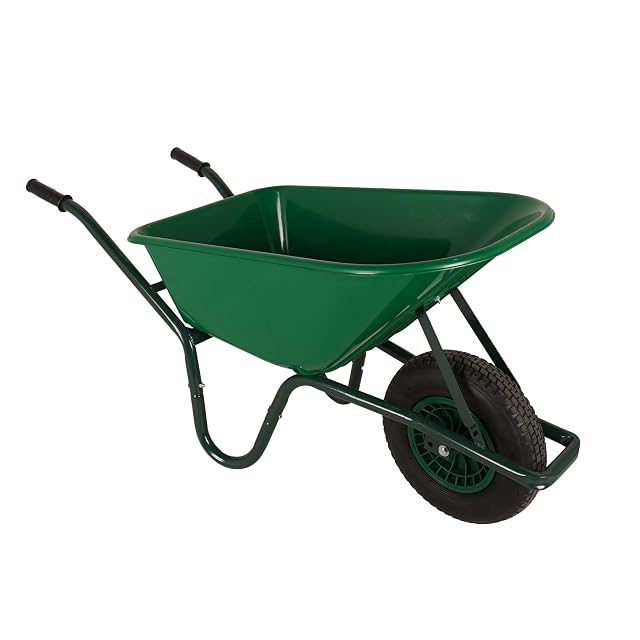
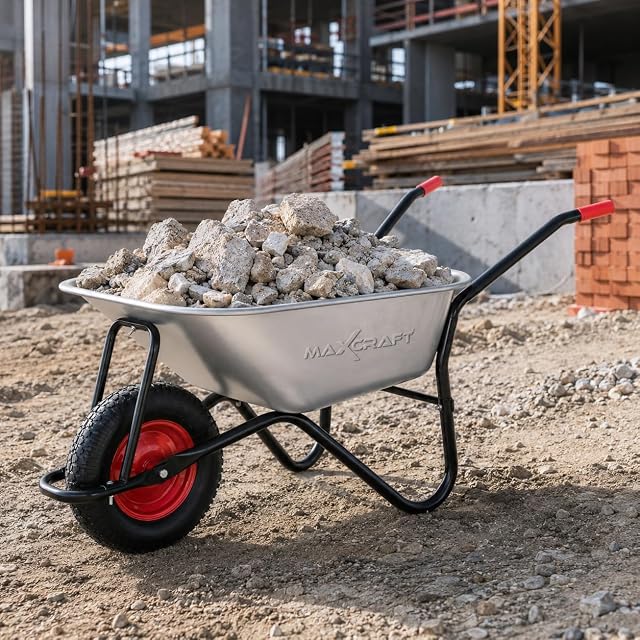
The only wheel on this shelf that cannot go flat
400 mm solid polyurethane on a steel rim.
Five of the seven barrows in this family run on pneumatic tyres. This is the
exception, and the listing calls it “almost indestructible”, which is a reasonable
description of the failure mode it removes.
Why a puncture is worse on a barrow than on a bicycle
Not because it is harder to fix. Because of when it happens.
A barrow tyre goes down while the barrow is standing in a shed, and it is discovered on the
morning a tonne of topsoil has been tipped on the drive, or with a full skip hired for the
day.
And the causes are everything a garden contains: a rose or bramble thorn, blackthorn,
a screw in a load of rubble, a sharp stone under a gravel heap, and a rim pinch from
running over a kerb with a soft tyre.
One barrow on this shelf includes a spare inner tube in the box, which is the honest
acknowledgement of all that.
This one removes the problem. No tube, no valve, no pump, no repair, no seasonal
check.
And what it costs, which nothing here mentions
Cushioning.
That is the second job a pneumatic tyre does, and it matters more on a wheelbarrow than
almost anywhere.
Air is a spring. When a loaded barrow drops off a step, a kerb or the edge of a paving
slab, the shock goes into the air in the tyre and is released gradually.
Solid polyurethane does not compress meaningfully. The same shock passes straight into
the rim, the axle, the frame, the tub, and then into your wrists and
elbows.
With 100 kilos of gravel in the tub, that is not a small impulse. It is why builders’
barrows are traditionally pneumatic despite the punctures, and it is the reason this is a
trade rather than an upgrade.
Two consequences over time: your arms, over an afternoon of loads; and the tub’s
bolt holes, which are where a repeatedly shock-loaded tub eventually tears.
The 400 millimetres, which is the mitigation
The same diameter as the largest pneumatic wheel on this shelf, and larger than the
38 cm one.
Diameter does much of what air does, by a different route:
It rolls over obstacles instead of stopping at them — a lawn edge, a root, a paving
joint, a threshold. And rolling over an obstacle is a gentler event than being lifted over
it.
It sinks less into soft ground, because the contact patch is longer under the same
load. On grass, which is where garden barrows spend their lives, that is the difference
between crossing a wet lawn and cutting a line into it.
It rolls more easily. Rolling resistance falls as diameter rises.
So the choice on this shelf is not “solid and small against pneumatic and large”. It is
solid at 400 mm against pneumatic at 380 to 400 mm — the diameter is not the
compromise, the material is.
And a solid wheel at full diameter is always at full diameter, which a pneumatic at 1 bar
effectively is not.
The PVC tub
Named, and PVC is the third tub material on this shelf.
Across the family: two galvanised steel, one painted steel, two plastic,
and this PVC.
What it gains: it cannot rust.
Which is a bigger advantage than it sounds, because a barrow tub is scraped by a shovel
on every single use — a steel blade dragged along the bottom and up the front lip, dozens
of times per load. No coating survives it. Paint leaves bare steel holding wet soil;
galvanising leaves protective zinc; plastic and PVC have nothing to corrode.
What it loses: cold and sunlight. PVC goes brittle below freezing and chalky
under UV, and a barrow stored outdoors for five summers and then loaded with rubble on a
frosty February morning is the one that cracks at a bolt hole.
No wall thickness is published. One plastic-tub barrow on this shelf publishes about
3 mm, which is the figure that would settle how substantial it is.
The long handles
“Thanks to the long shafts an excellent lifting characteristic is ensured, which spares the
back and allows long effortless working.”
Mechanically correct. A wheelbarrow is a lever: the wheel is the fulcrum, the load sits
between the wheel and your hands, and longer handles mean less force at your hands to lift
the same weight.
Which is also why where you shovel the load changes how heavy it feels. Load towards
the front, over the wheel, and the handles carry very little; load towards the back and you
lift a share of the whole thing.
What handle length costs is room — a wider turning circle, and more space to park. No
overall length is published here; one barrow on this shelf publishes 142 cm, which
becomes its height when stood on its nose against a wall.
The 250 kg, unqualified
Like four other barrows here.
One product on this shelf publishes its rating as two figures: 150 kg dynamic and
250 kg static (not in motion).
Static is what the frame holds standing still. Dynamic is what it holds while being
pushed, tipped, run over a step and set down — the only condition a barrow is used in. On
the one listing that splits it, the gap is 40 per cent.
That distinction has extra force on this barrow, because a solid wheel transmits shock
rather than absorbing it — so the dynamic loads reaching the frame are higher than they
would be on the same barrow with air in the tyre.
For scale: 100 litres of wet soil weighs roughly 130 to 150 kg.
What goes unpublished
No dimensions. Not length, width or height — width being what decides whether a barrow
fits through a gate or a side passage. Two barrows on this shelf publish all three.
No empty weight. One publishes 11.2 kg. A steel rim with a solid polyurethane tyre
is heavier than a pneumatic wheel of the same size, and the figure is absent.
No frame tube size. Two barrows here publish theirs, at 3 cm and 33 mm, and the
frame carries the load in bending every time the handles are lifted.
Availability
Around 85 €, read at the German Amazon store on the day of the survey.
Nothing came back from the American, British, French, Italian and Spanish Amazon stores at all; the buy button there runs a search rather than opening an empty page.
Taken from Keepa on the day this page was last revised; stock and prices move without notice.
Prices quoted in this text were read on 26 September 2026. The live price is at the top of the page.