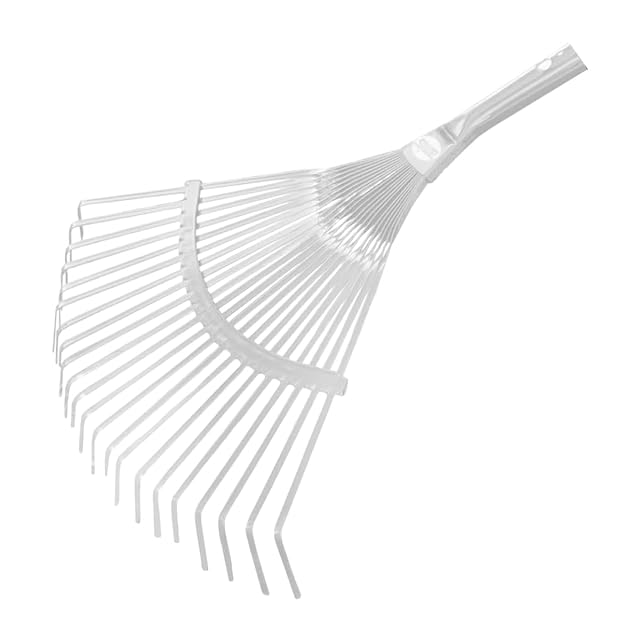
The only adjustable rake on this shelf
30 cm to 50 cm.
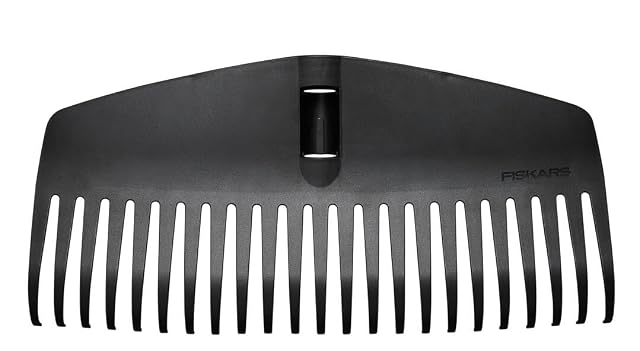
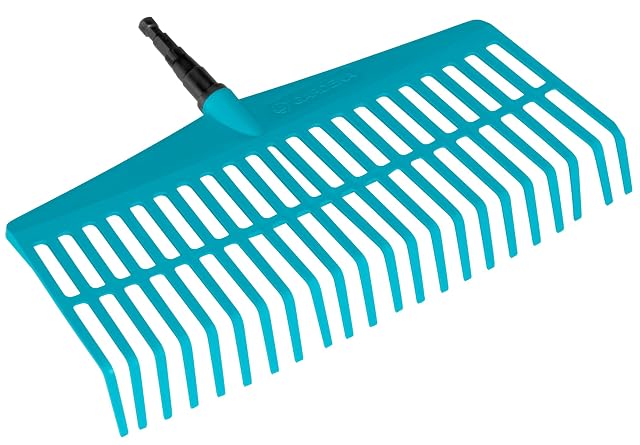
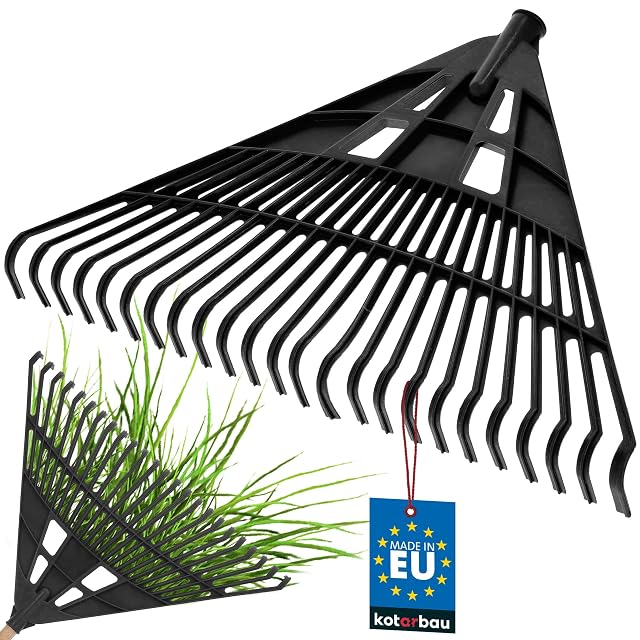
Every other rake here is a fixed width: 42, 43, 43.2, 61 and 78 cm, with one publishing
nothing.
And an adjustable fan rake is not a gimmick. It is the answer to a problem most people
solve by owning one rake and accepting it is wrong half the time.
Because a leaf rake needs two widths
Wide is for open lawn. A 78 cm head under a large tree covers well over twice the
ground per pull of a 30 cm one, and raking leaves is a job measured entirely in passes.
Narrow is for everything else in a garden: between shrubs, along a fence line, under
a hedge, around the edge of a bed, into the corner by the shed. A wide head simply does
not go there, and using one anyway is how bed edges get raked into.
And narrow is also for wet leaves. A wide head engages every tine at once, and in
heavy sodden leaves that load stalls the rake — the tines splay, the leaves ride over
the top, and nothing moves. A narrower bite gets it done.
One tool doing both, changed in the garden rather than in the shed, is a real
convenience.
What the adjustment changes besides width
The tines pivot at the head and fan out or close in.
So it is not only the width that changes — the spacing changes with it.
At 50 cm, the 22 tines are spread wide apart. That is a leaf rake: it passes over
grass and lifts loose material.
At 30 cm, the same 22 tines are much closer together. That grips harder, into the
surface rather than over it, which suits matted material — and it is the direction
that turns a leaf rake towards being a dethatcher.
For comparison, the dethatching rake on this site’s aerator shelf has 21 pairs of
spring steel tines across 43.2 cm — perhaps twice the density of this rake at its
narrowest.
So: two settings, two behaviours, and the narrow one is more aggressive on a lawn than
its width alone suggests.
The 30 mm socket, which is the honest fitting
“A 30 mm socket, compatible with wooden, plastic and telescopic handles.”
That single figure is worth more than any brand promise on this shelf, and it is worth
explaining why.
Five of the seven rakes here are heads without handles, and they divide by how
knowable the fit is:
A published socket diameter — this at 30 mm, another at 26 mm. Any handle of that
size fits. A tape measure in a shed settles it, and a replacement is a broom handle
from any hardware shop, in twenty years’ time.
A proprietary part number — one head on this shelf fits one named handle from its
own maker, and the listing states it is not compatible with that maker’s other
handle system.
A modular range — one head fits any handle in its manufacturer’s range and publishes
no diameter.
Or nothing at all — three heads on this shelf publish no fitting information.
A published diameter is the only one of those four that is independent of a company
still existing.
Galvanised steel, and the honest trade
What steel does that plastic cannot: move matted, wet, heavy material. Four rakes on
this shelf have plastic tines, and plastic under real load bends back — the tines
splay and the leaves slide over the top of the head.
What steel does that plastic will not: dig. On a soft wet lawn in November, a steel
fan rake pulled hard lifts grass crowns out with the leaves, and it scratches paving.
Galvanising is zinc, and it is why the tines do not rust. Zinc corrodes in
preference to the steel underneath, so a scratch does not become a rust spot.
What it does not survive is wear. The tine tips are the part in contact with the
ground, and they abrade — and an abraded tip is bare steel, which does rust. It is a
slow failure and it is the one this tool will eventually have.
22 flat tines is the other useful figure: flat rather than round means more edge
presented to the material and more stiffness in the pulling direction.
The fourth feature line
It says to place the head on a suitable door handle and adjust the tines — and calls
the socket a door stopper in the third line.
Both are translation errors for the handle, and they are reported here because the rest
of the listing is unusually well specified and it would be odd to print the figures
without noting the text they arrived in.
What goes unpublished
No weight.
Two rakes on this shelf publish one: 560 g and 360 g, both plastic.
A galvanised steel head with 22 flat tines and an adjustment mechanism is heavier than
either, and the figure is absent.
That matters because of where it sits: the head is at the end of a 1.5 metre lever,
held up by your shoulders, for an hour, in autumn. The weight at your hands is
multiplied by the geometry, and it is the number that decides when raking stops.
Availability
From 14 € to 19 €, that being the spread across the German, French and Spanish Amazon stores on the day of the survey.
Beyond the euro zone, the American and British Amazon stores price it in their own currencies, which the spread above sets aside.
More than 1.6× the cheapest country at the Italian Amazon store; a gap of that size normally means forwarded stock rather than a seller on the ground, so the spread above leaves it out.
Taken from Keepa on the day this page was last revised; stock and prices move without notice.
Prices quoted in this text were read on 26 September 2026. The live price is at the top of the page.