Five feature lines, and four of them are facts
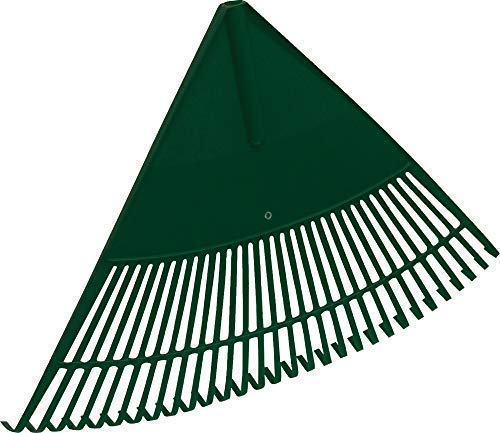
In full: Leaf rake. Material: plastic. 30 tines. Working width: 78 cm. Colour:
green.
No adjectives. No philosophy. No claims about premium quality, longevity or the
manufacturer’s family history — which two other listings on this shelf spend a fifth of
their description on.
It is a thin listing and it is not an empty one, because two of those four facts are the
two that matter most.
78 centimetres
The widest rake on this shelf, and by a clear margin.
The widths here run 30, 42, 43, 43.2, 50, 61 and 78 cm, with one rake adjustable
and one publishing nothing.
Against the 61 cm head: about 28 per cent more ground per pull.
Against the 42 cm heads: about 86 per cent more.
And raking is a job measured in passes
That is why width is the headline figure rather than a detail.
Clearing leaves off a lawn is not a task with a difficulty; it is a task with a
quantity. The leaves have to be moved from wherever they are to wherever they are
going, and the tool’s width sets how many pulls that takes.
Under a mature lime, a beech or a plane tree — which is where most of a season’s leaves
actually land — the difference between 42 cm and 78 cm is the difference between two
afternoons and one.
30 tines across 78 cm
The second useful fact, because a count and a width together give the spacing:
roughly 26 mm between tines.
That number is what identifies the tool.
Wide spacing — 18 to 26 mm — is a leaf rake. The tines pass over the sward and
lift loose material off the top of it. Two other rakes on this shelf that publish a
count work out in the same range: 23 tines across 42 cm, and 22 across an adjustable
30 to 50.
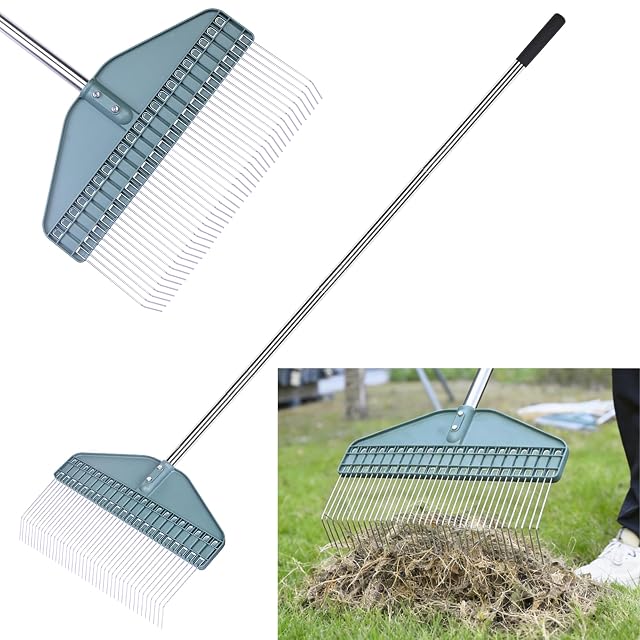
Close spacing, in stiff steel, is a dethatching rake. This site’s aerator shelf
carries one with 21 pairs of spring steel tines across a 43.2 cm head — roughly
twice the density, in steel, with a hooked profile, and designed to dig into the mat
of dead material between the green grass and the soil.
Same family of shape, opposite intentions. This is a leaf rake, and the spacing proves
it rather than the name.
The honest cost of a wide head
It will not go between things.
A 78 cm fan cannot work along a fence line, between shrubs, under a hedge, or into the
corner by the shed. Used there anyway, it rakes the bed edge along with the lawn.
And it loads all thirty tines at once.
In heavy sodden November leaves that is the failure mode: a wide plastic head splays
under the load, the leaves ride over the top of it, and nothing moves. The remedy is
narrower bites — which gives back exactly the width advantage that was the reason to buy
it.
So 78 cm is the right tool for dry leaves on open lawn and the wrong one for a small
enclosed garden, and it is the wrong one for wet matted material.
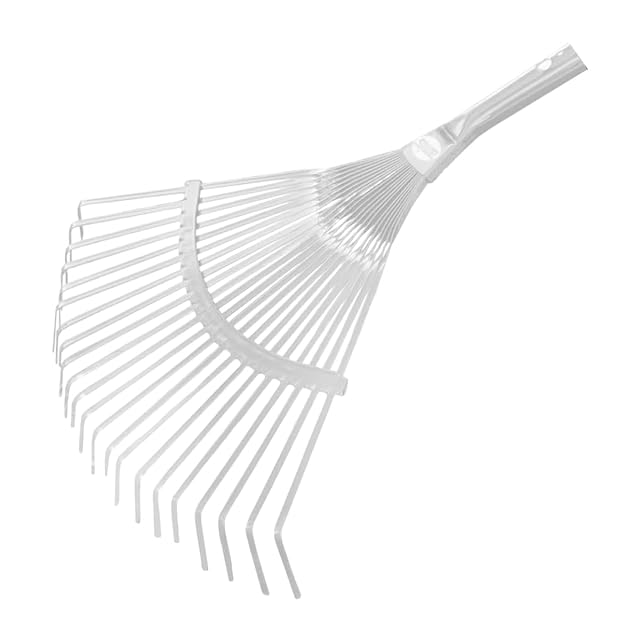
One rake on this shelf answers that with an adjustable width, 30 to 50 cm. Two are
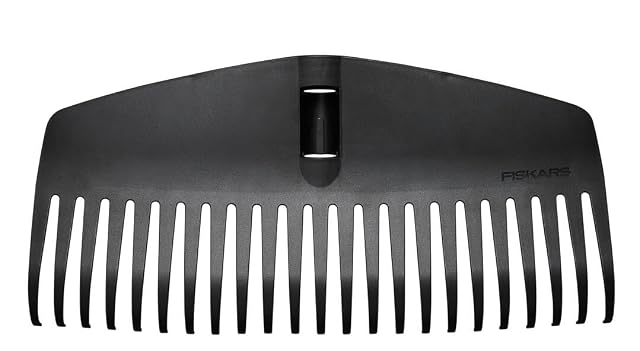
fixed at 42 and 43 cm, which is the narrow-garden choice.
What goes unpublished, and one of the gaps is the important one
Nothing about the handle.
Five of the seven rakes on this shelf are heads without handles, and two of those
publish a socket diameter — 30 mm and 26 mm — which is the only figure that tells
you whether a handle you own will fit. One requires a specific proprietary handle, and
one fits a whole modular range.
This listing does not say whether a handle is included, whether there is a socket, or
what diameter it is.
On a 78 cm head that is a larger problem than usual, because a wide head puts more
leverage through the joint than a narrow one. A loose socket on a 42 cm rake rattles; on
a 78 cm rake it splits.
No weight.
Two rakes on this shelf publish one — 560 g for 42 cm and 360 g for 61 cm — and
this is the widest head in the family.
That matters because of where the mass sits: at the end of a 1.5 metre lever, held
up by your shoulders, for an hour. The weight at your hands is multiplied by the
geometry, and on the widest head on the shelf it is the figure a buyer most wants.
The 61 cm rake here manages 360 g, which sets a benchmark this one is not measured
against.
Availability
Around 20 €, read at the German Amazon store on the day of the survey.
Listed and unsold: the British, French, Italian and Spanish Amazon catalogues hold the reference with nobody behind it.
Nothing came back from the American Amazon store at all; the buy button there runs a search rather than opening an empty page.
Taken from Keepa on the day this page was last revised; stock and prices move without notice.
Prices quoted in this text were read on 26 September 2026. The live price is at the top of the page.