The two things this listing gets right
A 1 cm folded top edge, published as a dimension.
Robot mower compatibility, stated as a function.
Neither appears anywhere else on this shelf in that form, and both are worth more
than the adjectives around them.
The fold, and why the dimension matters
Three products on this shelf address the sharp top edge of a thin steel sheet. Two
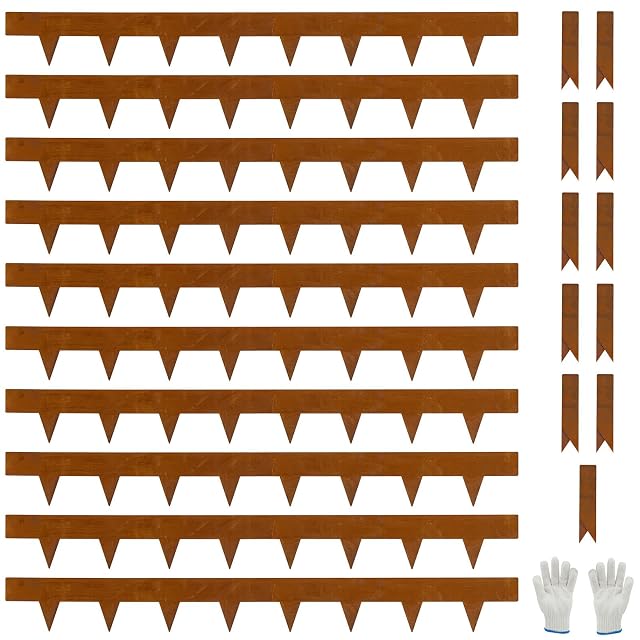
describe a hem or a protective edge without measuring it, and three supply gloves
— which is an admission rather than a solution.
This publishes the figure: 1 cm, folded (gebördelt).
That single centimetre does two jobs.
It removes the cut edge. A sheared 0.6 mm steel edge standing at ankle height in
a garden, for twenty years, next to a lawn children walk on. Folding it back makes
the exposed surface a rounded double thickness instead.
It stiffens the whole sheet. This is the part people miss. A thin upright sheet’s
resistance to bending comes almost entirely from its top edge, because that is
the part furthest from the ground and under the most stress when the sheet is pushed
sideways. Doubling the material there is worth far more than doubling it anywhere
else.
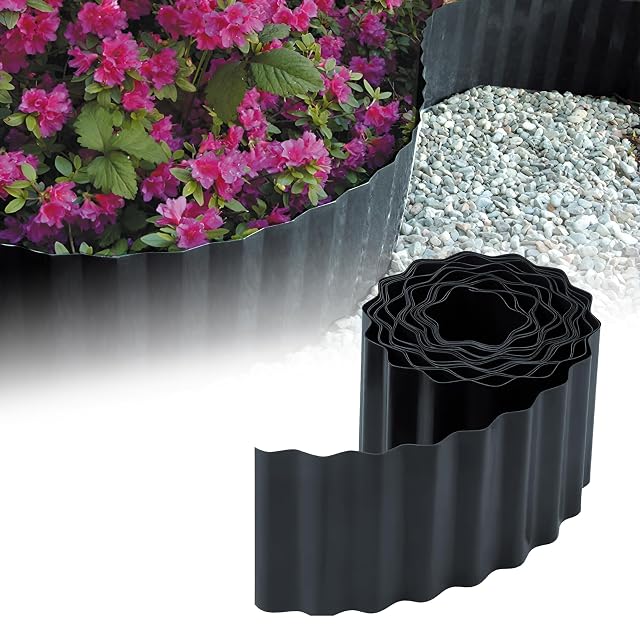
It is the same principle as the dimpled panels on this site’s rain barrel shelf and
the corrugation on the plastic edging here: on thin material, form beats
thickness.
The listing calls it “ideal for family gardens”, which is the right framing.
Robot mower compatibility, which is a real claim
This is the second product on this shelf to say something functional about mowing —
the other states that mower wheels can run along it.
Five products here are bed borders sold under the name lawn edging. They stand
proud, and the mower cannot reach the grass against them, so a strip still has to be
trimmed by hand along the whole run.
A mowing edge is set at or near lawn level so the machine cuts right up to it.
For a robot that distinction is sharper than for a push mower, because a robot
has no operator to steer it into a corner. It works to a boundary and then turns, and
the result on most lawns is a permanent fringe of longer grass around every edge —
against fences, walls, beds and borders.
A low edging (14 cm, with most of it buried) set so the blade passes over it is
what removes that fringe. It is the single most useful thing an edging can do on a
robot-mown lawn, and only this listing says it.
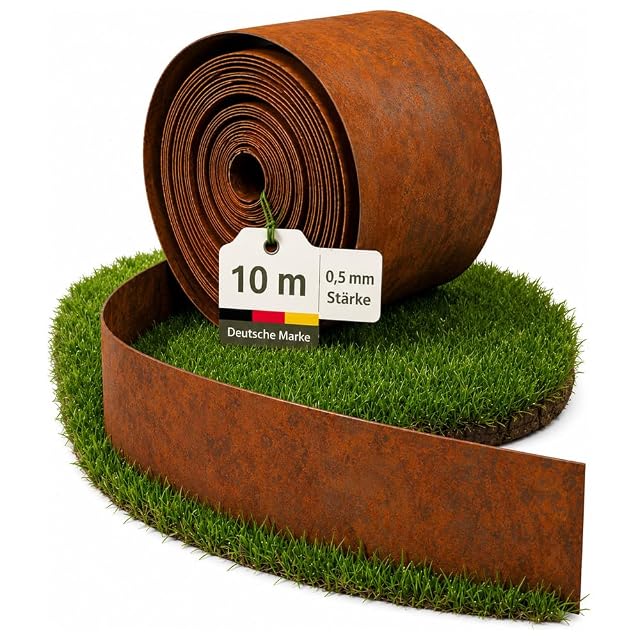
Corten, and the schedule it comes with
Four products on this shelf are weathering steel, and three describe the patina
differently.
What Corten is: steel alloyed with copper, chromium, nickel and phosphorus so
that its rust forms a tight, adherent layer rather than a flaking one. The oxide
seals the surface and corrosion effectively stops. The rust is the protection, and
that is why it is never painted.
What to expect: a grey-brown blotchy sheet on delivery, and an even orange-brown
after months of alternating wet and dry weather. Two other Corten products on
this shelf are supplied pre-rusted to skip that stage.
And what no Corten listing here mentions: while the patina forms, rain carries
iron oxide off the surface and downwards. On pale paving, render, limestone or
light gravel that stains — the same chemistry this site’s moss killer shelf warns
about, where iron treatments mark concrete permanently.
Against grass, dark soil or bark mulch it does not matter. Alongside a pale patio,
the galvanised edging on this shelf is the one that will not mark it.
The installation, described
“Quickly laid without special tools. Tap in with a rubber mallet and extend as
needed.”
That is more than most of this shelf offers, and the rubber mallet is the correct
specification: a steel hammer on a 0.6 to 0.7 mm top edge buckles it, and buckling
the fold destroys the thing that makes the sheet stiff.
The practical addition the listing does not make: water the line the day before
in dry weather. Dry summer clay will not take a steel edging tapped by hand, and the
temptation is to hit it harder. This site’s aerator shelf carries the same advice for
the same reason — one listing there is the only product on that shelf to say that
watering first is what makes a hand tool reach depth.
The seven feature lines
Two of them are fragments: one reads “High-quality material &” and another reads
“Stable &”, with the text that should follow them appearing as separate bullets.
An HTML ampersand has broken the list into pieces.
It is reported here because this page’s job is to describe what was published, and
because the substantive content — the 1 cm fold, the mallet, the robot compatibility
— survives the formatting and is better than most of this shelf.
What goes unpublished
No sheet thickness.
The fold is measured; the material is not. Two products on this shelf publish a
gauge — 0.7 mm galvanised and 0.6 mm Corten — and it is what decides whether
a run holds a clean line or follows every hollow in the ground.
A 1 cm fold on thin sheet is stiffer than a flat edge on thicker sheet, so the fold
partly compensates. It does not substitute for the figure.
No fixing pegs. The mallet is the method; nothing anchors it afterwards. Two
products on this shelf supply ground clips or pins.
About 4.70 € per metre
Mid-shelf for Corten, where the four runs come to about 3.83 €, this 4.70 €, 5.00 €
and 6.32 € per metre.
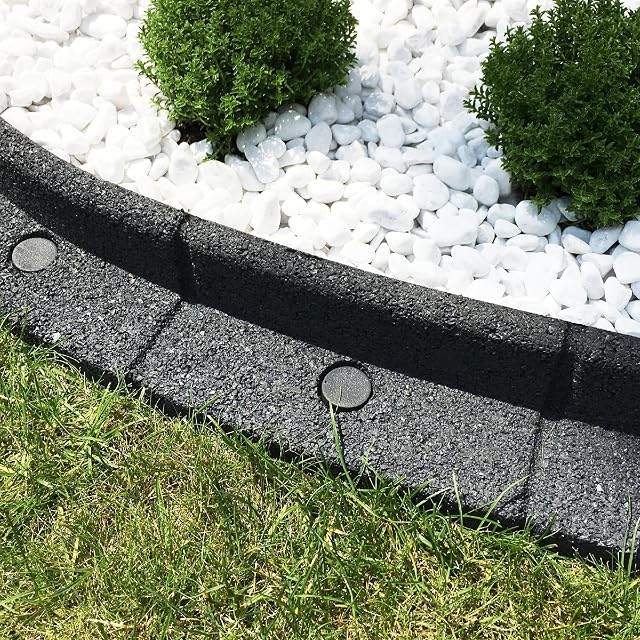
Galvanised steel here is about 3.10 €, plastic about 1.11 €, and recycled rubber
about 15.00 €.
Availability
Around 47 €, read at the German Amazon store on the day of the survey.
More than 1.6× the cheapest country at the French and Italian Amazon stores; a gap of that size normally means forwarded stock rather than a seller on the ground, so the spread above leaves it out.
Listed and unsold: the British and Spanish Amazon catalogues hold the reference with nobody behind it.
Nothing came back from the American Amazon store at all; the buy button there runs a search rather than opening an empty page.
Taken from Keepa on the day this page was last revised; stock and prices move without notice.
Prices quoted in this text were read on 26 September 2026. The live price is at the top of the page.