The cheapest square metre on this shelf
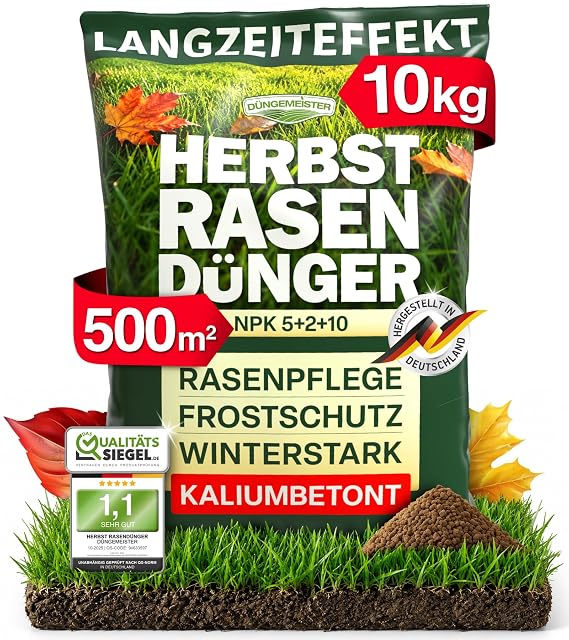
10 kg. 20 g/m². Up to 500 m².
Those three numbers are consistent — 10,000 grams divided by 20 is exactly 500 —
and they work out at about 0.056 € per square metre.
Across this shelf the range runs from about 0.055 € to about 0.24 € per
square metre. A factor of more than four.
And the ordering has very little to do with the price on the bag. One 20 kg bag
here costs considerably more than another and covers twice the area, because its
rate is 20 g/m² rather than 40 to 45 — so the dearer bag is the cheaper square
metre.
Price per bag is the least informative figure in this family.
What “maintenance feeding” implies
The rate is given as “only 20 g/m² for maintenance feeding”.
That phrasing carries a second rate that is not published. Maintenance means
a lawn already in reasonable condition; a lawn being brought back, or a new
lawn, normally takes more.
So 500 m² is the coverage at the lower of two doses, and the higher one is
absent. On a shelf where rates run from 20 to 45 g/m², that is not a small gap.
The feature line that explains the nutrients
The listing spends a whole line on what each element does: nitrogen for deep
green, growth and regeneration; phosphorus for root growth and energy supply;
potassium for cell structure, resistance, and protection against frost, disease
and stress.
All of that is accurate.
None of it is an analysis.
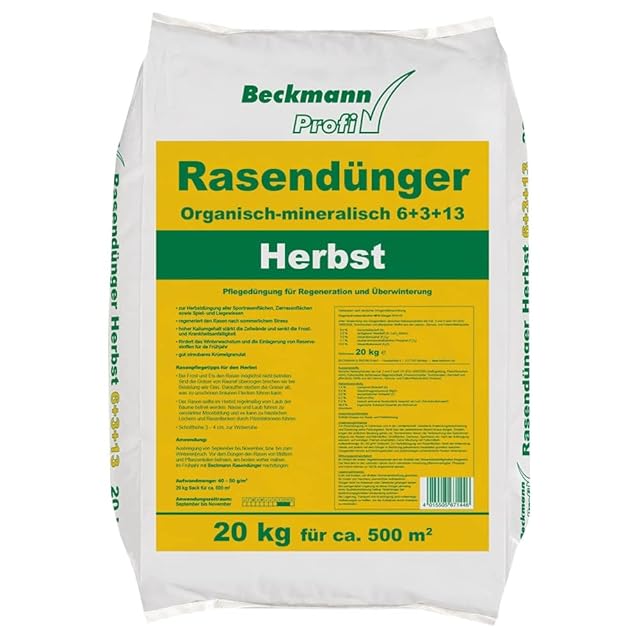
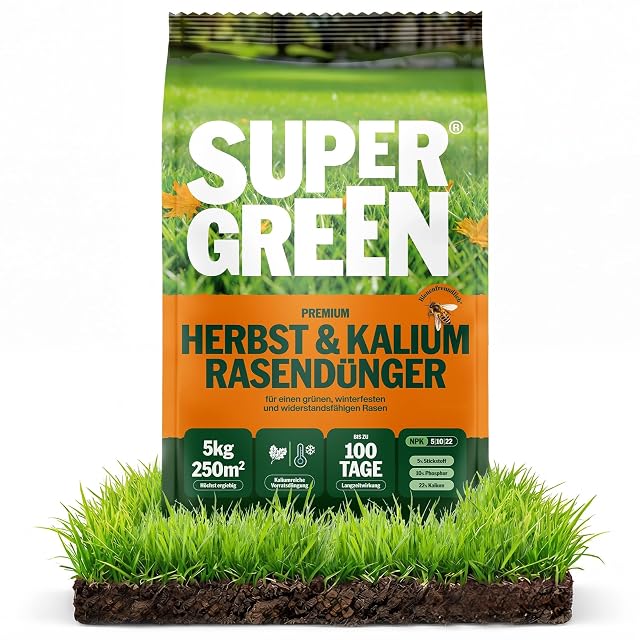
Two products on this shelf publish actual figures — 5-10-22 and 6+3+13 —
and on those two it becomes possible to work out what the potassium costs: about
23.18 € and 11.86 € per kilogram of K₂O, a factor of two.
Explaining what potassium does, at length, while not saying how much is in the
bag, is the characteristic move of this shelf. Five of seven products do it.
And the claim this page will not carry
“Perfect protection against mould and diseases” — and that the formula activates
the soil’s microbial activity, producing enormous soil improvement over winter.
Potassium genuinely does reduce a lawn’s susceptibility to frost damage and to
some fungal problems, by thickening cell walls. That is the mechanism the whole
shelf is built on and it is real.
“Perfect protection” is not a description of it. Snow mould in a wet mild winter
happens on well-fed lawns too, and a fertiliser is not a fungicide.
This page reports the claim as published and states the mechanism rather than the
superlative.
What an autumn feed is for, and when it is the wrong bag
All seven products on this shelf are autumn feeds, which the shelf name does
not say.
That means low nitrogen, high potassium, and it is a deliberate inversion of
a spring feed.
Nitrogen makes leaf. Soft leaf going into winter is what frost burns and what
fungal disease colonises, so an autumn feed keeps nitrogen low on purpose.
Potassium thickens cell walls, which is what “winter hardiness” means in
practice.
Applied in April, an autumn feed will not damage a lawn and will not green it
either. The spring product is a high-nitrogen feed and it is not on this shelf.
What goes unpublished
No NPK. No granule size — one product here publishes 2 to 5 mm, and it is
what a spreader is set for; this site’s spreader shelf has one machine that maps
its settings to fine seed, medium fertiliser and coarse grit, and the granule
decides which.
No duration. Two feeds on this shelf state 100 days and three months
respectively; this says “long-term action” and gives no period.
Availability
Around 28 €, read at the German Amazon store on the day of the survey.
Nothing came back from the American, British, French, Italian and Spanish Amazon stores at all; the buy button there runs a search rather than opening an empty page.
Taken from Keepa on the day this page was last revised; stock and prices move without notice.
Prices quoted in this text were read on 26 September 2026. The live price is at the top of the page.