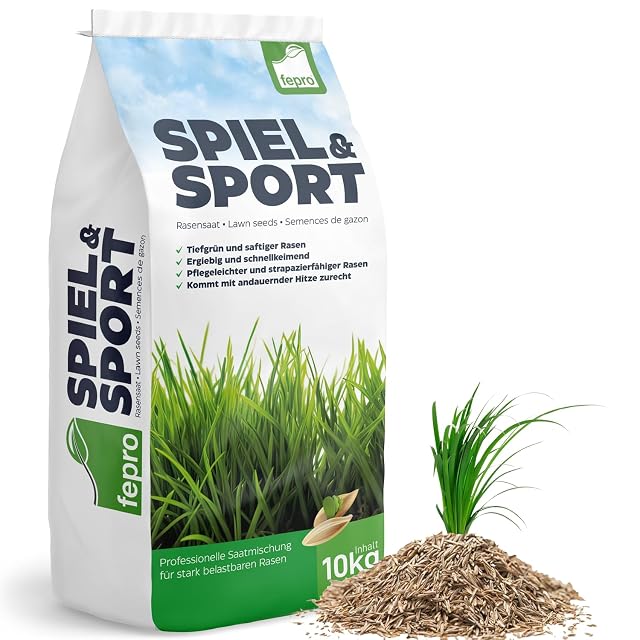
The cheapest seed on this shelf
About 4.40 € per kilo. About 0.11 € per square metre.
Across this family those figures run up to 15.87 € and 0.40 € — a factor
of 3.6 either way, and the ordering follows pack size almost exactly:
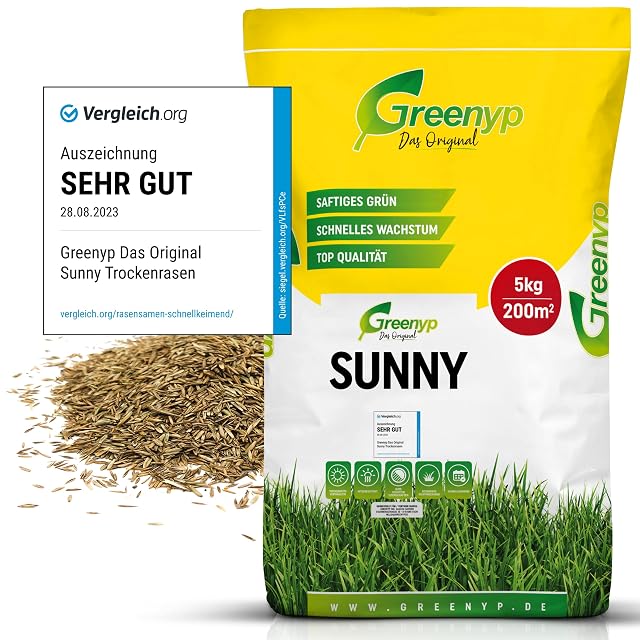
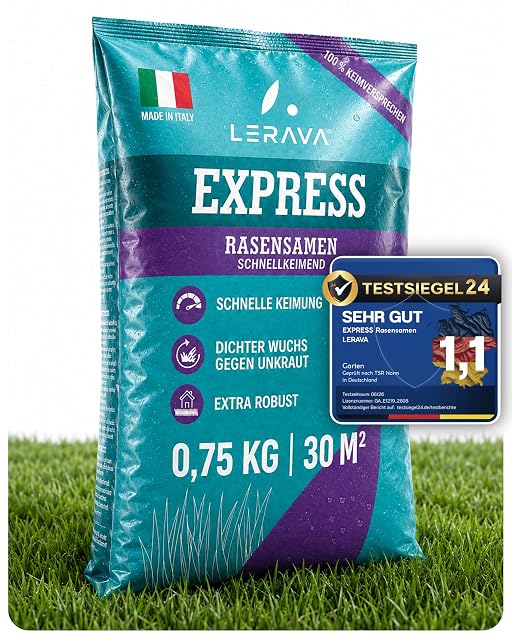
0.75 kg → 15.87 €/kg. 1 kg → 12.70. 2.6 kg → 8.84. 5 kg → 5.78. 10 kg → 4.40.
That is the ordinary economics of bagged goods. The sack, the printing, the
handling and the shelf space cost much the same whatever weight goes in.
And the reason not to buy it anyway
Grass seed does not keep indefinitely.
Stored cool and dry it holds its germination for a year or two, and declines
gradually after that. Stored in a shed through two summers and two winters, in a
bag that has been opened, it declines faster.
Ten kilograms at 25 to 30 g/m² is 300 to 400 square metres of lawn. If the lawn
is 80 m², this sack is four years of overseeding — and the fourth year’s seed is
not the seed you paid for.
The saving per kilo is real. It is only a saving on seed that actually gets
sown.
So this is the right purchase for a new lawn, for several hundred square
metres, or for a garden that genuinely overseeds a large area every spring. For
a patch by the gate, the small bags on this shelf are dearer per gram and cheaper
in total.
The rate, stated as a range
25 to 30 g/m², and the listing gives it explicitly rather than leaving it to
be divided out.
A range is the honest form, because the correct rate depends on what the seed is
landing on.
Bare soil, new lawn: the top of the range. Nothing is competing, every seed
has a chance, and a dense sowing closes the surface before weeds find it.
Overseeding existing turf: the bottom, or less. Most of the seed will land on
grass rather than soil and will never germinate — and more seed does not change
that. What changes it is scarifying first so the seed reaches ground.
At 10 kg the difference between the two ends of the range is 100 square metres of
lawn, which is worth getting right.
Ten degrees, and April to September
Both published, and together they are the most complete sowing guidance on this
shelf.
10 °C soil temperature is the gate. Two other bags here agree; a third says
8 °C. Below the threshold seed does not germinate — it waits, in cold wet ground,
available to birds and liable to rot.
April to September is the calendar version of the same thing, and it is
sensible: it excludes March, which is often too cold, and October, which is
warm enough to germinate but not warm enough to establish a seedling before
frost.
The proxy for anybody without a soil thermometer: when the existing lawn starts
growing and needs cutting, the soil is warm enough.
The illustrated guide
“Every pack contains an illustrated German instruction sheet for laying out your
lawn optimally.”
Nothing else in this family mentions any instructions at all, and for a 10 kg
sack aimed at a new lawn it is the right thing to include — because sowing a lawn
badly is easy and the mistakes all happen before the seed goes down.
Levelling, firming, and then not letting the seedbed dry out for two weeks are
what decide the result. This site’s lawn roller shelf covers the firming step, and
this shelf’s own repeated lesson is the watering one: a finished lawn can survive
a dry fortnight, and germinating seed cannot survive a dry afternoon.
The two identical listings
This product and another 10 kg sack on this shelf share:
The same title, word for word, including the same claimed coverage.
The same five feature lines, word for word.
The same price in all four markets where both are priced.
Barcodes with the same GS1 company prefix.
Those are observations, not conclusions, and this page will not draw one. The
practical consequence is simply stated: reading both listings gives you one set of
claims twice, and the price is the same either way, so there is nothing to choose
between them on anything published.
What goes unpublished
The species mix.
Six of the seven bags on this shelf omit it, and this is one of them. “A proven
premium mixture of grass varieties” names nothing.
For a sport and play mix, the expected answer is ryegrass-heavy — it is the
grass that takes wear — with meadow grass to knit the sward together over time.
One bag on this shelf publishes exactly that ratio, 90 % and 10 %, and it is the
only page in this family where the claims on the packet can be checked against
what is in it.
Availability
From 44 € to 55 €, that being the spread across the German, French, Italian and Spanish Amazon stores on the day of the survey.
Listed and unsold: the British Amazon catalogue holds the reference with nobody behind it.
Nothing came back from the American Amazon store at all; the buy button there runs a search rather than opening an empty page.
Taken from Keepa on the day this page was last revised; stock and prices move without notice.
Prices quoted in this text were read on 26 September 2026. The live price is at the top of the page.