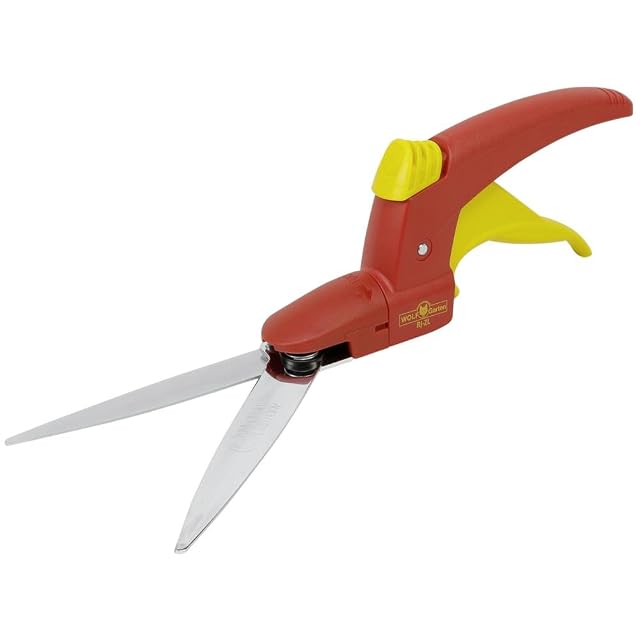
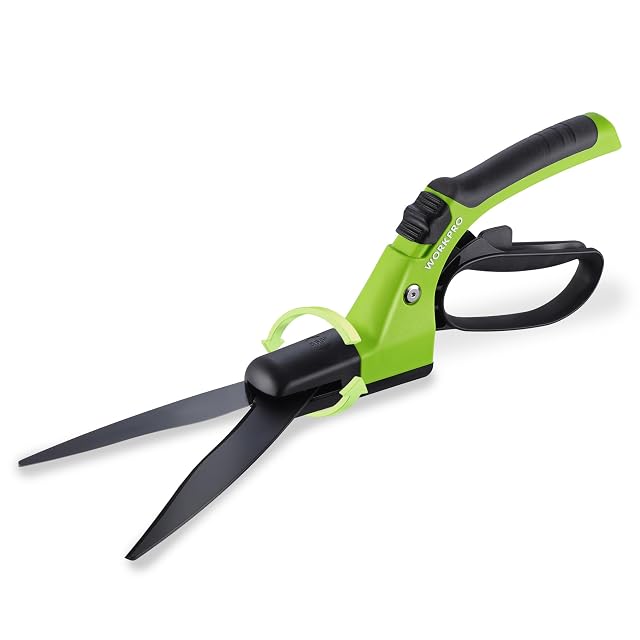
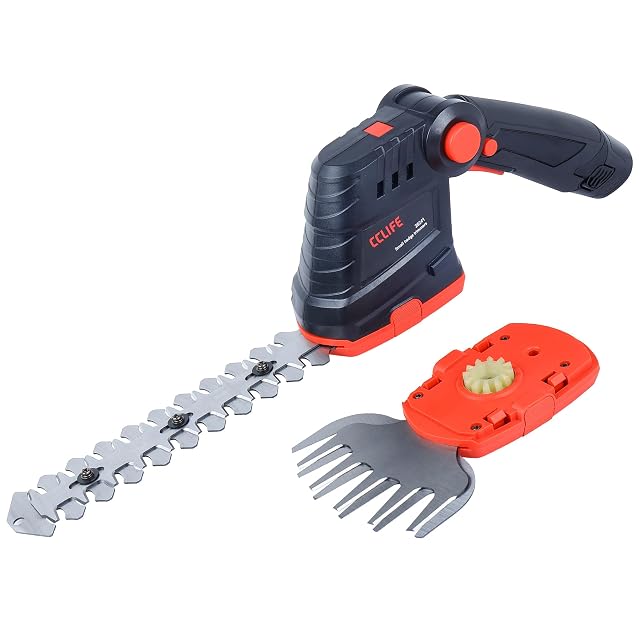
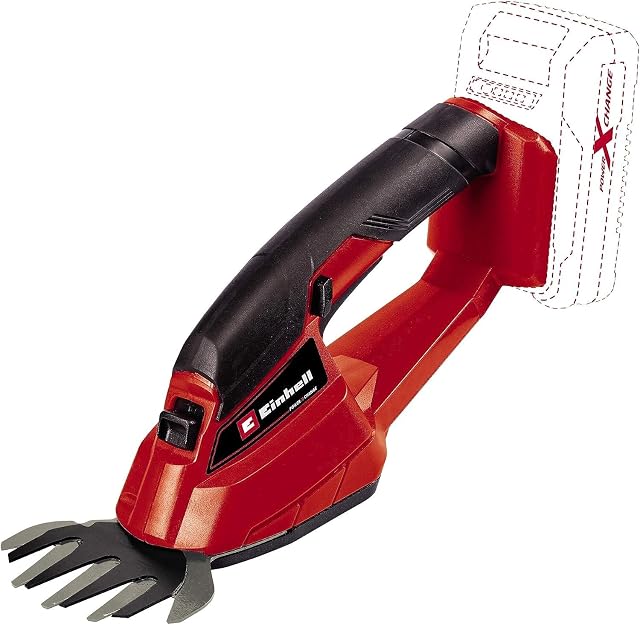
What it says it is for, and why that is the right claim
Four feature lines, and two of them are about access:
“Lawn edge care in hard-to-reach places.”
“Suitable for cutting at walls.”
That is the honest purpose of a hand grass shear, and it is worth stating plainly
because nothing else does the job.
The strip along every wall
Every lawn has a boundary it cannot be mown to.
A mower cannot put its deck against a wall — the housing is wider than the blade
circle, and the wheels have to be on the grass.
A strimmer reaches it and damages what it touches. Nylon line at speed against
render leaves grey scars, against paint it strips it, against a fence post it shaves
the wood, and against a tree trunk it rings the bark and can kill the tree.
A robot mower turns away at its boundary, which is why robot-mown lawns have a
permanent fringe of longer grass around every edge — a problem one product on this
site’s lawn edging shelf specifically addresses.
So the last few centimetres against a wall, a kerb, a fence or a tree are hand-shear
work, and they always will be.
180 degrees, and why that is enough
The head rotates through a half circle.
One shear on this shelf offers 360° in 16 locked positions, and two offer none.
The range needed is smaller than either number suggests. A shear has to go from
horizontal — taking a strip off the top of the grass — to vertical, cutting
down the face of an edge. That is 90°.
A hundred and eighty degrees covers it in both directions, which matters when the
wall is on your left rather than your right.
What the 360° tool adds is not reach but increments: 16 stops, 22.5° apart, so
there is always a position close to an awkward angle. Useful around a tree; not a
different capability.
The 20 per cent
“20 % less force needed thanks to improved mechanics.”
This page reports it and does not adopt it.
What is missing: the comparison. Twenty per cent less than an earlier model of the
same shear? Than a competitor? Than an unsprung shear? And measured how — peak force,
average force, force to cut a specified stem?
None of that is stated, which makes it a marketing figure rather than a measurement.
What is plausible: the mechanism. A shear’s effort depends almost entirely on
pivot geometry — where the fulcrum sits relative to the handle and the blade, and
how the blade faces are ground. Moving a pivot a few millimetres genuinely changes the
force at the hand by a noticeable fraction, and manufacturers do redesign them.
So the claim is the right kind of claim, made without the evidence that would let
anybody check it.
Two other shears on this shelf approach the same problem differently: one with a
spring return, so the hand only ever pulls, and one with a two-finger grip
instead of a whole-hand squeeze.
What effort actually costs on this job
Worth setting out, because it is the reason all three approaches exist.
Edging twenty metres of lawn boundary by hand is several hundred cuts.
None of them is hard. The load is repetition, and repetition punishes the part of
the action that uses the weaker muscles — which, on an unsprung shear, is opening the
blades rather than closing them.
That is why a spring is worth more than a sharper blade on this tool, and why a
percentage off the closing force is a smaller gain than it sounds.
What goes unpublished
No cutting width. Four hand shears on this shelf and not one publishes a blade
width, while all three battery models do — 83 mm, 100 mm and 120 mm. The hand tools
publish overall lengths instead, and the two figures are not comparable.
No weight. One battery shear publishes 0.62 kg and it is the only figure in the
family.
No blade description. No grind, no serration, no coating — where one shear here
publishes a wave-ground non-stick blade, and another publishes coated steel.
No spring. Three of the four hand shears here have one in some form; this listing
does not say.
No skid plate. One shear on this shelf has one, and it is the only mechanism in the
family for holding a constant cutting height — which is what stops a hand-cut edge
coming out wavy and scalped.
Availability
From 30 € to 47 €, that being the spread across the German and Italian Amazon stores on the day of the survey.
Beyond the euro zone, the American Amazon store prices it in its own currency, which the spread above sets aside.
Listed and unsold: the British Amazon catalogue holds the reference with nobody behind it.
Nothing came back from the French and Spanish Amazon stores at all; the buy button there runs a search rather than opening an empty page.
Taken from Keepa on the day this page was last revised; stock and prices move without notice.
Prices quoted in this text were read on 26 September 2026. The live price is at the top of the page.