The widest blades on this shelf
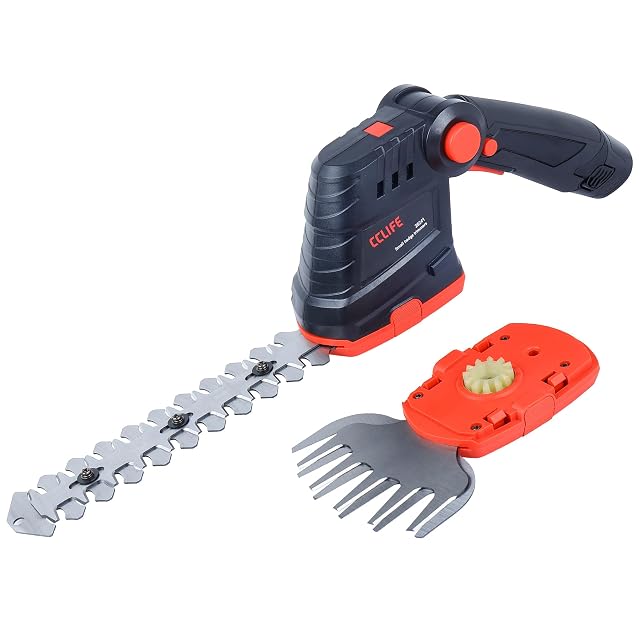
120 mm grass blade. 200 mm hedge blade.
Against the two other battery shears here: 83 / 140 mm and 100 mm grass only.
That is about 45 per cent more grass per pass than the narrowest, and on twenty
metres of lawn boundary it is a meaningful reduction in the number of strokes.
And the shortest runtime, published
15 to 20 minutes, from a 10.8 V pack, charging in about an hour.
The other battery shear on this shelf that publishes a runtime states 60 minutes,
from an integrated 1500 mAh cell at 7.2 V.
So this is a third to a quarter of that, and the two facts belong together rather
than separately.
Because width and runtime are the same trade
A wider blade moves more steel and cuts more grass on every stroke. Both draw more
current.
A higher voltage delivers more power, and drains a pack faster at the same capacity.
So the numbers on this shelf are internally consistent:
7.2 V, 83 mm, 60 minutes — the light, long-running tool.
10.8 V, 120 mm, 15–20 minutes — the wide, fast, short-running one.
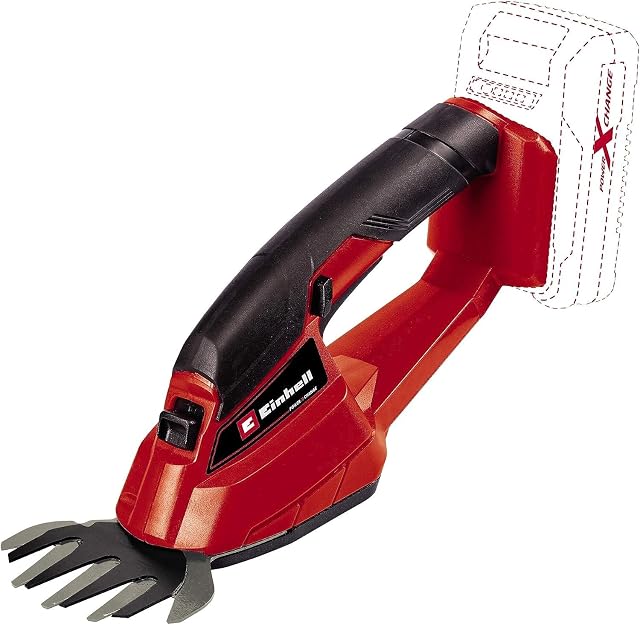
18 V, 100 mm, metal gearbox, runtime unpublished — the platform tool, whose runtime
depends on which pack is fitted.
None of the three is better. They are three different points on one curve, and this
listing is the only one that publishes both ends of its own trade.
What is missing to check it
No battery capacity.
The listing gives a voltage and a runtime and not the milliamp-hours, so the two
figures cannot be reconciled. The competitor that publishes 60 minutes also publishes
1500 mAh, which makes its claim checkable in a way this one is not.
The removable battery, which is the real advantage
“The battery is at the handle end and must be taken out of the device to charge. Please
note: the charger is not connected directly to the machine but to the removed battery.
Charging time about 1 hour, runtime about 15–20 minutes.”
That is an unusually specific description of a charging arrangement, and it cuts two
ways.
The advantage: a second pack turns 15 minutes into 15 minutes plus 15 minutes, with
a ten-second swap. On the competitor with an integrated cell, sixty minutes is the
session and then it is an hour of waiting — and when that cell ages, the whole tool is
finished. A removable pack is a spare part.
The inconvenience: the tool cannot be left on charge. The pack comes out, goes
indoors to the charger, and has to be remembered and put back. Anybody who has gone to
edge a lawn and found the battery on a kitchen worktop knows the failure mode.
It is also, incidentally, better for the cell. Lithium packs prefer being stored
indoors at moderate temperature and part-charged, rather than sitting in an unheated
shed through a winter.
The 200 mm hedge blade
The longest on this shelf, and it changes what the tool is for.
Two blades, two geometries, and the difference is not arbitrary:
A grass blade is short and wide with fine teeth. Grass is soft, slippery and comes
in hundreds of thin blades at once, so the blade grips many and takes a broad swathe.
A hedge blade is long with coarser teeth spaced further apart, to trap a single
woody shoot and shear it rather than push it away.
At 200 mm this is a genuine light hedge blade rather than a token one — enough for
box, lavender, a small privet, the top of a low hedge. The 140 mm blade on the
competitor is a shrub-tidying tool.
What it is not is a hedge trimmer. Nothing on this shelf is, and the 15 to 20 minute
runtime settles the question: a hedge is measured in hours.
What goes unpublished
No weight. One battery shear here publishes 0.62 kg, and it is the only weight
in the family, hand tools included.
On a tool held out at arm’s length and pointed down, weight decides how long a session
lasts — and with a 15 to 20 minute battery the session is short anyway, which is a
genuine mitigation.
No blade speed. One competitor publishes 1100 rpm.
No cutting thickness. One competitor publishes 8 mm, and on a tool with a 200 mm
hedge blade that is the figure a buyer would want most.
No gearbox material. One competitor names a metal gearbox, and that is the part
that fails on this kind of tool: a gear train taking shock loads every time a blade
meets a tussock, a stone or a kerb. Plastic gears wear their teeth round and the tool
whines without cutting.
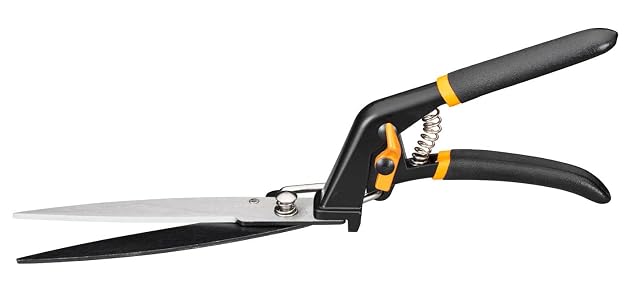
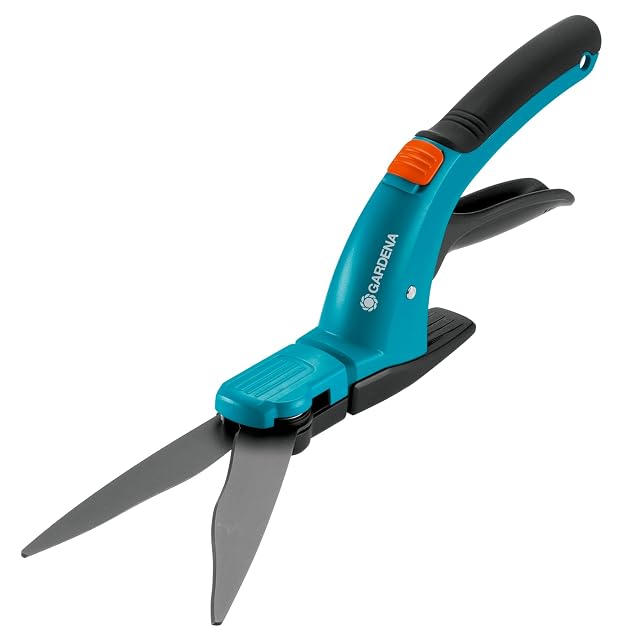
And no rotation, on any of the three battery shears here — where two of the four
hand shears offer 180° or 360°, which is what lets a blade cut a vertical edge against
a wall.
Availability
From 31 € to 38 €, that being the spread across the German, French, Italian and Spanish Amazon stores on the day of the survey.
Listed and unsold: the British Amazon catalogue holds the reference with nobody behind it.
Nothing came back from the American Amazon store at all; the buy button there runs a search rather than opening an empty page.
Taken from Keepa on the day this page was last revised; stock and prices move without notice.
Prices quoted in this text were read on 26 September 2026. The live price is at the top of the page.