Two different products share this shelf
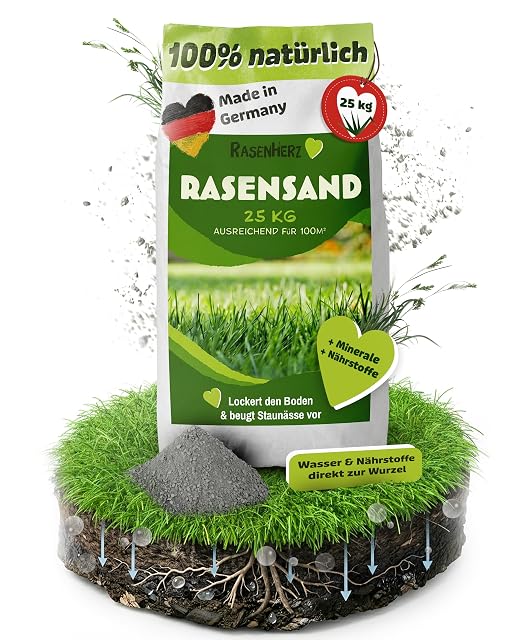
Three items here are lawn sand, sold by weight in 25 kg sacks.
Four are lawn soil — a compost-based substrate, sold by volume in 42 to 90
litre bags.
They are not alternatives. Sand opens a soil and drains it. Substrate feeds, holds
moisture and gives seed something to germinate in. A lawn being renovated usually
needs both, at different moments, and comparing a price per kilo against a price
per litre is meaningless.
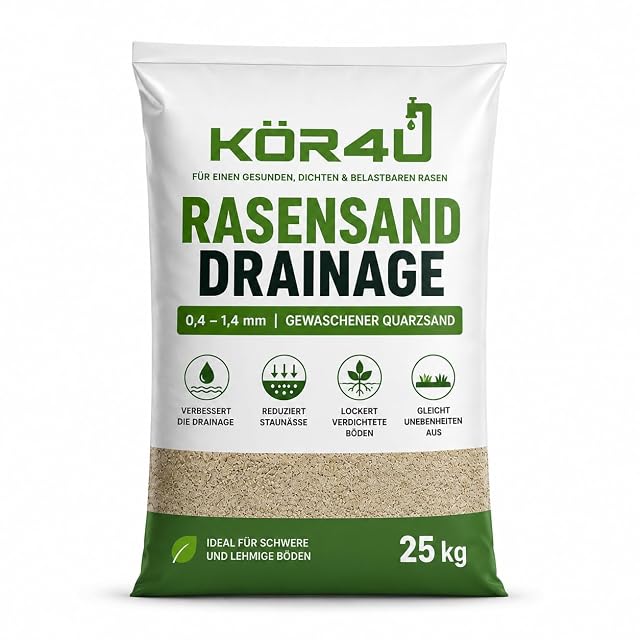
This is one of the sands.
The grain size is the whole specification
0.4 to 1.4 mm, washed quartz.
That figure is the only thing separating a lawn sand from a sand that will damage
a lawn, and two of the three sands on this shelf publish one.
Why a fine sand makes a clay lawn worse
This is the failure mode of the entire category, and it is worth being explicit
about.
Water moves through soil in the spaces between particles. A clay soil drains
badly because clay particles are minute and the spaces between them are minute
too, so water is held by capillary force rather than draining away.
The instinct is to add sand. The instinct is right only if the sand is coarse.
Coarse grains — the top of a 1.4 mm range — cannot pack closely. They leave
large pores that water moves through freely, and they hold the structure open
against compaction.
Fine grains do the opposite. They are small enough to fit into the spaces
between the clay aggregates, filling them rather than propping them apart. The
result is a denser, less permeable layer than the clay was on its own — which is
why builder’s sand mixed into clay is a classic way to make a lawn worse.
Add the silt and clay content of an unwashed building sand, and the sealing effect
is stronger again.
“Multiply washed, screened, fire-dried”
Three processes, and each removes a specific problem.
Washed takes out the silt and clay fines — the fraction that seals. This is the
single most important of the three.
Screened gives the grade its edges. A sand described as 0.4 to 1.4 mm has had
everything below 0.4 mm taken out, which is what makes the published figure mean
something.
Fire-dried makes it flow. Damp sand clumps, bridges in a spreader, and cannot
be brushed into aeration holes. Dry sand pours and works down into the sward.
That last one matters more than it sounds: 25 kg of damp sand is a wheelbarrow and
a shovel; 25 kg of dry sand can go through a drop spreader.
pH-neutral
Stated, and it matters for one specific reason.
Some sands are calcareous — crushed limestone, or a sea sand with shell fragments
— and they raise soil pH as they weather. On a lawn that is often not what is
wanted: moss thrives in acid conditions, and the usual cure for a mossy lawn
is to raise the pH, so a limy sand could be argued for.
But a lawn on chalk is already alkaline, and adding lime to it locks up iron and
turns the grass pale. Quartz is chemically inert and changes nothing, which makes
it the safe choice when you do not know your soil pH.
This site’s soil tester shelf is where that question gets answered — and one
product there measures pH by a chemical reaction rather than with a metal probe.
The timing, which decides whether it works at all
Straight after aerating or scarifying. The listing names both.
That is not a convenience, it is the mechanism.
Hollow-tine aerating leaves a field of open holes through the compacted layer.
Brush sand into those holes while they are open and each one becomes a permanent
vertical drainage channel — water gets from the surface past the pan, which is the
thing a compacted lawn cannot do.
Spread on an unaerated lawn, the same sand sits on the surface, gets mown up, and
achieves very little.
This site’s aerator shelf carries the tools for the first half of that job, and
one product there is the only hollow-tine aerator on it — the one that removes
cores rather than displacing soil, which is what leaves holes to fill.
What goes unpublished
No application rate.
That is the figure this shelf is most short of: two of the three sands here give
none, and the third gives 250 g/m² and 100 m² from 25 kg.
Rate matters because there are two very different jobs. A light top dressing
after aeration is a thin scatter brushed in. Levelling small hollows is
filling, locally, with as much as it takes.
Nothing here distinguishes them, and a 25 kg sack spread evenly over 100 m² is
about 250 g/m² — the figure the other product publishes — so that is the order of
magnitude for a dressing.
And one thing sand cannot do: feed a lawn. It is inert quartz. A thin lawn on
poor soil gets no nutrients from it, which is what this site’s fertiliser shelf is
for.
Availability
Around 15 €, read at the German Amazon store on the day of the survey.
Nothing came back from the American, British, French, Italian and Spanish Amazon stores at all; the buy button there runs a search rather than opening an empty page.
Taken from Keepa on the day this page was last revised; stock and prices move without notice.
Prices quoted in this text were read on 26 September 2026. The live price is at the top of the page.