The two numbers, and what they are for
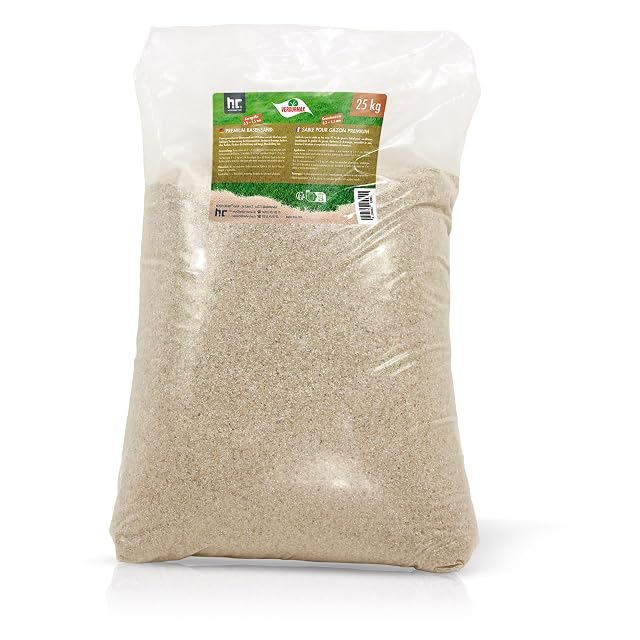
0.3 to 1.5 mm. About 97 % quartz.
Between them they are the whole specification of a lawn sand, and this is the only
product on this shelf that publishes the second.
Why the grade is the thing that matters
The failure mode of this entire category is adding the wrong sand to a clay
lawn and making it drain worse.
Water moves through soil in the pores between particles. Clay drains badly
because clay particles are minute and so are the spaces between them.
Coarse grains cannot pack tightly. They leave large pores that water moves
through, and they hold the structure open against compaction. That is the
mechanism.
Fine grains do the opposite. They are small enough to slot into the spaces
between clay aggregates, filling them rather than propping them apart, and the
result is a denser layer than the clay was alone.
So a lawn sand is defined by having the fine fraction taken out. Building
sand, which is unwashed and graded fine, is the thing that ruins lawns.
And this grade is the wider of the two here
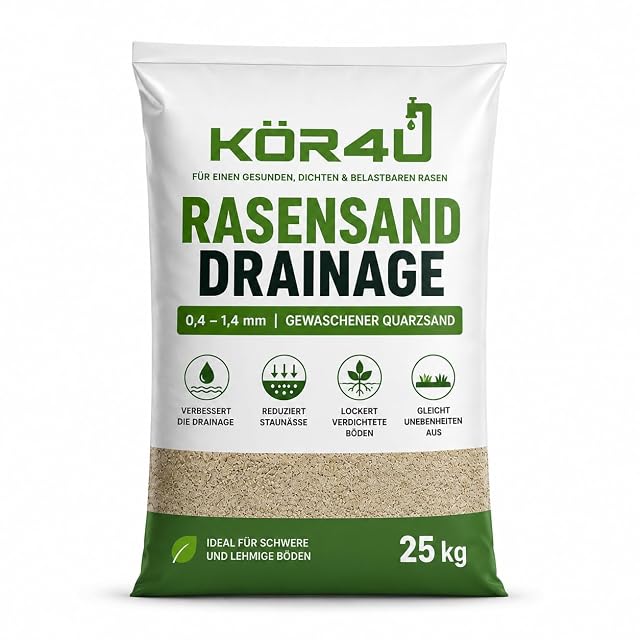
The other quartz sand on this shelf is 0.4 to 1.4 mm. This is 0.3 to 1.5
mm — coarser at the top and, more relevantly, finer at the bottom.
A grade that starts at 0.3 mm contains more fine material than one starting at
0.4. On a domestic lawn that difference is small and the sand will do its job. It
is not nothing, and the listing itself effectively acknowledges it.
“Not suitable for golf courses”
An unusual sentence, and it is the most informative thing in the listing.
Golf greens are top dressed to a tightly specified sand grade, with the
proportion of fines strictly limited and a narrow band of particle sizes — because
a green is a constructed rootzone where a few per cent of fine material changes
the infiltration rate measurably.
A 0.3 to 1.5 mm range is too broad for that, and the 0.3 mm end is the part that
would be excluded.
So the exclusion is not modesty, it is a specification statement in disguise: this
is a sand for lawns, overseeding, new lawns, turf, and sports and play
surfaces — which the listing names — and not for a constructed green.
A manufacturer narrowing its own market is worth more than any superlative, and
across this whole site it happens perhaps half a dozen times.
97 per cent quartz
Quartz is silica, and silica is chemically inert. It does not react, it does
not weather quickly, and it does nothing at all to soil pH.
The remaining 3 per cent — feldspars, micas, iron minerals, carbonate fragments —
is what a lower-purity sand has more of, and some of it does weather. Carbonate in
particular raises pH as it dissolves.
On a lawn that matters because pH is not a free variable. Grass wants roughly
6.0 to 6.5; below that moss gains the advantage, and above about 7 iron becomes
less available and the grass goes pale.
Nobody top dressing a lawn wants the dressing to move the pH in an unknown
direction, and 97 per cent quartz is a guarantee that it will not. The other sand
on this shelf makes the same point by declaring itself pH-neutral.
The listing’s claim, and it is worth separating the parts.
Waterlogging: direct and correct. Coarse sand worked into a compacted surface
opens drainage paths.
Moss: indirect and real. Moss colonises where grass is weak, and one of the
four common reasons grass is weak is poor drainage. Fix the drainage and the
moss has less advantage — which is the same argument one product on this site’s
moss killer shelf makes about feeding.
Thatch: indirect. Thatch builds up when organic matter accumulates faster than
soil organisms break it down, and waterlogged compacted soil has less biological
activity. Better drainage and aeration means faster breakdown.
None of the three happens from sand sitting on the surface. All three depend on
the sand getting into the soil.
Which means the timing, again
“Ideally combined with fertiliser or as a top dressing mixture.”
The listing is right about the combination and does not say the important part:
sand works when it goes into open holes.
Aerate first — hollow-tine for preference, so cores come out rather than soil being
displaced sideways — then brush the sand in while the holes are open. Each hole
becomes a permanent vertical drainage channel through the compacted layer.
Spread on an intact lawn, the same 25 kg sits on top and gets mown up.
This site’s aerator shelf carries the tools, and its one hollow-tine product is the
one that leaves holes to fill.
What goes unpublished
No application rate.
Two of the three sands on this shelf omit it. The third gives 250 g/m², and
25 kg spread at that rate covers 100 m² — which is the order of magnitude for a
light dressing.
Availability
Around 19 €, read at the German Amazon store on the day of the survey.
More than 1.6× the cheapest country at the French Amazon store; a gap of that size normally means forwarded stock rather than a seller on the ground, so the spread above leaves it out.
Listed and unsold: the American, Italian and Spanish Amazon catalogues hold the reference with nobody behind it.
Nothing came back from the British Amazon store at all; the buy button there runs a search rather than opening an empty page.
Taken from Keepa on the day this page was last revised; stock and prices move without notice.
Prices quoted in this text were read on 26 September 2026. The live price is at the top of the page.