A different legal category from everything else on this shelf
Three products here are biocides for stone and roofs. Three are
fertilisers with iron.
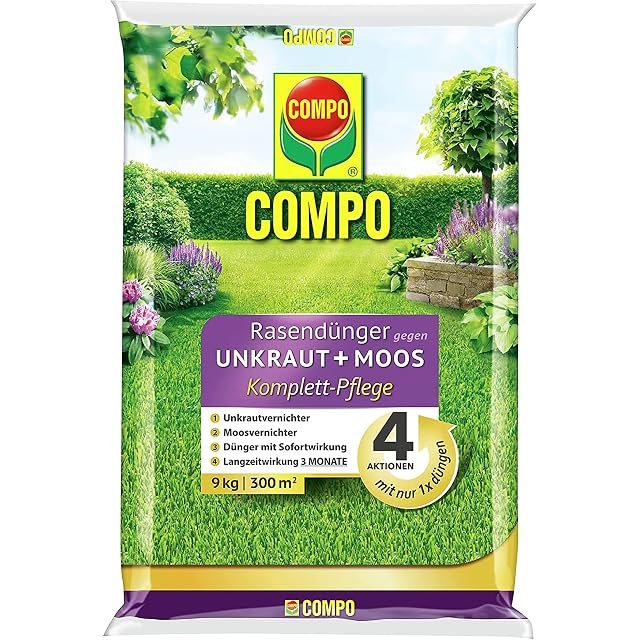
This is a plant protection product, and the listing carries the statutory
wording: use plant protection products carefully; always read the label and
product information before use.
That difference is not a formality. It brings restrictions nothing else in this
family has:
At most once a year.
May to August only, during the growing season.
Above 10 °C.
Not in the year of sowing.
The lawn may not be used for two to three days afterwards — after watering
in and after the surface has dried.
A buyer who treats this as interchangeable with the iron feeds on this shelf has
misread the product.
What it does that the others do not
Broadleaved weeds.
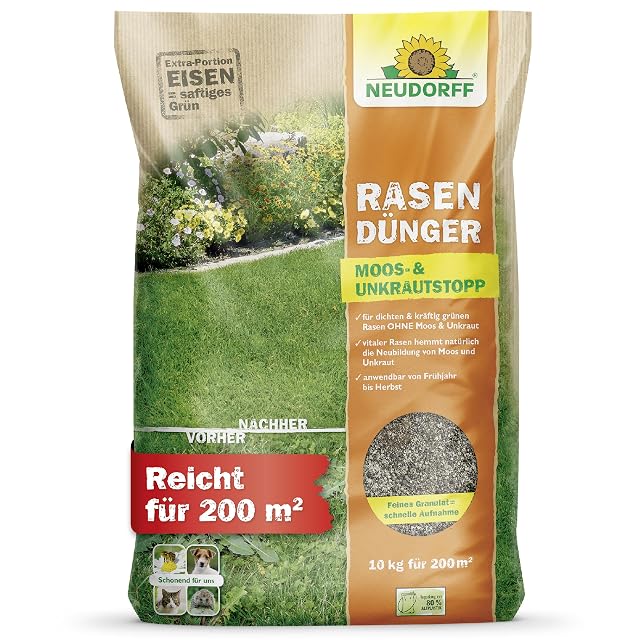
The iron feeds on this shelf blacken moss and feed grass. They do nothing at all
to dandelion, plantain, clover, daisy or buttercup — and on most neglected lawns
those are at least as much of the problem as the moss.
This contains a selective herbicide: something that damages broadleaved plants and
leaves grasses alone. That is the entire reason for the extra restrictions, and it
is the reason to choose this over a feed.
The protocol, which is unusually complete
The listing publishes the whole sequence, and it is worth following exactly because
there is only one application a year to get right.
Mow first, and wait one to two days. Cut foliage does not take up a herbicide
well, and weeds need a day or two to recover leaf area before they can absorb
anything.
Choose a rain-free day. Rain within a day or two washes the product off the
leaf before it has acted, and the application is spent.
Apply in the morning to a dew-wet lawn. Moisture is what dissolves the
granules and gets the actives onto the leaf and onto the moss. Moss in particular
absorbs dissolved minerals across its entire surface, having no cuticle to speak
of.
Let it act for one to two days. No watering during that period.
Water after two to three days. This moves the fertiliser off the leaf and into
the soil.
Then remove the dead weeds and moss mechanically.
That last line is the one no other lawn product on this shelf states, and it is
the most important. Killing moss does not remove it. A lawn full of dead black
moss still has the moss in it, holding water at the surface and breaking down into
thatch, and it has to be raked out — this site’s aerator shelf carries the rakes.
Ten degrees, and why it is not negotiable
A selective herbicide works through actively growing tissue. It is taken up by
the leaf and moved within the plant, and that movement depends on the plant
growing.
Below about 10 °C the target weeds are barely growing. They take up very little,
they survive, and the one permitted application for the year has been used.
So the temperature is not a comfort threshold, it is the mechanism. April warmth
is not the same as 10 °C of sustained growing weather, and the May-to-August window
exists to keep people out of the margins.
Not in the sowing year
Stated, and the reason is straightforward.
A selective herbicide relies on a difference in tolerance between grass and
broadleaved plants. Established grass has a deep root system, a developed cuticle
and reserves to recover with.
A lawn sown this season has none of those. Seedling grass has a small root system
and thin tissue, and a dose an established sward shrugs off can check it severely
or kill it.
This site’s lawn seed shelf covers the other half of that sequence: a new lawn
needs a full season before it can take this kind of treatment, and weeds in a new
lawn are better dealt with by mowing, which most annual weeds do not survive.
“Rapid closure of the bare patches”
The listing’s own phrase, and it identifies the real problem with any combined
product.
Killing moss and weeds creates bare ground. Whatever the moss was covering,
and wherever a dandelion rosette was sitting, is now open soil — and open soil in
a lawn is where the next moss and the next weeds arrive.
So the fertiliser half of this product is not a bonus, it is the necessary other
half: the grass has to grow into those gaps before anything else does.
Where a gap is too large for the surrounding grass to close, it needs seed. The
rates on this site’s lawn seed shelf run 20 to 30 g/m², and the condition that
decides success is that the seed reaches soil — which the raking has just
arranged.
The timing conflict is worth noting and the listing does not: a selective herbicide
in the soil is not an ideal seedbed, so overseeding is a job for a few weeks later
rather than the same afternoon. The label is the authority on how long.
The rate, and the granule
9 kg for 300 m² is 30 g/m², and the two figures agree.
The granule is described as a homogeneous fine granule that dissolves
quickly.
Both halves matter here more than on a plain feed. Homogeneous means the
fertiliser and the actives are in every granule rather than blended as separate
particles — which is what stops the mixture separating in the bag and in the
spreader, and it is what makes 30 g/m² deliver the same dose everywhere.
Fine and fast-dissolving matters because a herbicide has to get onto leaf
and stay there. A coarse granule sits in the sward and takes days.
At 30 g/m² the spread has to be even. This site’s spreader shelf is blunt about
why: a rotary spreader throws a cone denser in the middle than at the edges, so
passes must be overlapped correctly or the lawn records the error — pale strips
where neither pass reached full rate, and scorched strips where two overlapped.
With a herbicide in the granule, a double dose is a more serious matter than with
a feed.
The fifth feature line
“Age description: No.”
A database field, published as a product feature.
It is reported here because this is the one product on the shelf carrying legal
restrictions on who may use it and when, and a listing that spends a fifth of its
description on an empty catalogue attribute is worth describing accurately.
The label on the pack is the authority for this product. Not the listing.
Availability
From 61 € to 78 €, that being the spread across the German and Spanish Amazon stores on the day of the survey.
Nothing came back from the American, British, French and Italian Amazon stores at all; the buy button there runs a search rather than opening an empty page.
Taken from Keepa on the day this page was last revised; stock and prices move without notice.
Prices quoted in this text were read on 26 September 2026. The live price is at the top of the page.