What this shelf actually contains, and why it has to be said first
Three different kinds of product sit under the name “moss killer”, and they are
not interchangeable.
Iron fertilisers for lawns. This is one of them. They feed grass and blacken
moss, and they are made to be put on grass.
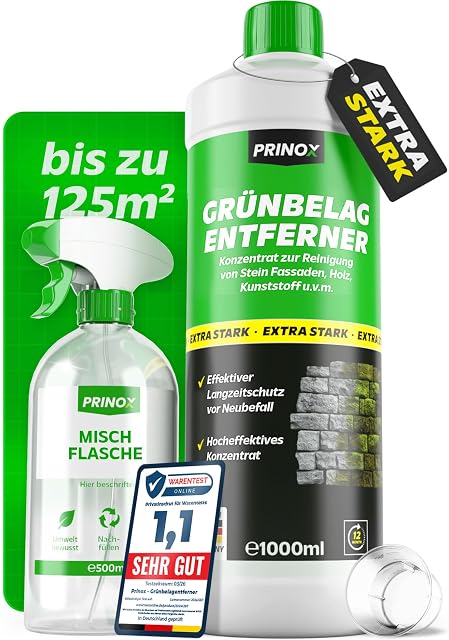
Green-deposit removers for hard surfaces. Three products on this shelf are
these — biocides for patios, paving, facades, roofs, fences and gravestones. Two
of them carry a national biocide registration number and the statutory wording
that biocidal products must be used carefully and the label read before use.
They are not for lawns. Applied to grass they kill grass.
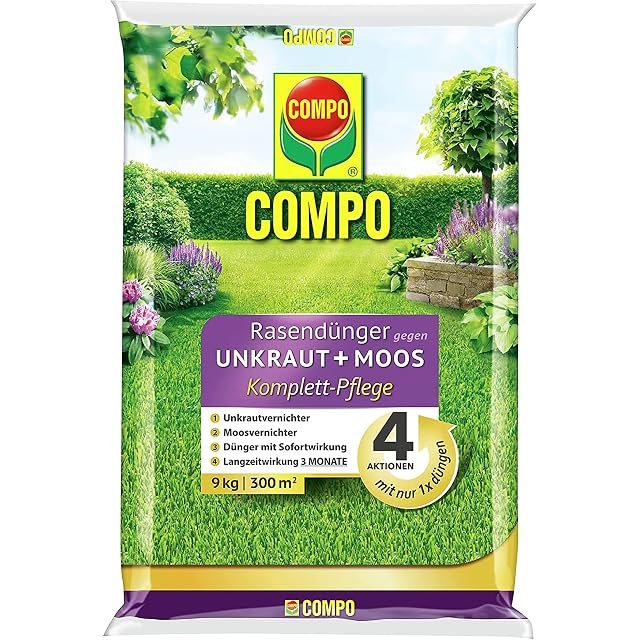
A plant protection product. One product here is a lawn feed combined with a
herbicide. It is restricted to one application a year, in a stated temperature
window, and the lawn may not be used for two to three days afterwards.
A buyer who takes the wrong one of those three has not bought a weaker version of
the same thing. Every page in this family says so.
What iron sulphate does to moss
It acidifies and desiccates it.
Moss has no cuticle worth the name and no vascular system — it absorbs water and
dissolved minerals directly across its whole surface. A soluble iron salt
delivered onto it in solution is taken straight in, and it cannot exclude it.
The result is visible in two to three days: the moss turns black, then
brown, then brittle.
Grass is far more resistant, because it has a waxy cuticle, a root system that
regulates uptake, and a growing point below the surface. At the right
concentration the grass takes the iron as a nutrient and greens up, while the
moss dies.
At the wrong concentration the grass blackens too. That is the whole reason the
rate matters, and it is the figure this listing does not publish.
The rate, which is absent
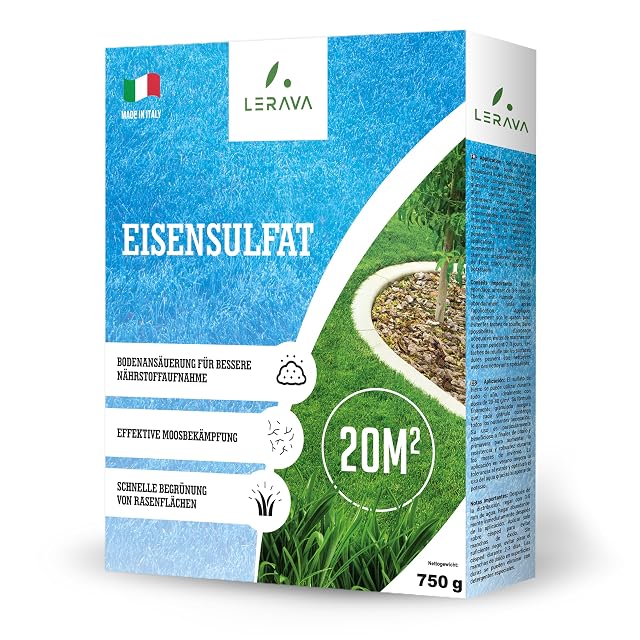
“20 m².”
No weight. No grams per square metre. No dilution.
Across this shelf the lawn products publish 30 g/m², 35 g/m² and 50 to 80 g/m².
This publishes an area and nothing to divide by.
That means two things cannot be done: the price per kilogram cannot be worked
out, and — more importantly — the dose cannot be checked against anything.
What can be worked out is the area price: about 0.55 € per square metre,
against a shelf where the other lawn products come to roughly 0.19 €, 0.20 € and
0.20 €.
That is nearly three times the next dearest, and it is the sort of figure a small
pack always produces.
Iron stains, and this is not a minor caution
Iron sulphate rusts.
Rust on concrete, sandstone, block paving, decking or a gravel path is a
permanent orange-brown stain. It is not dirt; it is iron oxide bound into the
surface, and washing, brushing and pressure-washing do not remove it.
So:
Keep the granules off every hard surface. Sweep strays onto the grass before
watering in, not after.
Do not treat a lawn strip that drains onto a path — the run-off carries the
iron with it.
Wash the spreader or the can on the grass, never on a drive.
One product on this shelf publishes an iron content of 6 %. This one does not
publish a figure, which means the staining risk cannot be graded — only avoided.
“Optimises the pH by acidifying the soil”
The listing’s claim, and it is worth unpicking because it is half right in a way
that matters.
Iron sulphate does acidify. That is real chemistry.
Whether acidifying is an improvement depends entirely on the soil. And on the
moss question it points the other way: moss is favoured by acidity. A lawn
that is mossy on compacted, acidic, shaded soil is mossy partly because of the
acidity, and lowering the pH further does not help the grass compete.
Where acidification is genuinely useful is on a limy or alkaline soil, where
iron is present but locked up and the grass cannot take it — which is what makes
a lawn pale yellow-green rather than mossy.
So “optimises” depends on which soil you have, and nothing on this shelf measures
that. This site’s soil tester shelf is where that question is answered.
And the part no iron product on this shelf mentions
Killing moss does not remove it.
Two days after treatment there is a lawn full of black dead moss, and it is
still physically there — occupying the ground, holding water at the surface, and
turning into thatch as it breaks down.
It has to be raked out, and a mossy lawn treated and not raked is a lawn with
a thicker thatch layer than it started with. This site’s aerator shelf carries the
rakes for exactly that job.
Then the bare ground it leaves has to be filled, by the grass or by seed, or the
moss simply comes back into the same gaps.
Why moss was there in the first place
Worth stating plainly on the cheapest page in this family, because the treatment
is not the cure.
Moss colonises where grass is weak, and the four common reasons are shade,
compaction, poor drainage and cutting too short.
An iron treatment resets the symptom. If none of those four changes, the moss is
back within a season — and this is exactly why one product on this shelf is sold
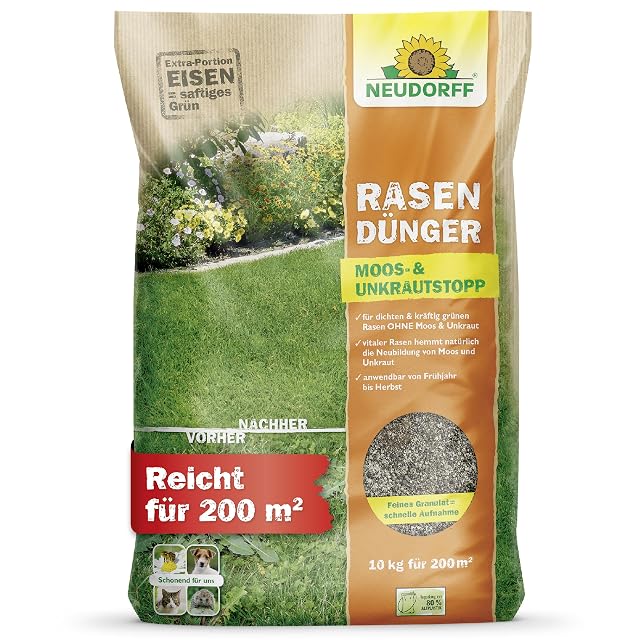
on the idea that a well-fed dense lawn keeps moss out without any treatment at
all.
Availability
From 11 € to 15 €, that being the spread across the German, French, Italian and Spanish Amazon stores on the day of the survey.
Listed and unsold: the American Amazon catalogue holds the reference with nobody behind it.
Nothing came back from the British Amazon store at all; the buy button there runs a search rather than opening an empty page.
Taken from Keepa on the day this page was last revised; stock and prices move without notice.
Prices quoted in this text were read on 26 September 2026. The live price is at the top of the page.