The best instruction on this shelf
From the fourth feature line:
“Note: the soil tester must not be used directly to measure liquids. In soil that
is too dry or too hard, do not force the probe in. Lightly moisten the test area
before measuring and wait 10 minutes, to avoid damaging the device.”
Two separate problems, correctly identified, in one sentence.
The first is mechanical
A probe forced into dry clay bends, and the probe is the instrument.
A bent tip changes the contact area with the soil, permanently. Readings taken after
that cannot be compared with readings taken before it, and nothing on the display
tells you anything has changed.
Two other meters on this shelf address the same risk from the other end — one
supplies a protective cover for the probe, another specifies a
high-strength alloy. This one simply tells you not to do it.
The second is electrical, and the listing does not spell it out
A probe in dry soil has almost no contact.
These meters read the soil through its water: current passes through the moisture
films around particles. In genuinely dry ground there are no continuous films, the
circuit is broken, and the numbers on the screen are not measurements of anything.
So the ten minutes is not only about protecting the probe. It is about there being
something to measure.
And the consequence nobody on this shelf mentions
Moistening the soil changes what you are measuring.
Water added to make a reading possible dilutes the soil solution — which is exactly
the thing a conductivity probe is responding to — and it brings its own chemistry
with it. Tap water in a hard-water area carries dissolved calcium carbonate, which
is chemically lime.
That matters most for the pH figure, and it is precisely the variable the chemical
test on this shelf controls for: that kit supplies distilled water in the box,
because tap water shifts the result by an amount that depends on where you live.
It is also the fourth of four user-controlled variables that the makers on this
shelf have documented between them:
Moisture — here.
Insertion depth — another listing warns that inconsistent depth in the same
sample gives inaccurate pH readings.
Probe cleanliness — a third warns that a constant reading of 7 means the
probe needs cleaning and the measurement retaking elsewhere.
Soil compaction — the same listing says the soil must be compacted first or the
probe cannot register it.
Four independent manufacturers. Four variables. And not one of the six probe meters
in this family publishing a tolerance, a calibration procedure or a reference
solution for pH.
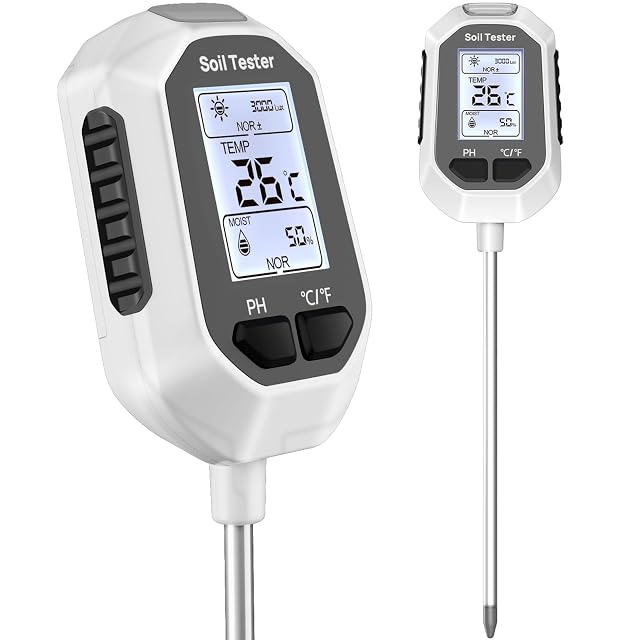
The 45 degree head
The reason to pay more for this one, and it is a real ergonomic argument rather than
a feature.
A probe meter is used at ground level. Push it into a lawn and a fixed screen
faces straight up at the sky — where it catches reflections, and where reading it
means kneeling down.
Forty-five degrees of tilt means standing and looking down.
That sounds trivial until you consider how these readings should actually be taken.
Every good practice on this shelf involves several measurements in different
places: one listing asks for multiple positions for a more accurate pH, and soil
varies across a lawn far more than people expect — the shaded corner, the strip by
the path, the middle.
Four readings kneeling is a chore. Four readings standing is a walk across the lawn.
The low-battery warning
Worth more on this device than on most, because of how a failing battery presents.
An electronic meter with a weak cell does not usually stop. It reads low — a
lower voltage through the same circuit looks like less conductivity, which looks
like drier and less fertile soil.
So the failure is a plausible wrong answer rather than a blank screen. A warning
indicator is what separates the two, and only one other meter on this shelf has
anything comparable.
The batteries themselves — 4 × AAA — are not included.
The five readings, ranked honestly
Temperature — dependable. A thermistor does not depend on contact area, and
this is the most useful figure on the shelf for a lawn: this site’s lawn seed shelf
publishes germination thresholds of 8 °C and 10 °C, and the calendar cannot
tell you which side of them you are on.
Light — dependable. A photocell measures light properly. Shade is one of the
four reasons moss gets into a lawn, and this is how you find out whether a corner
has any chance.
Moisture — comparative. A conductivity reading, so dissolved salts affect it.
The same spot over time is informative; an absolute number is not.
pH — conditional, per the four warnings above.
Fertility — not a nutrient analysis. It comes from the same conductivity probe.
An electrode pair cannot distinguish nitrogen from potassium from de-icing salt; it
measures total dissolved ions. Very low is consistent with a leached soil and
very high with recent feeding, and neither is a figure to feed from.
For that, this site’s fertiliser shelf shows what a real declaration looks like —
and the two feeds there that publish an NPK are the only two whose potassium cost
can be compared.
The “latest 2024 probe technology”
Claimed, with no earlier version named, no measurement, and no comparison.
Reported as published.
Availability
Around 28 €, read at the German Amazon store on the day of the survey.
Beyond the euro zone, the British Amazon store prices it in its own currency, which the spread above sets aside.
Listed and unsold: the French, Italian and Spanish Amazon catalogues hold the reference with nobody behind it.
Nothing came back from the American Amazon store at all; the buy button there runs a search rather than opening an empty page.
Taken from Keepa on the day this page was last revised; stock and prices move without notice.
Prices quoted in this text were read on 26 September 2026. The live price is at the top of the page.