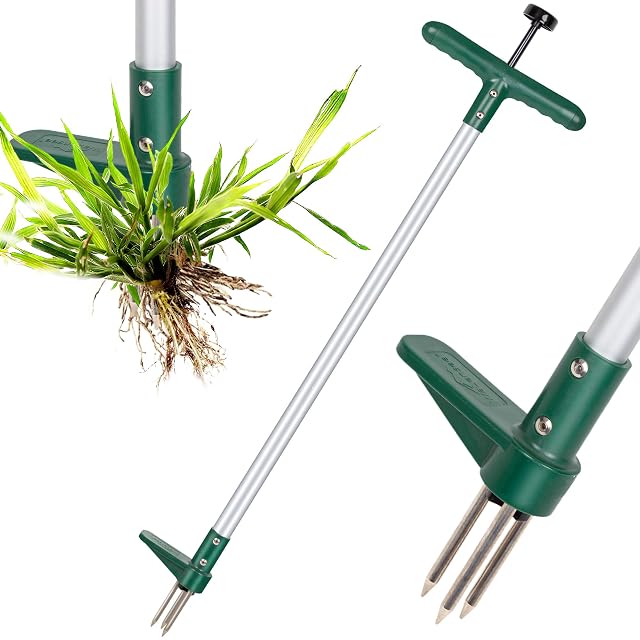
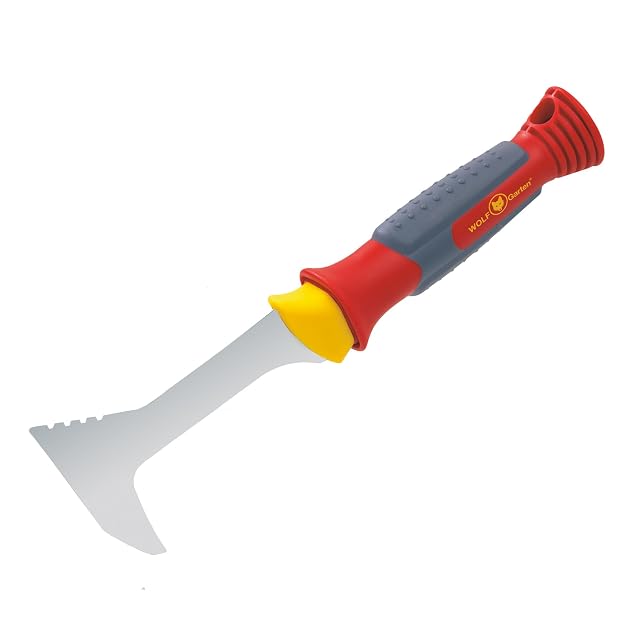
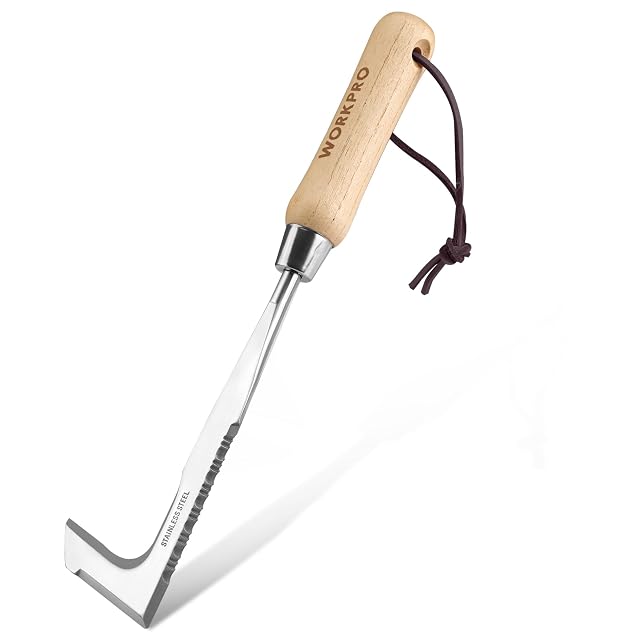
First, because nothing in this family’s listings says it.
A flame kills grass exactly as readily as the weed in it. Passed over a lawn it leaves
a scorched patch that has to be reseeded.
This is a tool for paving joints, drives, gravel and bare ground — and, the listing
adds, for lighting a barbecue or a stove and for warming roofing felt.
For weeds in a lawn, this site’s weeder shelf carries the taproot knives and stand-up
claw pullers that lift the root and leave the turf.
The warning nobody else on this shelf gives
“Note for customers from Austria and Switzerland: gas bottles in AT and CH have a
different bottle connection. For operation, a Euro gas adapter No. 4 is additionally
required.”
That is the only cross-border compatibility note in this family, and it is exactly the
kind of thing that is normally discovered on a Saturday morning with the tool in one hand
and a cylinder that will not connect.
And it points at the real complication of a cylinder burner
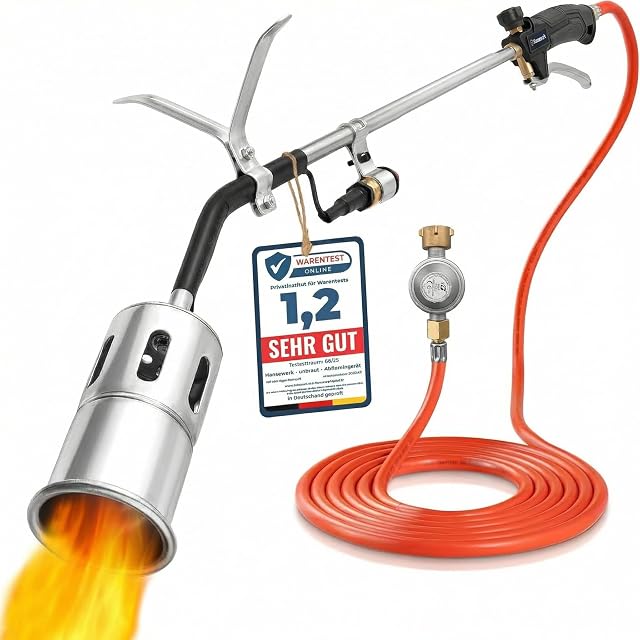
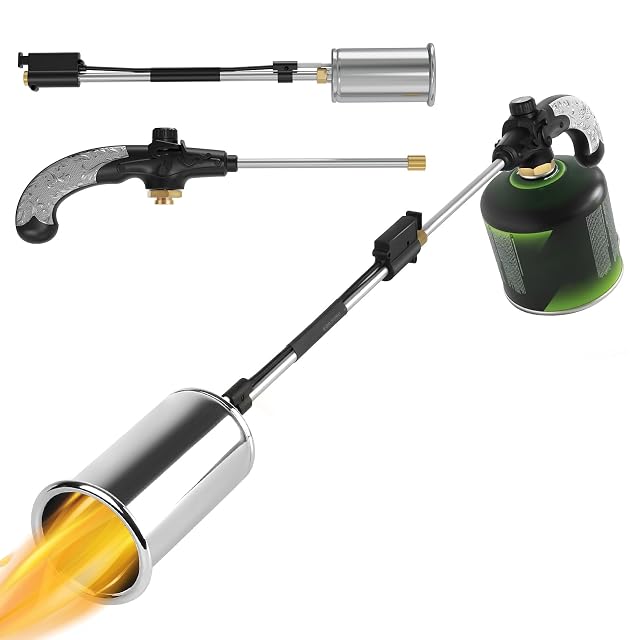
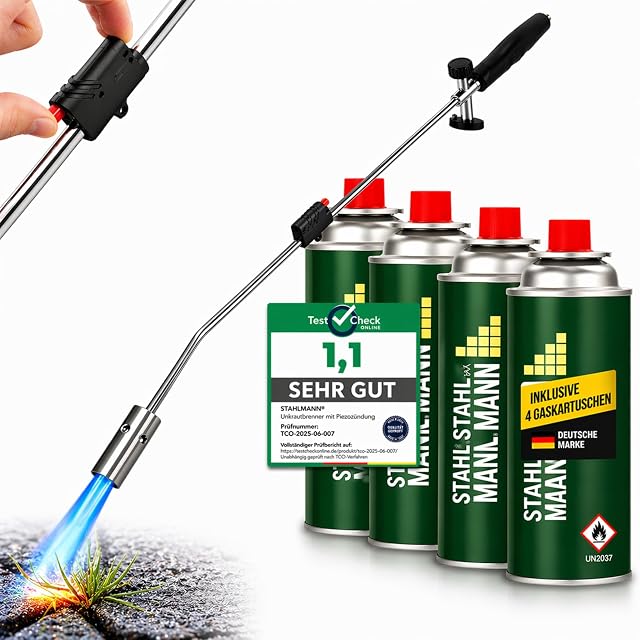
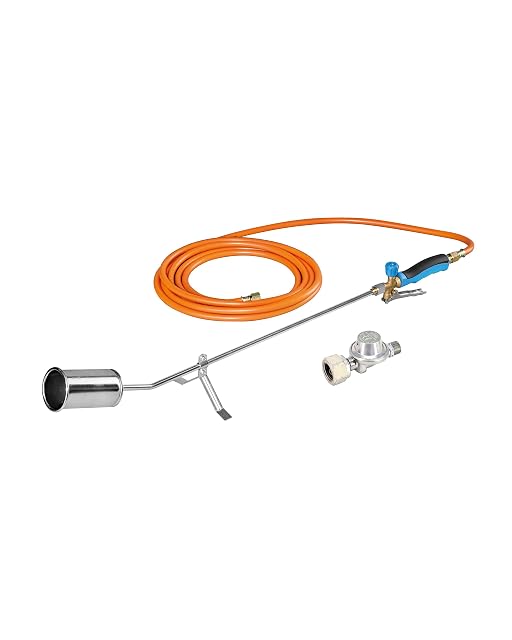
Three burners on this shelf run on a cartridge screwed to the tool. Three, including
this one, run on a hose to a refillable cylinder.
A cartridge tool has one fuel question: does the cartridge fit? One burner on this shelf
answers it by naming EN 417, the European standard for small cartridge valves, so any
EN 417 cartridge works.
A cylinder tool has three fuel questions:
Does the regulator fit the bottle? Bottle connections are national rather than
universal — which is precisely what this listing is warning about.
Is the regulator the right pressure? Two burners on this shelf publish theirs:
2.5 bar with a smaller head and 4 bar with a 60 mm one. A regulator matched to the
wrong burner gives a flame that is either feeble or uncontrollable.
Is the hose sound? A gas hose perishes and has a service life. One burner on this
shelf states DVGW certification for its hose and regulator specifically.
This listing supplies a regulator and a 5 m hose, and publishes neither a pressure nor a
certification — but it is the only one that warns you the bottle end may not fit at all.
Piezo ignition
Named, and three of the six burners here have one.
It matters more than it sounds. Without it, lighting the burner means holding a lighter
or a match to a gas jet, outdoors, in wind, with the other hand holding a metre of steel
tube. And then doing it again every time the flame blows out.
A button also makes the correct technique practical, which is the next section.
Two to three seconds, which no listing here prints
You do not burn the plant.
The heat ruptures cell walls in the foliage. Water in the cells expands, the membranes
fail, and the plant dries out over the following days — which is why flame weeding looks
useless on the day and convincing a week later.
So the treatment is two to three seconds, until the leaf darkens and goes limp.
That colour change is the cells rupturing, and the plant is already dead.
Charring it to ash takes ten times as long, uses ten times the gas, and adds nothing.
Two burners on this shelf describe this mechanism correctly. One of them calls it the cell
fluid of the roots, which is where the method’s limits get overstated.
Because the root is not reached
Soil is an excellent insulator. A few seconds of hot gas at the surface barely warms
what is a centimetre down.
Annual weeds die outright — groundsel, chickweed, annual meadow grass, seedlings of
anything. The whole plant was above ground.
Perennials regrow. Dandelion and dock from a taproot, couch grass, bindweed and ground
elder from rhizomes. The top dies back and a new shoot appears within a fortnight.
The method that works on perennials is repetition. Burn the regrowth every two or
three weeks and the root spends its reserves rebuilding leaves it never keeps. Over a
season or two it exhausts itself.
A cylinder burner is the right tool for that, because repetition means hours of running
and a refillable bottle is a fraction of the cost per hour of a non-refillable cartridge.
The five metres
The working radius before the cylinder has to be moved, and on a drive it is the figure
that decides how often you stop.
Both hose burners on this shelf publish 5 m — though one of them gives 5 m in its title
and 4.5 m in a feature line.
What none of them publishes is the tool length, which is what decides whether the work
is done standing or stooped. Two cartridge burners here publish 97 cm and 80 cm,
and one hose burner publishes an 85 cm handle.
The safety, which this listing does not print
One burner on this shelf publishes a full warning line. It applies to all six:
Outdoors only. Keep clear of hedges, wood, mulch and dry lawn. Do not work in
drought or wind. Let the tool cool before storing. Disconnect the fuel.
The mechanism worth naming, because it is not the obvious one: dry organic matter does not
flare, it smoulders. A fire started in bark mulch, in the dry litter at the base of a
hedge, or under decking can burn unseen for an hour before it shows, by which time nobody
is watching.
Working a joint against a timber fence, beside a mulched bed, or along a dry hedge bottom
is where this category does damage.
What goes unpublished
No temperature and no output. Three burners on this shelf publish a flame temperature
— 1000 °C, 1300 °C, 1800 °C — and one publishes 58 kW. Those two are
different quantities and neither is the limiting factor for weeding, but they are what a
buyer compares.
No burner diameter. One publishes Ø 60 mm, which is what tells you how wide a
strip a pass treats.
No weight. One publishes 1.6 kg.
No regulator pressure. Two publish theirs, at 2.5 and 4 bar.
No standards or certifications. Two burners on this shelf cite them — one three EN
standards plus EN 417, one a TÜV SÜD GS mark with DVGW hose and regulator — and
three, including this one and the dearest on the shelf, cite none.
This page reports that as an observation about what was published, not a conclusion about
any product.
And the price
The dearest burner in this family.
What it buys, itemised: a regulator, a 5 m hose, piezo ignition, and the only
cross-border fitting warning on the shelf.
What it does not buy is a published specification. The cheapest burner here costs about
three fifths as much, and the one in the middle arrives with four cartridges, a
burn time, a temperature, a length and four cited standards.
Availability
Around 50 €, read at the German Amazon store on the day of the survey.
Listed and unsold: the British, French, Italian and Spanish Amazon catalogues hold the reference with nobody behind it.
Nothing came back from the American Amazon store at all; the buy button there runs a search rather than opening an empty page.
Taken from Keepa on the day this page was last revised; stock and prices move without notice.
Prices quoted in this text were read on 26 September 2026. The live price is at the top of the page.