Before anything else, because a buyer who picks the wrong kind has bought a tool for
another surface.
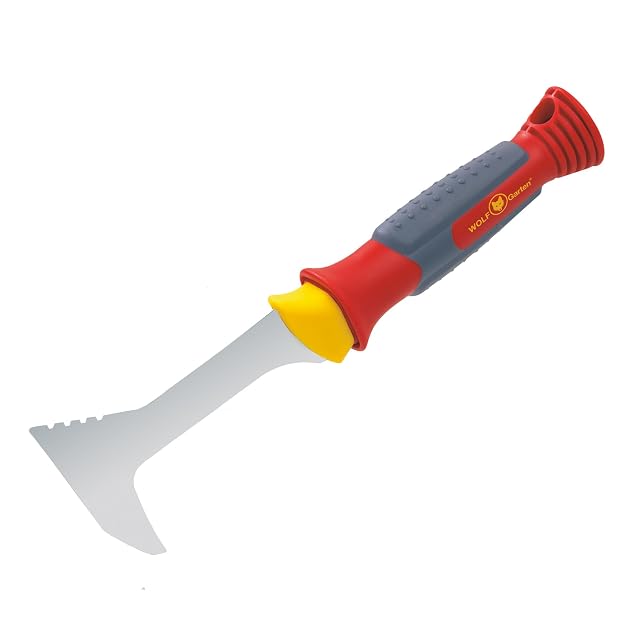
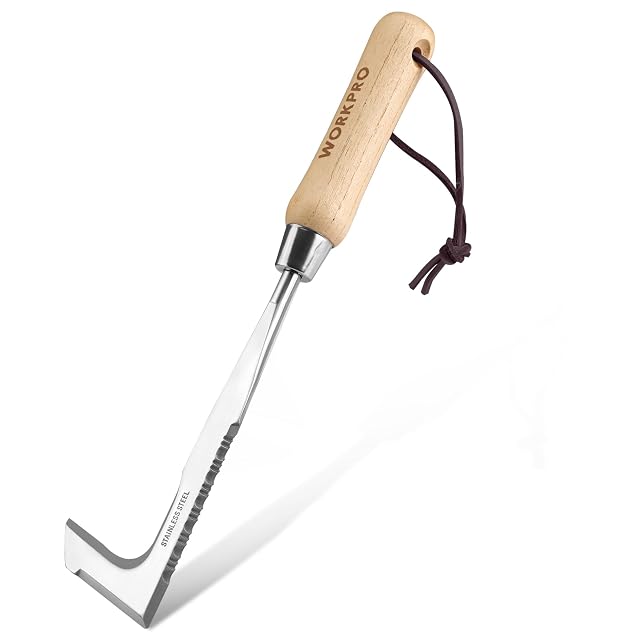
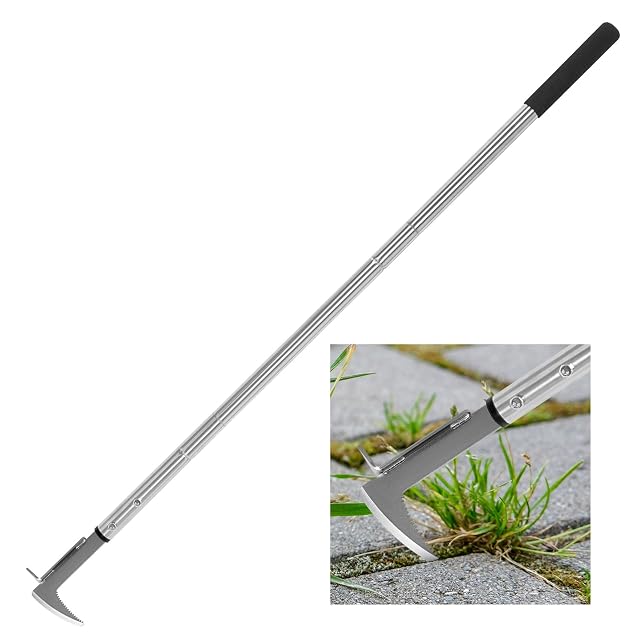
Joint scrapers — three products here, including this one. They are for paving:
the moss and grass growing in the joints between slabs, along a kerb, in the gap between
a wall and a path. They have a hooked blade that is dragged along a joint.
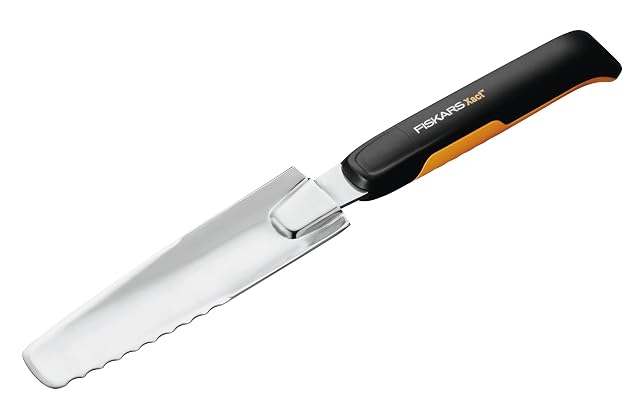
Taproot knives — two products. A long narrow blade pushed into soil beside a
dandelion or a thistle to lever the root out. Lawn tools, used kneeling.
Claw pullers — two products. A long handle, a foot pedal and a set of claws that
grip a rosette and pull it, root and all, from standing.
A scraper does nothing to a dandelion in a lawn. A claw puller does nothing to moss in a
paving joint. They share a shelf name and nothing else.
What a joint scraper is actually fighting
Not weeds, most of the time. Moss and grass in a 5 mm gap.
Paving joints fill with windblown dust and organic debris, and that becomes a thin soil
in a slot that holds water and never dries out. Moss colonises it first, then grass, then
anything whose seed lands there.
The gap is narrow, the material is matted and rooted into jointing sand, and it is at
ground level.
Which sets the design problem: a narrow hooked blade that fits a joint, and enough
leverage to pull matted material out without the tool folding.
7 centimetres
The only working width published on this shelf, and on this kind of tool it is the
figure that matters.
Seven centimetres is the length of joint cleared per pull. A drive with forty metres of
joint in it is a great many pulls, and the width sets how many.
The other joint scrapers here publish total tool length — 31.5 cm and 138 cm — which
is a different measurement entirely, and one of them is an adjustable handle length
rather than anything about the blade.
That mixing of tool dimensions and working dimensions runs through this whole shelf.
Only two products here publish anything about the working end: this 7 cm, and a blade
width of 4.3 cm on a taproot knife.
One-handed, and what that costs
“One-handed joint scraper.”
It is a hand tool, which means the work is done kneeling or bent double, at ground
level, for as long as the path takes.
That is the real cost of the cheapest tool on this shelf, and the reason the shelf
contains 100 cm and 138 cm alternatives — one of them a joint scraper on an adjustable
handle up to 138 cm, sold explicitly on not bending.
For a small terrace, kneeling is fine and a short tool gives far better control in a
narrow joint. For a drive, it is an afternoon on your knees.
The grip, described properly
“High grip security through a control zone at the handle. The ergonomically shaped
handle with a soft insert sits very well in the hand; the formation of blisters and
pressure points is prevented.”
Blisters are the correct thing to design against here, and it is worth saying why.
A joint scraper is used with a pulling action, hard, repeatedly, with the hand
gripping tightly to stop the tool twisting out of a joint. That is exactly the load
that raises a blister at the base of the fingers — not weight, but repeated shear
against skin.
A soft insert and a defined control zone — a shaped section the hand settles into
rather than sliding along — is the answer. Half an hour of joint scraping is the point at
which any hand tool’s grip stops being a marketing claim.
The coating
“The special coating makes the joint scraper additionally durable and weather
resistant.”
No material is named for either the blade or the coating.
What a coating does on this tool is specific: a scraper blade spends its life wet, in
grit, and in contact with soil, and it is put away dirty because it is the last tool
used. Bare steel in that duty rusts within weeks, and a rusted blade drags rather than
cutting.
What a coating does not do is stay on the edge. The cutting edge is abraded by sand
and stone on every pull, and it is bare metal within a season whatever the rest of the
blade is coated with.
Which makes the maintenance the same as for any garden blade: wipe it dry, and put it
away dry.
35 years
“MADE IN GERMANY: our quality promise… underlined with 35 years WOLF-Garten
manufacturer’s warranty (please note the current warranty conditions).”
That is the longest warranty anywhere in this network, and it is worth reading for what
it is.
What it plausibly covers: the tool breaking. A coated steel blade on a plastic
handle, with no moving parts, that fails structurally is a manufacturing defect and it
will show up early.
What warranties on hand tools generally do not cover: the blade going blunt, which
is the thing that will actually happen — and which is wear rather than a fault.
So it is a long promise on a low risk, which is exactly the circumstance in which a
manufacturer can afford to make one. That is not a criticism: a company willing to be
findable in thirty-five years is making a statement about itself, and the parenthesis
about current conditions is an honest hedge rather than a get-out.
For comparison, the only other warranty in this family’s neighbouring shelves is five
years, on a Corten steel lawn edging.
What goes unpublished
No weight. One tool on this shelf publishes 260 g, and it is the only figure of
its kind here.
No blade material. Two other tools on this shelf name stainless steel, and one
names quality steel with a thermoset coating.
No blade length, only the 7 cm width — so how deep into a joint it reaches is
unstated. One joint scraper here publishes a depth limit of 5 cm, and states that
deeper cracks need a different tool.
Availability
Around 8 €, read at the German Amazon store on the day of the survey.
More than 1.6× the cheapest country at the French and Spanish Amazon stores; a gap of that size normally means forwarded stock rather than a seller on the ground, so the spread above leaves it out.
Listed and unsold: the American, British and Italian Amazon catalogues hold the reference with nobody behind it.
Taken from Keepa on the day this page was last revised; stock and prices move without notice.
Prices quoted in this text were read on 26 September 2026. The live price is at the top of the page.