A joint scraper. For paving.
Three products here are joint scrapers, two are taproot knives for lifting weeds out
of soil, and two are claw pullers used standing with a foot pedal.
A scraper is dragged along the gap between slabs. It is a terrace, path, kerb and drive
tool, and it does nothing at all to a dandelion in a lawn.
The L-shape, and why every scraper here has one
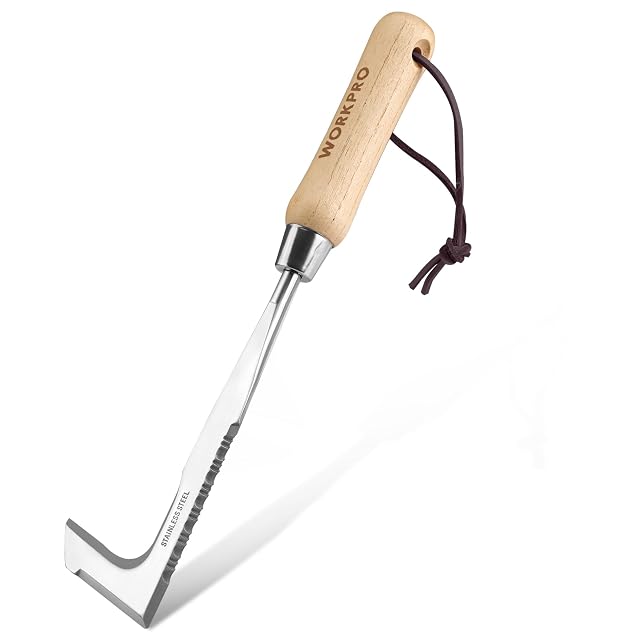
“The 7-shaped weeder allows effortless removal of weeds from stone crevices.”
The listing calls it 7-shaped; L-shaped or hooked describes the same geometry. The blade
runs forward from the handle and then turns down.
The reason is the direction of force.
A straight blade can only be pushed, and pushing along a paving joint is both weak
and imprecise — the blade rides out of the gap.
A hook is dropped in and pulled. The blade stays down in the joint because the pull
is taking it against the side of the slab, and pulling is where an arm is strong.
It is the same principle as a pull saw, and it is why the whole category looks like
this.
The saw teeth, which is the best secondary function on this shelf
“The saw teeth on the back allow cutting through vines and cord without an additional
tool.”
That is genuinely useful rather than a spec-sheet addition, and the reason is specific to
garden work.
The things that stop a weeding job are the things that need cutting rather than
scraping: a bindweed stem wound through a fence, an ivy runner rooted into a wall, old
twine, a buried cable tie, a bramble.
Each of those normally means standing up and going to the shed.
Teeth on the back edge of a blade already in your hand — the edge that is otherwise
doing nothing — means the interruption costs a second.
No other tool on this shelf has a second cutting edge of any kind.
Stainless steel, which is the right call here
Named, and it matters for the same reason it does on the taproot knives on this shelf.
This is a tool used in wet grit and put away dirty. It is the last thing used before
going indoors, and it goes in a bucket by the door.
Carbon steel in that duty is pitted in a season and drags rather than cutting. Stainless
is still a blade.
The other joint scraper at this end of the shelf uses a coated blade instead — which
protects the flat and not the edge, because the edge is abraded by sand and stone on
every pull.
The wooden handle, and what it asks for
“The joint scraper is made of wood and corresponds to the ergonomic design. The handle is
based on the lever principle.”
Wood is a real choice with real consequences, and no listing on this shelf mentions the
second half.
What wood gives: it is warm to hold in March, it does not get slippery in the way
smooth plastic does, and it absorbs vibration and shock from a blade catching on stone.
What wood needs: to be kept dry, or at least dried. A bare wooden handle used wet and
stored wet raises its grain, then splinters, then works loose at the ferrule where the
steel enters it — which is how wooden-handled tools actually fail.
The remedy is trivial and it is never printed on a listing: wipe it, and rub a little
linseed oil into it once a season.
The soft-grip plastic handles elsewhere on this shelf need none of that, and they are
colder and harder on the hand.
The sheath and the strap
“At the end of the weeder there is a hole with a leather strap, and the joint scraper is
fitted with a protective sheath, for easy carrying and storage.”
Two small provisions, and almost nothing on this shelf has either.
The sheath protects the edge and protects you. A hooked stainless blade loose in a
bucket of hand tools is sharp at exactly the height a hand reaches in — and it is also
the reason the edge gets nicked against a trowel.
The strap stops it being dropped, and gives it somewhere to hang, which is the
difference between a tool that gets put back and one that is found in a bed in
October.
One taproot knife on this shelf has a hanging hole for the same reason.
What goes unpublished
No working width.
That is the figure a joint scraper is judged on, and it is the length of joint cleared per
pull. One scraper on this shelf publishes 7 cm, and on a drive with forty metres of
joint in it the width sets how long the job takes.
Thirty-one and a half centimetres is the total tool length, handle included — a
different measurement, and the one that tells you this is a kneeling tool rather than a
standing one.
No blade depth. One joint scraper on this shelf states a limit: joints at least
2.5 mm wide and less than 5 cm deep, with deeper cracks needing a specialised tool.
That is the most useful sentence anywhere in this family and only one listing has it.
No weight. One tool here publishes 260 g.
And the position it is used in
31.5 cm means kneeling or bent double, at ground level, for as long as the path
takes.
For a small terrace that is fine, and a short tool gives far better control in a narrow
joint than a long one.
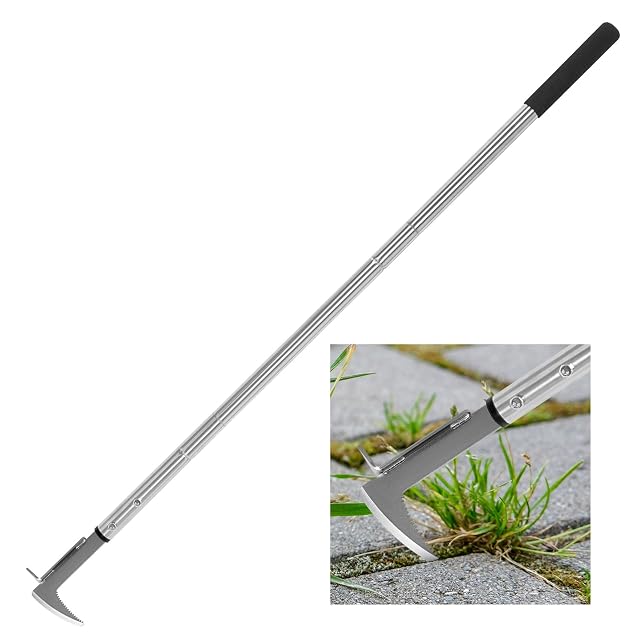
For a drive it is an afternoon on your knees — and this shelf carries a joint scraper on
an adjustable handle up to 138 cm, sold explicitly on not bending, for about three
times the price.
Availability
Around 11 €, read at the German, French, Italian and Spanish Amazon stores on the day of the survey.
Beyond the euro zone, the American and British Amazon stores price it in their own currencies, which the spread above sets aside.
Taken from Keepa on the day this page was last revised; stock and prices move without notice.
Prices quoted in this text were read on 26 September 2026. The live price is at the top of the page.