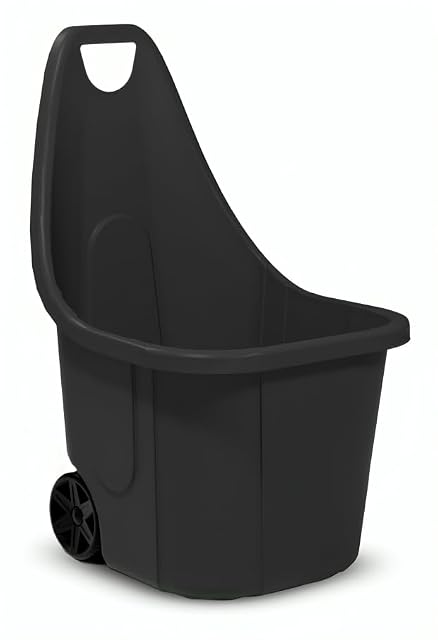
This is a garden cart, not a wheelbarrow
Every other product on this shelf is rated at 160 kg or 250 kg and holds 100
litres.
This holds 60 litres and carries 40 kg.
That is not a cheaper version of the same tool. It is a different tool, and the honest
framing is worth getting right before anything else.
What 40 kilograms actually is
Roughly two 20 kg bags of compost.
Or about 40 litres of damp soil, which is two thirds of this tub.
Or one bag of sand, and not much of a second.
The arithmetic worth doing on any barrow is load divided by volume, because that gives
the densest material it can be filled with:
60 L and 40 kg is about 0.67 kg per litre.
Damp garden soil is heavier than that. Sand is much heavier. Gravel and wet rubble are
heavier still.
So this tub is full before it is heavy only for light bulky material — and that is
precisely what it is for.
Which is a real job, and a common one
Leaves. Sixty litres of autumn leaves is a genuine load and it weighs almost nothing.
This site’s garden rake shelf is about collecting them; this is about moving them.
Grass clippings. A box-mower’s worth of cuttings, repeatedly, from lawn to heap.
Prunings and hedge trimmings. Bulky, springy, light.
A couple of bags of compost from the car to the bed.
Weeds off a bed, and the spoil from a lifted dandelion.
For all of those, a 100 L steel barrow rated at 250 kg is a heavy empty object to push
around a small garden, and this is easier.
And the jobs it is wrong for
Soil, sand, gravel, hardcore, paving slabs, rubble, and a load of turf.
Those are what the six 100 L barrows on this shelf are for, and one of them is the only
listing in this family to say honestly how much of its rating is usable — see below.
The rating, and the one thing this listing does not qualify
“Load capacity of up to 40 kg.”
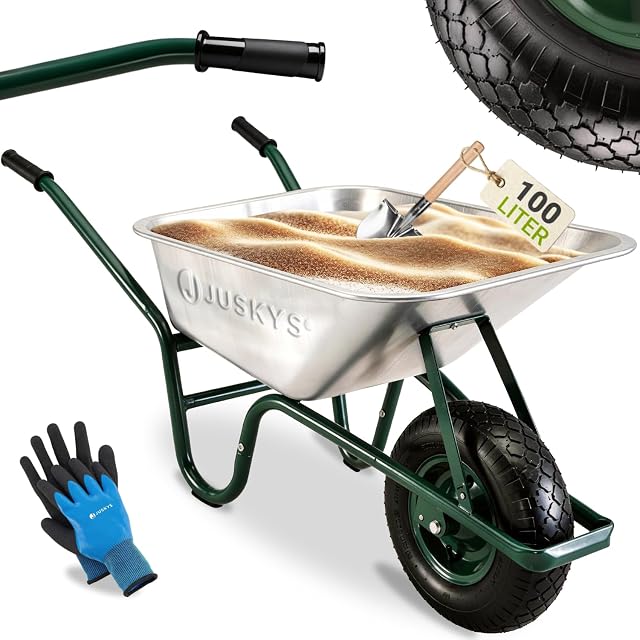
One barrow on this shelf publishes its rating as two figures: “max. load capacity:
150 kg dynamic and 250 kg static (not in motion)”.
That distinction matters on every barrow ever made, and it is published once in this
family.
A static load is what the tub and frame will hold standing still.
A dynamic load is what they will hold while the barrow is being pushed, tipped, run
over a step and set down — which is the only condition in which a wheelbarrow is
actually used.
The difference on that one product is 250 down to 150 — a 40 per cent reduction.
This listing publishes a single figure of 40 kg with no qualifier, like five others on this
shelf. Whether it is a standing figure or a moving one is not stated, and this page will
not assume.
Recycled polypropylene
Named, and it is the right material for this size of cart.
Polypropylene cannot rust, which is the failure mode of every steel barrow left out in
the rain — and on this shelf three barrows have painted or plain steel tubs that
are scraped bare by a shovel on the first use.
It is also light, which is the whole point here.
What polypropylene does instead is go brittle in cold and chalky in UV. A plastic
barrow left outdoors for five summers and then loaded on a frosty February morning is the
one that cracks. Stored under cover it lasts indefinitely.
Recycled PP is also what this site’s lawn edging shelf’s rubber border and its soaker hoses
are made from — the same principle applied to a different product.
Stated, and worth crediting on a shelf where one competitor devotes an entire feature line
to how to bolt a tub on correctly without twisting it.
84 × 60 × 50 cm
All three published, which four barrows on this shelf do not manage — one of them
publishing instead that its dimensions and weights are “guide values”.
The useful one here is the 50 cm width, because that is the figure that decides whether
a barrow goes through a gate, along a path between beds, and through a shed door.
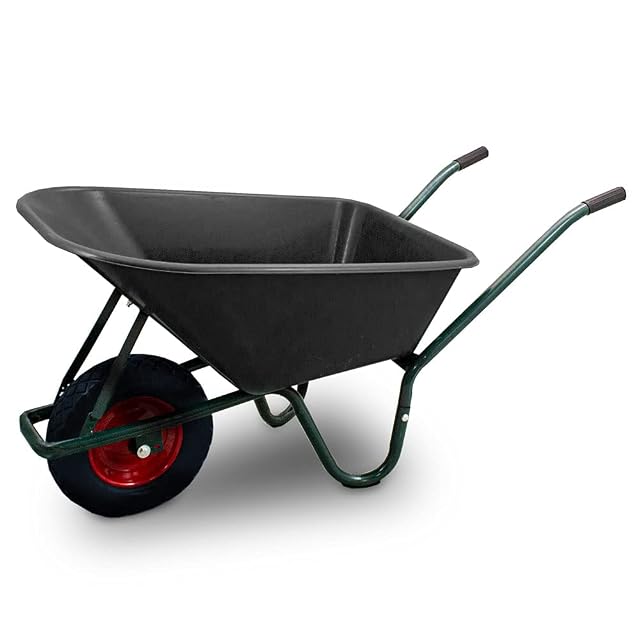
A 100 L builder’s barrow on this shelf is 58 cm wide and 142 cm long. In a small
garden with a side passage, that difference is the difference between using it and lifting
it over things.
What goes unpublished
No wheel. No type, no diameter, no bearing.
That is the largest gap, because the wheel is what a barrow is. Across this shelf the
wheels run from 38 cm to 40 cm pneumatic, one solid 400 mm polyurethane, and one
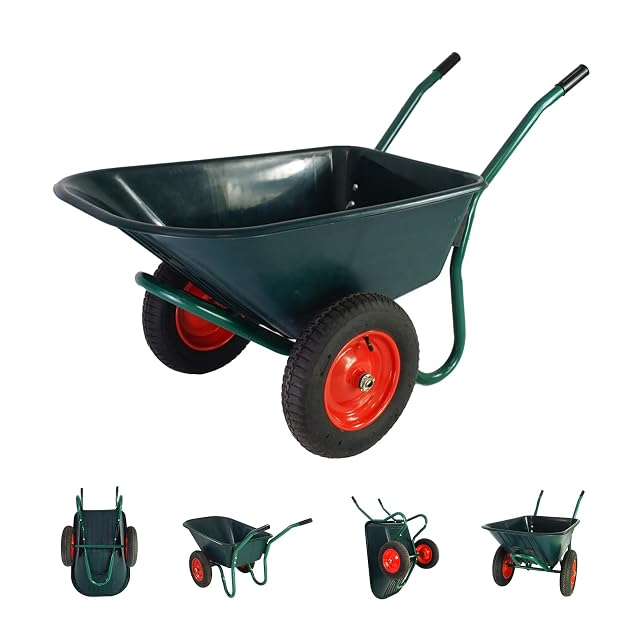
pair of two pneumatic wheels — and one listing publishes a 2 bar tyre pressure,
which is the only inflation figure in the family and the commonest reason a barrow feels
heavy.
A small plastic garden cart is most likely on a small hard wheel, which rolls poorly on
grass and gravel and is exactly where this size of barrow is used.
No weight. One barrow on this shelf publishes 11.2 kg empty, and it is the only
such figure here.
Availability
Around 20 €, read at the German Amazon store on the day of the survey.
Listed and unsold: the British, French, Italian and Spanish Amazon catalogues hold the reference with nobody behind it.
Nothing came back from the American Amazon store at all; the buy button there runs a search rather than opening an empty page.
Taken from Keepa on the day this page was last revised; stock and prices move without notice.
Prices quoted in this text were read on 26 September 2026. The live price is at the top of the page.