September to December
A four-month window, published, and three feeds on this shelf give no window at
all.
That is worth stating because autumn feeding is the one lawn job where timing is
the whole point, and “autumn” is not a date.
What is actually happening in those four months
Two things run on different clocks, and the gap between them is the reason an
autumn feed works.
Leaf growth stops early. Grass stops making new leaf at around 5 to 6 °C of
soil temperature, which in most gardens is some time in November.
Roots keep working much longer. They go on taking up water and nutrients at
soil temperatures well below that, through December and into a mild January.
So potassium applied in October or November is absorbed by a plant that is no
longer growing leaf — which is precisely the intention. It goes into cell walls
and into reserves rather than into growth.
A December application is at the margin of that. It will still be taken up
over the following weeks; it will not produce visible greening, and anybody
expecting a colour change from a December feed will be disappointed.
Why not earlier than September
Because nitrogen.
Even a low-nitrogen autumn feed contains some, and applied in August it goes into
leaf. Soft new growth in September is exactly what frost damages in November and
what snow mould colonises under a wet January.
The window’s early edge is about not stimulating growth that will not harden off
in time.
“Mineral fertiliser”, stated
An unusually plain declaration, and this shelf needs it.
A mineral feed supplies nutrients as soluble salts. They are immediately
available, they act fast — the listing says the nutrients strengthen the lawn
directly after application — and they are correspondingly easy to over-apply,
because there is nothing between the granule dissolving and the roots taking it
up.
An organic feed supplies the same nutrients bound in plant or animal
material. Soil organisms have to break it down first, which makes it slow,
weather-dependent and considerably harder to get wrong.
One product on this shelf is organic and cites two EU regulations by number. The
rest are mineral, and this is one of only two that says so.
The fine granule
Described as making even distribution easy, especially with a hand spreader or a
spreader cart.
At 20 g/m² that matters more than it sounds.
Twenty grams is a small quantity spread over a square metre. With a coarse
granule that is relatively few particles, and any unevenness in the spread shows
up a fortnight later as mottled colour — dark where there were more granules,
pale where there were fewer.
A fine granule puts down many more particles for the same weight, so small errors
average out. It also dissolves faster, which is consistent with the immediate
action claimed.
The trade-off is at the spreader. A fine granule flows more like grass seed than
like a coarse fertiliser, and on this site’s spreader shelf one machine maps its
settings explicitly to fine seed (1–3), medium fertiliser (4–6) and
coarse grit (7–8). A fine feed set on the fertiliser setting goes down
heavier than intended.
Only one product on this shelf publishes an actual granule size, at 2 to 5 mm.
The area that has to be worked out
The listing publishes a rate and no coverage.
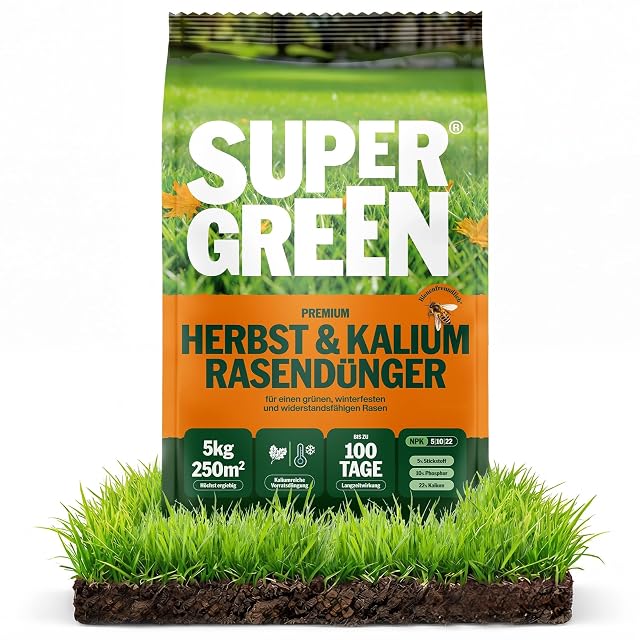
5 kg at 20 g/m² is 250 m².
That is simple arithmetic and it should not have been left to the reader — one
product on this shelf publishes a title and a feature line that disagree about
coverage by a factor of two, which is what happens when these numbers are not
checked against each other.
At 250 m² the price works out at about 0.12 € per square metre, against a
shelf range of roughly 0.055 € to 0.24 €.
What goes unpublished
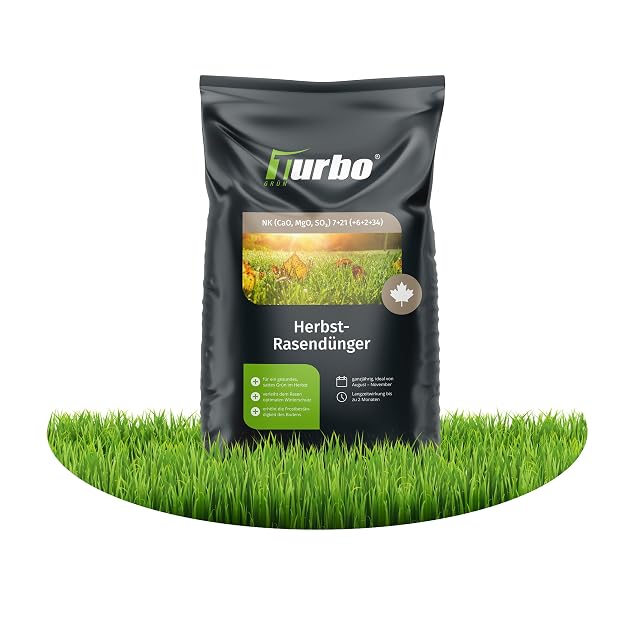
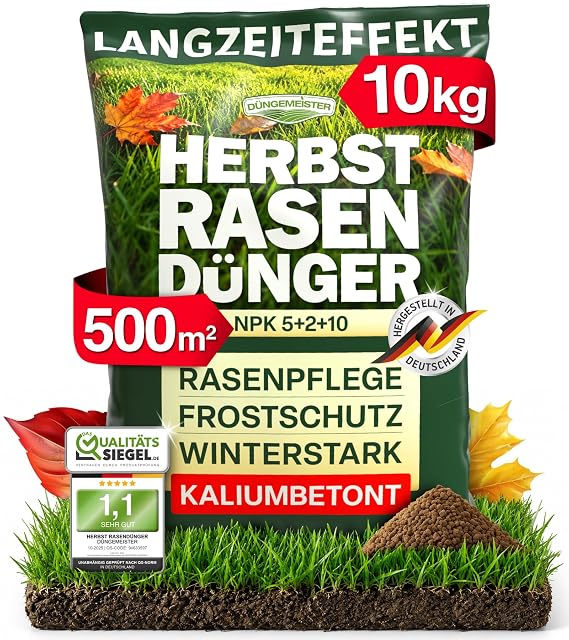
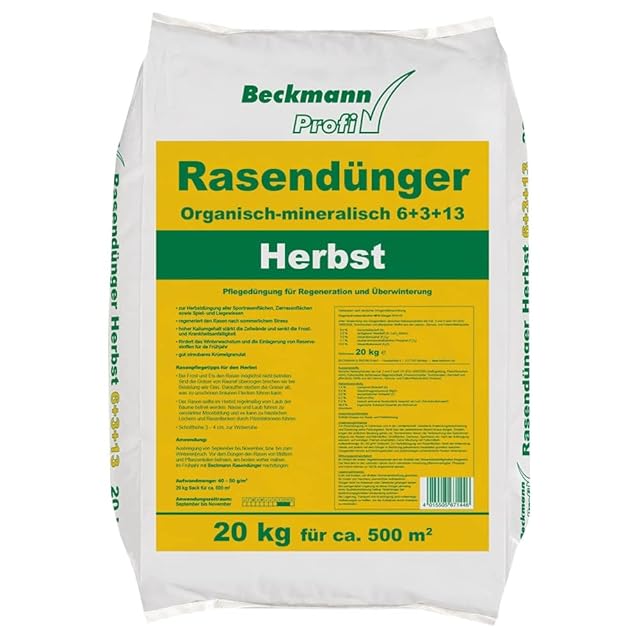
No NPK. Five of seven here omit it. “A balanced mixture of potassium and
further nutrients” is not an analysis, and the two products on this shelf that do
publish one make it possible to compare what the potassium actually costs — about
23.18 € against 11.86 € per kilogram of K₂O.
No duration of action, where two feeds here state 100 days and three months.
Availability
From 30 € to 40 €, that being the spread across the German and French Amazon stores on the day of the survey.
Nothing came back from the American, British, Italian and Spanish Amazon stores at all; the buy button there runs a search rather than opening an empty page.
Taken from Keepa on the day this page was last revised; stock and prices move without notice.
Prices quoted in this text were read on 26 September 2026. The live price is at the top of the page.