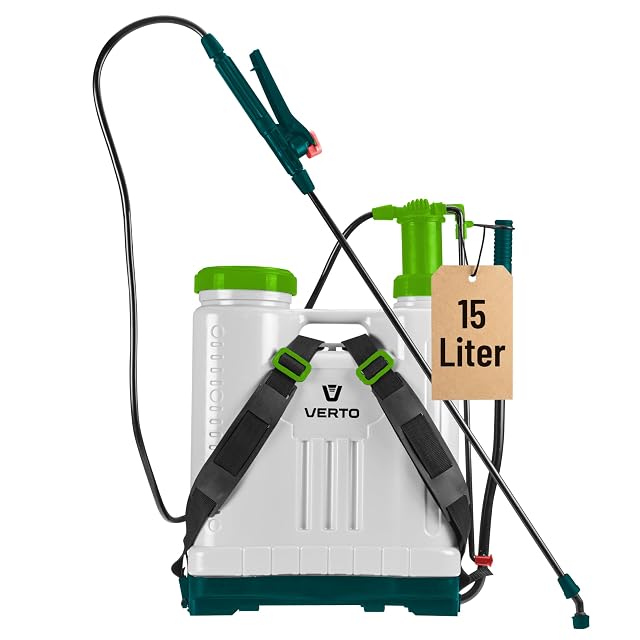
Fifteen litres, and what that changes
Three times the biggest hand sprayer on this shelf.
The arithmetic is the argument: a 5-litre sprayer treating a large hedge or a
quarter-acre of weeds needs mixing, filling and pressurising three times. This
needs it once.
Refilling is not just time. It is a bucket, a measure, a chemical container and
a tap, usually at the other end of the garden, and it is the reason big jobs get
abandoned half done.
And what it costs
Fifteen litres is fifteen kilograms of liquid, plus a sprayer whose own
weight the listing does not publish.
Carried on the shoulders that is workable — a backpack distributes load in a way
a single handle cannot — and it is still a real load. Most people who own one
fill it two-thirds.
It also has to be lifted onto your back full, which is the moment that actually
hurts.
The published pressure
2.5 to 3 bar working.
Four of the seven sprayers on this shelf publish no pressure at all. This one
gives a range, which is better than a maximum, because it describes where the
sprayer actually operates rather than the peak a determined pumper can reach.
On a manual sprayer the pressure falls as you spray and you pump it back up.
A stated range is an honest description of that cycle.
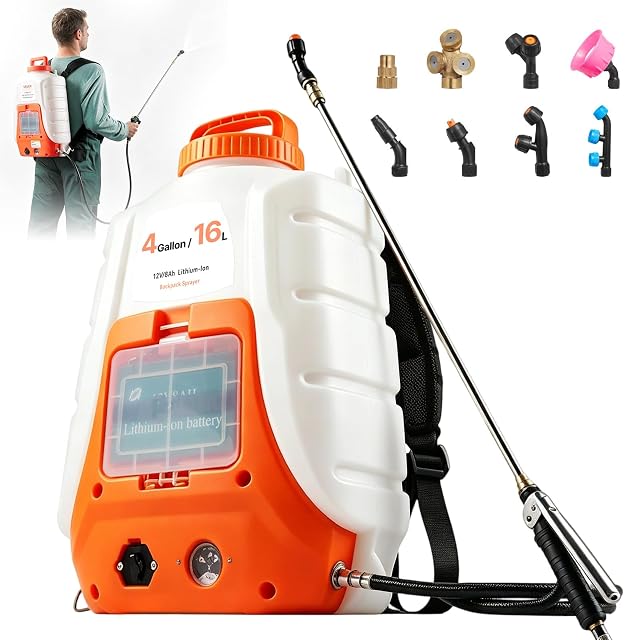
For comparison, the battery sprayer on this shelf holds 6.2 bar continuously.
The brass nozzle
Two sprayers on this shelf specify brass, and this is the larger of them.
The nozzle orifice is what makes the spray pattern, and it is worn by whatever
passes through it: fertiliser salts, suspended solids in a wettable powder,
acidic cleaners. A plastic orifice widens and the fine mist becomes a coarse
spray.
On a 15-litre sprayer that matters more, because a sprayer this size gets used
for the jobs with the harshest mixes.
The listing describes the adjustment as running from a fine mist to a strong,
concentrated jet — the two ends that matter: a mist coats foliage, a jet reaches
into a hedge or a crack.
The temperature range, which nobody else gives
0 °C to 45 °C.
The only such figure on this shelf, and the lower limit is the useful half.
At or below freezing, liquid in the hose and the lance can freeze; the seals
stiffen and stop sealing; and a pump working against a blocked line strains
itself. None of that is hypothetical in a knapsack left in an unheated shed
overnight in March.
It also, read plainly, rules out the still frosty mornings that are otherwise
ideal spraying conditions — no wind, no sun, no bees. The manufacturer has drawn
a line and this page reports where.
The tank dimensions
580 mm high × 360 mm wide.
Published, which almost nothing on this shelf manages — and on a knapsack it is
the figure that decides whether it fits your back and your shed.
580 mm is most of the height of an adult torso. A tank that sits from belt to
shoulder is what a knapsack is; anything taller catches on branches, which is
exactly where this sprayer is meant to be used.
An integrated lock on the ergonomic grip, described as preventing accidental
activation and uncontrolled discharge.
On a hand sprayer a lock is about comfort. On a 15-litre knapsack it is
about not soaking your own leg — the lance hangs at your side when you are not
spraying, and an unlocked trigger brushed against a branch discharges whatever
is in the tank onto your boot.
Five of the seven sprayers on this shelf have a lock. This is the one where it
is a safety feature rather than a convenience.
And the rule that matters most at this size
One sprayer, one purpose.
A 15-litre tank, a long hose and a brass nozzle hold a great deal of residue,
and rinsing does not clear it. A knapsack used for weedkiller should be labelled
and used for nothing else, permanently.
At this capacity the consequence of getting that wrong is not a scorched pot.
It is a lawn.
Availability
From 37 € to 52 €, that being the spread across the German, French, Italian and Spanish Amazon stores on the day of the survey.
Beyond the euro zone, the British Amazon store prices it in its own currency, which the spread above sets aside.
Nothing came back from the American Amazon store at all; the buy button there runs a search rather than opening an empty page.
Taken from Keepa on the day this page was last revised; stock and prices move without notice.
Prices quoted in this text were read on 26 September 2026. The live price is at the top of the page.