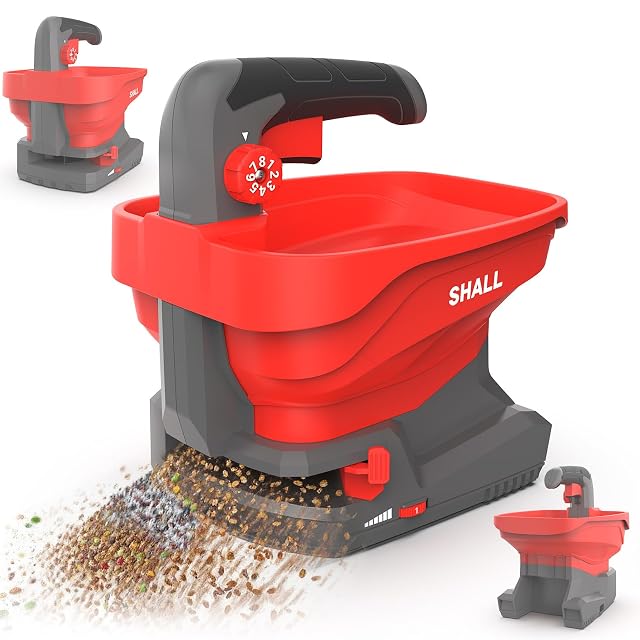
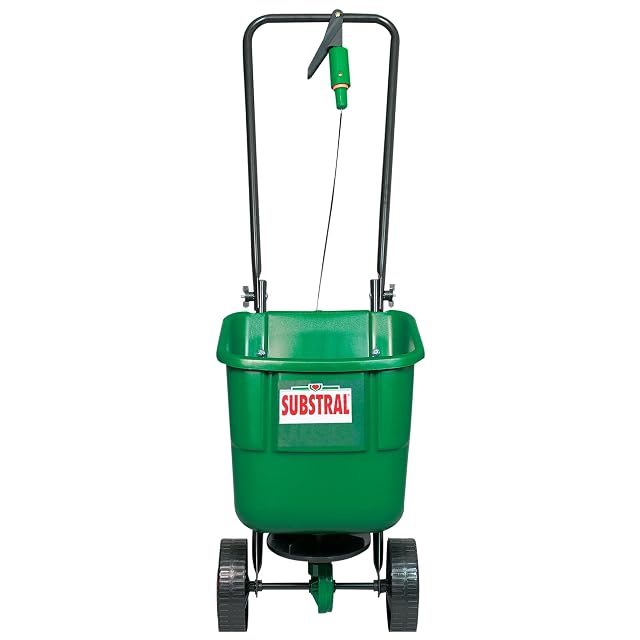
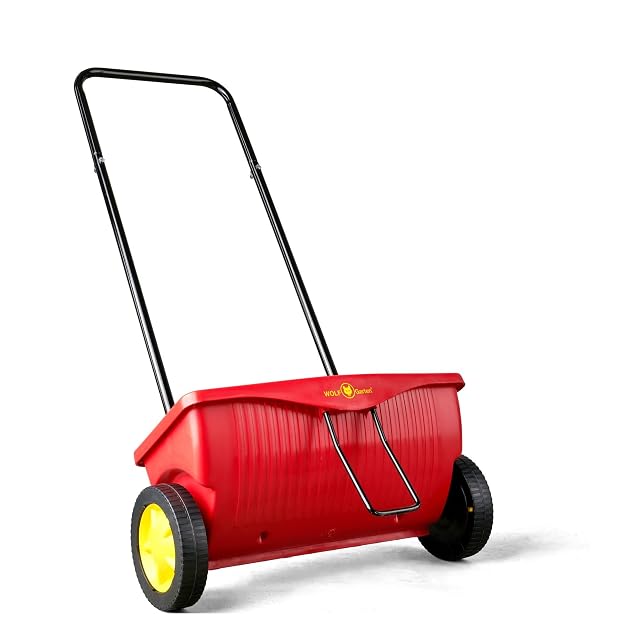
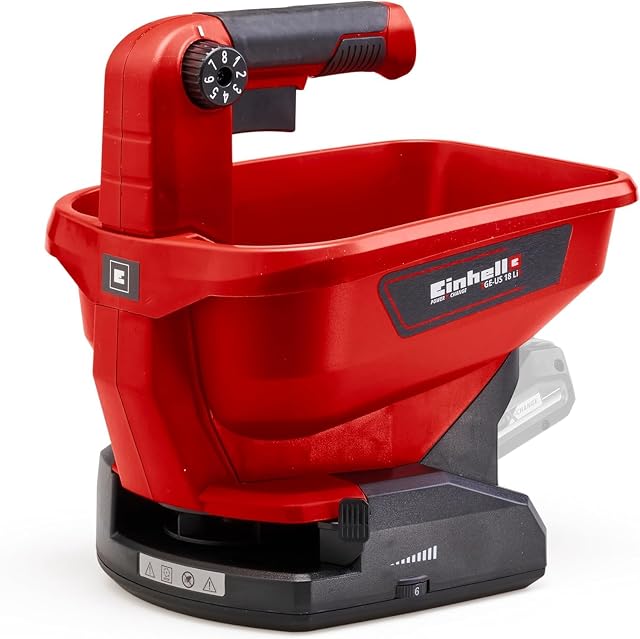
The only listing that connects a dial to a product
“Levels 1–3 are suitable for fine seed, levels 4–6 for medium-grained
fertiliser, and levels 7–8 for coarse de-icing salt.”
Nothing else in this family does this, and it is the most useful sentence on the
whole shelf.
Because the three materials do not behave alike
Every spreader on this shelf claims to handle seed, fertiliser, sand and salt.
Only this one acknowledges what that means.
Grass seed is small, light and slippery. It pours through a small opening
and, through a large one, it all leaves at once.
Granular fertiliser is heavier and rounder. It needs a wider gap to flow at
all, and it flows steadily once moving.
De-icing grit is coarse, irregular and inclined to bridge — it jams
across a narrow opening and stops, and then a lump breaks free and dumps.
So a single numbered dial without guidance is not a calibration, it is a starting
point for trial and error on a path. Six spreaders here give the dial. One gives
the map.
About 350 m² of fertiliser. About 600 m² of seed.
Same 3.3 litre hopper, nearly double the area.
That is because the application rates differ: a granular lawn feed goes on at
roughly 30 to 40 grams per square metre, and grass seed at roughly 20 to 30 —
figures visible on this site’s fertiliser and seed shelves.
Publishing one number for a spreader is publishing a number that is wrong for
most of what goes in it. This is the only listing in the family that splits it.
Six angles, 0° to 127°
The width control, and the angle approach is worth explaining because it is
different from the speed control on the other handheld spreader here.
An angle setting limits the arc the material is thrown through rather than
how far it goes. At 0° it is effectively a chute; at 127° it is a broad fan.
What that gives you is edge control. Set the arc to the side away from a bed
and the spreader throws onto the lawn and not onto the border — which is the
single most useful thing a handheld spreader can do, because it is why you are
carrying one instead of pushing a wheeled machine.
Combined with 900 to 2200 rpm, the two adjustments cover both how wide and
how far.
Battery and charger included
Worth noting on a shelf where two other battery spreaders arrive as bare tools,
with their platform batteries and chargers sold separately.
2.0 Ah is modest and a spreader is a light-duty machine — a small disc, turning,
for as long as it takes to cross a lawn. This is not a tool that empties
batteries.
The two warnings, which are unusually candid
“The device is not waterproof.”
That is a real constraint and it cuts against the advice everywhere else on this
shelf. Fertiliser is a salt; it cakes and corrodes; the drop spreaders here are
sold on being washable with a hose.
This one has a motor and a battery in it. The listing asks for cool, dry,
ventilated storage and a cover — which means emptying it thoroughly and wiping
it out rather than rinsing it.
“If the spreading wheel jams, do not force the adjustment slide — free the
wheel with a tool, then set speed and angle to maximum.”
That is a manufacturer describing its own failure mode and the wrong response to
it.
The jam is the bridging problem: a lump of caked fertiliser or a coarse grit
stone across the opening. The instinct is to work the rate lever back and forth
to break it, and the listing is saying that this is what breaks the mechanism.
Clearing it from the wheel and then opening everything wide is the right order,
and almost no listing anywhere admits this much.
What goes unpublished
No weight, which on a handheld spreader carried at arm’s length with 3.3
litres of fertiliser in it is the figure that decides how long you last.
No spread width in metres — the angles describe the arc, not the distance.
Another handheld spreader here publishes up to 5 m.
Availability
From 49 € to 56 €, that being the spread across the German, French, Italian and Spanish Amazon stores on the day of the survey.
Beyond the euro zone, the American Amazon store prices it in its own currency, which the spread above sets aside.
Listed and unsold: the British Amazon catalogue holds the reference with nobody behind it.
Taken from Keepa on the day this page was last revised; stock and prices move without notice.
Prices quoted in this text were read on 26 September 2026. The live price is at the top of the page.